1. A Man in the Branches
The cinema truck had taken half of the mulberry tree before Alma managed to signal to the driver. He braked, passed his head through the door and looked in his rear-view mirror at the branches stuck against the roof.
— I sent you the dimensions.
— And me, a plan.
They looked at each other with the reasonable hostility of two people who were right. Then a blackberry fell into the collar of the man. Seeing him try to catch her without crushing her, Alma began to laugh; she had had such a bad day that this laughter took her by surprise.
His name was Samir. He came to ensure five projections in their Breton campsite, between July and August, and it was now covered with purple spots. Alma brought him a towel, then guided him to the reserve. There, he could park his truck without further ravaging the establishment.
At forty-six, she had been running the campsite with her sister long enough to recognize those who would complicate the season for her. Samir unloaded the stakes, unrolled the cables, and then asked him to hold the other handle of the projector body. He made no comment on the dimensions of the court. She was grateful to him.
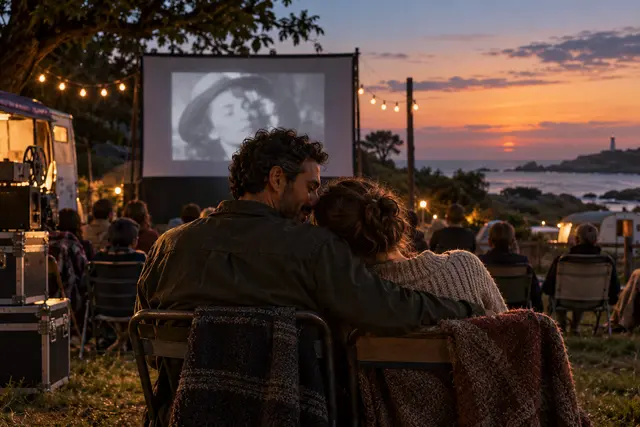
The session began after ten o’clock, when the sky had become dark enough to reveal the image. Alma sat in the last row, near the equipment. She should have gone back to her bills; yet, when her phone vibrated, she covered the screen with her hand.
Samir knew the movie. Just before some passages, he stopped watching the projection to watch the spectators. A little boy burst out laughing, and his face shone with a satisfaction so plain that Alma smiled too. She had no idea what had just happened on the screen.
Later, they put the chairs in the wet grass. Samir told him that the day before, in a nearby village, a lady had brought her lounge chair on a trailer.
— Did she stay until the end?
— She fell asleep before the credits. Her husband loved it. He had to wake her up to get the trailer.
Alma offered him a drink. By this time, the kitchen was still smelling the coffee and the product it had washed the floor of. She was suddenly embarrassed by the tea towel left on a chair, by her chipped cup, by everything she no longer noticed when she was alone.
Samir chooses precisely this cup. He had asked for tea, but he did not protest the infusion of fennel that she had found at the bottom of the cupboard.
— “It’s terrible,” she said after a sip.
— I was waiting for you to say it.
They opened apricot juice and talked for up to an hour. He had grown up in Lyon, where his mother and sister still lived, and worked for a travelling film association. Between rounds, he occupied a room with a friend. Alma asked him if he liked to never know where he would sleep.
— I know where I sleep. That’s where I want to put my stuff now.
He had said this without complaining, looking at the buffet where his letters were piled up. She asked him to take a few bills.
When she came back, she thought of asking him to have lunch with her the next day. The phrase seemed disproportionate to him in the silence of the campsite.
— Do you want me to open the gate at what time?
He hesitated, then answered nine o'clock.
2. Around 9 a.m.
For the second session, Samir arrived in the early afternoon. Alma had put on a dress, under the pretext that it was hot, and Bérangere did not even have the delicacy to pretend to believe it.
— You can go for a walk, if you want. I take the welcome.
— I’m waiting for the drinks to be delivered.
— I can recognize a truck.
They went down to the market. Samir longed for peaches; Alma walked beside him with unusual attention to his own hands. Sliding them in her pockets gave the impression that she was bored, letting them hang seemed ridiculous. She ends up carrying the bag.
In front of the fishmonger, Gérard, who had known Alma since school, gently blocked their way. He asked Samir where he came from, and then greeted his reply LyonLyonwith a little impatient gesture.
— Yes, but first?
— “Her parents are Moroccan,” Alma intervened.
The conversation continued on Gérard’s holidays in Marrakech. Samir remained polite. Once alone, he picked up the bag of peaches.
— Do you know him well?
— “Ever since. He's kind, only, when he starts...
— You could let him wait for my answer.
She opened her mouth to explain that she had wanted to spare them ten minutes. Samir looked at the fruit through the wet paper, and she realized that she was still about to decide for herself what was important.
— "Excuse me. I didn’t think.
He nodded. They bought bread and sat on the wall of the port. She would have liked to have regained their carefreeness at once; she had to accept a few minutes of silence, during which he chose the least damaged peach and handed it to her.
In the evening, after the film, she held him by the sleeve while he put away a cable.
— Tomorrow I don’t work until noon.
— “Okay.
She saw at his expression that he was waiting for the next one.
— We could have breakfast somewhere else. If you are not in a hurry.
— "Ah. Yeah. That's right.
His eagerness satisfied her more than a skillful answer. She kissed him before losing her courage, and he pressed her against him with the cable still in his hand. A loop hit him behind the knee; they had to walk away laughing.
He stayed two nights.
Over the course of July, Alma learned that Samir sang falsely knowing the words perfectly, that he became unpleasant when he was hungry and that it took him ten minutes in the morning to enjoy a conversation. He found out that she was stealing other people’s fries after saying she didn’t want any. In bed, she liked the weight of her arm on her waist, then pushed it back as soon as she was too hot. He came back to get her while he was asleep.
She had forgotten that we could spend an hour organizing nothing. Sometimes, sitting on the kitchen steps, they would listen to campers arguing with their tent arches and exchange a look without going to help them immediately.
But on the mornings of departure, Alma prepared the coffee, found his socks and opened the barrier with an efficiency that silenced them both.
Once, he looked at her holding the door of his truck.
— Do you have another appointment?
— - Nope. Why not?
— You've been putting me out for eight and a half hours.
— You said nine o'clock.
He put his bag on the seat and came back to kiss her.
— I should have said about nine.
3. The Sunday of Lyon
At the end of July, they spent two days in Lyon. Nadia, Samir’s sister, insisted on receiving them, and Alma ended up buying his tickets before he could invoke a boiler failure.
At Nadia’s, she felt at first bulky with her two bouquets. Samir’s mother took the smaller one and placed it in a water pot, while Nadia handed him a pile of plates.
— Can you put five? The big man eats at a friend's house. Finally, he says that, then he comes back to look in the pots.
This task did him good. She discovered Samir in an apartment where everyone knew things about him that she didn’t know. His mother called him by a diminutive; his sister evoked an excruciating haircut, shoes that he had refused to give up. Alma wanted to hear it all. When the conversation passed in Arabic, she followed the glances, smiled with a slight delay and waited for someone to come back to her.
Samir translated, but sometimes he forgot. She touched him under the table after a long exchange.
— What are you talking about?
— - From the room. At my mother's. She says I can put my stuff in there when I get home.
His mother understood the end of the sentence and spoke to Alma.
— He never wants to leave anything. Even his books, he carries them. Tell him I'm not going to sell them.
Alma smiled. Samir stood up to fetch water.
Later, in the kitchen, her mother asked her when the campsite was closing, and then what she was doing in the winter. Alma described the work, the reservations, the accounting. She knew very well how to present this period to those who had never seen her go through November.
— “And you come to Lyon sometimes?”
— "Not often.
— We will have to come back. There, we didn’t talk.
On the way to the hotel, Alma asked Samir why he seemed in such a hurry to leave the table as soon as September was mentioned.
— “Because my mother has already chosen the bed where I am going to sleep.
— She offered you a room.
— "Yes, I know." And I couldn’t say no to him.
They walked a few steps. In front of a closed bakery, Samir stopped to face him.
— I applied to the cinema at home. In May, before we met. They reminded me this week.
At first, Alma felt an almost childish joy. Maybe he'd stay. Then she thought of the time they had spent together since this reminder, the opportunities he had to talk to her about it.
— When were you going to tell me?
— - If it worked.
— What if it didn't work?
He rubbed a trace on the window, near the bakery's opening hours.
— I wish you didn’t know.
She looked at him. Samir, so comfortable installing his screen in front of an unknown room, suddenly looked embarrassed by a man who had been waiting for an answer for too long.
— “You can tell me that too,” she replied. When it doesn't work.
He nodded without looking at her again, then took her hand. At the hotel, they searched for apartments on his phone. Alma knew the streets, the damp buildings, the coffee shop that delivered crates at five in the morning. She started talking too quickly; Samir ended up closing an ad with a laugh.
— Are you going to find me something, or are you trying to disgust me?
She showed him a small two-room rue des Tilleuls. There was a balcony.
4. Free housing
The position was awarded to him in mid-August. Samir arrived with a bottle and the smile that Alma had seen him during the first film. She kissed him on the threshold, in front of a family waiting for shower tokens, and then spent the rest of the afternoon imagining their Sundays.
In the evening, he told her about the two-piece. The owner asked for a guarantor. His sister had offered to be; he still had to collect the documents.
— “You could take the lodging of the seasonal workers,” said Alma. After September, it will be empty.
The idea seemed excellent to her as soon as she uttered it. No record, no rent lost, and Samir would be near her. She was already looking for the key in the drawer.
— It is a little dark, but we could paint.
— “Alma, wait. I want my apartment.
— I wouldn't make you pay.
— It’s not just the rent.
She sat down, vexed in spite of herself. Samir took the time to refill the bottle.
— "I am forty-eight years old. Since my divorce, I have been asking where I can put a box. I'd like... You saw the balcony. We can't even open a chair properly, but it would be mine.
— I just wanted to simplify things for you.
— "I know. Come see him with me on Saturday.
Alma said she had the morning departures. He proposed in the afternoon; she found something else. With each response, she heard herself becoming drier, without succeeding in returning to the joy she had felt on the threshold.
Samir finally gets up.
— I'll go back to the truck.
— You’re sleeping here, right?
— “I want it. But not like that.
She let him out. Through the open window, she heard him walk on the gravel, and then open his door. She waited for him to come back until the cabin light went out.
The next day, she told Bérangère that he refused free housing. Her sister listened by cutting out the labels of the breakfast jams.
— Did he want to live at the campsite?
— He already lives there.
— “There’s a truck, Alma.
The chisel had stopped. Bérangère was looking at her over her glasses.
— Did you want him to stay or stay here?
Alma asked him not to complicate everything and went out with the pots. She wanted him most of the morning.
While preparing the tables, she thought about the breakfasts of her old couple: Thomas reading the news, she consulted the reservations, the things they put off until she didn’t know how to ask for them. Since her departure two years earlier, she had moved the armchair from the living room in front of the window. In the winter, it was there that she spent her most difficult days, her phone at hand without answering anyone.
Samir only knew the woman who found extensions, joked with holidaymakers and opened the barriers on time. At the campsite, it could at least have continued to be useful.
She called him during the lunch break.
— Do you still have a visit on Saturday?
— "At three o'clock."
— Can I come?
He let it pass for a moment, and then gave him the exact address.
5. A window in November
The apartment smelled fresh paint and the closet closed. The owner showed them the radiators; Samir tried the windows. Alma waited until they were alone on the balcony to tell her that she had been unjust.
— “I could already see myself putting you in an office in the house,” she added. I don’t know if you need an office.
— Especially a washing machine.
She smiled, then looked down at the courtyard. A neighbor had installed three tomato pots on the roof of a garage.
— I am not very pleasant in winter.
Samir leaned against the French window.
— It seems to be before lunch.
She laughed briefly, but he saw that she was looking for her words and was silent.
— There are days when I don’t get much. I don't sleep well, I let everything hang around. I feel ashamed, so I don’t open up. Even my sister sometimes.
The owner called them from the kitchen. Samir replied that they were coming, then turned to Alma.
— Did you tell anyone about it?
— After Thomas, yes. I stopped the appointments when the season resumed.
He nodded. She was relieved that he didn’t promise to make her laugh all winter long or come knocking on her door. They went back to see the water heater, and while the owner was talking, Alma felt her fingers looking for hers behind her back.
In October, Samir moved in. His sister came to help him, with their mother and far too much food for such a small refrigerator. Alma invited them to dinner. This time, when a joke escaped her, she asked to be translated; she did not want to spend the evening pretending to understand.
Samir’s mother accompanied him for dessert.
— "It's fine here," she said, looking out the window.
Alma began to answer, but the old lady continued:
— It bothers me that he is so far away.
Alma took out the little spoons. She could understand this without finding an answer that would fix everything.
The autumn was not as sweet as she had hoped. Samir worked at night and sometimes fell asleep when she finally wanted to talk. He forgot a dinner; she answered him for two days with an unbearable politeness. One Sunday, he stood in front of his closed door and finally left. She called him the next day, ashamed. He was hurt, and he told her.
She resumed her appointments and forced herself to go out with Bérangère once a week, even when she had nothing to tell. Samir learned to ask her if she wanted company before showing up with a shopping bag. They also spent good evenings, eating too late in the kitchen of the small apartment. Alma left a sweater there; when she found it stowed in a drawer, she did not speak of it, but handed it over with a pleasure that lasted the whole evening.
In November, the association proposed to Samir to replace a colleague for a ten-day tour in January. He brought the program home before responding.
— "It tempts me," he said. The cinema can let me take my holidays.
She went through the names of the villages. He waited on the other side of the table, and she recognized the effort he was making to let her see his hesitation.
— I will be disappointed if you leave.
He looked down at the program.
— You might want to, she added. I'm just telling you I'll be disappointed.
He asked her to come for a few days. She said she was going to look at her dates, then kept the sheet.
6. Staying to the end
Alma took the train on a Tuesday in January. Bérangère had agreed to move an appointment with the carpenter; in exchange, Alma would ensure alone the following weekend. Nothing, in preparing these four days, had been so impossible as she had told herself.
She missed her correspondence and called Samir from an icy dock. She wept with fatigue and annoyance, angry at giving so much importance to a train. He was looking for a bus while she bought a sandwich. Two hours later, she recognized him behind the window, near the stop, with two cafés whose lids he was trying to hold in the wind.
She had imagined jumping to his neck. As she went down, she stood in front of him without knowing what to do with her suitcase. Samir placed the cups on a bench and opened his coat to draw him against him. She buried her face in her scarf; she smelled cold, laundry, and something indefinable that was simply her smell.
— “Your coffee is going to be bad,” he murmured after a while.
— “I don’t care.
He squeezed her a little harder.
The screening took place in an overheated party room. Alma laid out the cushions for the children, then helped Samir carry the projector case. She had taken a dress that she left in her suitcase: they ate a soup in the kitchen of the room, with the volunteers, and he wiped a drop of his thumb at the corner of his mouth without interrupting his conversation.
At the time of the film, she chose a chair next to him. She already knew this story, but some passages had escaped her in July. Samir sat down, his legs stretched out carefully so as not to touch the cables.
— "Tomorrow," she asked low, "what time do we leave?"
— "About ten o'clock. The next room is an hour away.
— "Towards?"
He turned his head and smiled.
She placed her hand on his thigh. He covered it with his own, and they watched the film. Alma gradually felt his weight drop against his shoulder; he had been working all day and still struggling to keep his eyes open. She’s calming down so it’s better.
When the lights came back on, spectators came to thank him. Samir stood up, a little confused. Around them, the seats were folded, the children demanded their coats and someone was looking for a glove under the cushions.
Alma was going to get up to stack the chairs when she saw Samir looking at the hand she had pulled out. He had asked for nothing. She sat down and took up her hand, while the credits continued to unroll on the screen names they did not read.
The chairs could wait a little longer.
End