1. The Blue Thrush
In late January 1684, Ned Barlow discovered that his boat was selling soup.
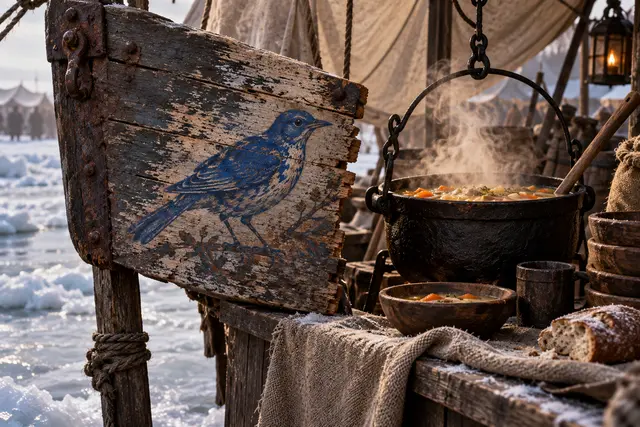
He recognized the thrush first. His father had painted it on the stern twelve years earlier, with a remnant of blue too light for a bird of this species. Ned asked her why she looked like a piece of sky. Will replied that no traveler would pay more for an exact bird.
The thrush was now nailed above a counter, between two rags stiffened by the cold. Under her, a woman was stirring a pot. Ned remained motionless in front of the stall until a man behind him asked him to choose his soup or to choose another place to think.
Around them, the Thames carried a temporary city. Barracks, passers-by, vendors and horses occupied the frozen surface. Ned, who had grown up to the rhythm of the river, did not get used to seeing shoes where he once sought the position of the current.
— "That wood," he said to the merchant. Where did you find it?
— “In a boat, before it ceases to be one.” Do you want to eat?
— This is our boat.
The woman stopped moving. She had red cheeks, wrists wrapped in wool bands and a small white burn above her thumb.
— What's your name?
— - Ned Barlow.
— Ask Will Barlow. He sold it to me.
Ned felt his ears getting hot under his bonnet. He looked behind the stall. There were curved borders, a split bench, pieces stacked under a canvas. He recognized the hole he had repaired the previous summer and the three marks of his knife on the back seat.
His father had told him that the Thrush had been pulled dry for the winter. That was true, obviously. He simply forgot to add the rest.
Ned laid his hand on the painted bird.
— "Don't tear it off," warned the merchant. I paid for the wood. If your father lied to you, we're both having a bad morning, and I've already lit my fire.
The merchant put her ladle back into the pot. Ned remained in front of her, his hand on the bird, until the soup overflowed. She swore by pulling the pot out of the fire; he finally stepped back. Going up to the shore, he kept his fingers tight in his pocket, as if he had still managed to take something away.
2. Will's Hands
At home, Will was looking to open a box with the blade of a knife. His right hand slipped on the sleeve. He rubbed her against his knee when he saw his son come in.
Grace, leaning close to the fire, looked up before Ned spoke. She had already understood in her face.
— You sold it.
Will put the knife down.
— - Yeah.
— You told me it would be mine.
— When I stopped rowing. If only she could still serve.
— You forgot the second sentence when you promised it.
Ned was twenty-two. He has been working with his father since adolescence. Each summer, he had imagined the one where he would lead the Thrush without receiving advice for each movement. He knew his faults, the seat that pinched his fingers and the board that had to be watched. He saw work, money earned by him, an entire place.
Since the frost, he carried loads where he found them. The pieces passed through Grace's hand for food and fuel. He kept the rest in an old stock exchange, persuaded to save for spring repairs.
— "The hull was bad," said Will.
— We would have done it again.
— With what?
— With my arms.
Will had a little laugh that hurt both of them.
— We also needed wood.
Grace stood up. She said what the sale had paid: some provisions, some fuel, some of their rent delay. She did not ask Ned to thank her father. She herself had learned about the sale after the departure of the boat. On the table, Will had left a folded receipt. Grace had slipped it into the little prayer book she kept safe from the ashes, along with their other papers.
On his knees lay a neighbor's coat. Since the water races had stopped, she was taking back clothes for those who could still pay. Ned recognized a seam she had lost the day before: in the wrong light, she had sewn a closed pocket. She would work a second time for the same amount. He had spoken of her arms without looking at her fingers, swollen by the cold, which were now looking for the needle lost in the folds of the mantle.
— “He should have talked to us,” she said.
Will turned his eyes to her. Ned thought he was going to defend himself; instead his father brought the closed box back to him.
Ned took the box, lifted the lid, and laid it before him a little too violently. It was a way of showing him that he still needed someone, and he was ashamed of it almost immediately.
— “Where is the rest of the wood?” he asked.
— The woman who bought it.
— - Everything?
— Anything that was worth taking.
Ned came out. He heard Grace tell him to take his gloves. He continued to the stairs, then returned to look for them, still furious enough to hate the solicitude that forced him to this little return.
3. What could be saved
The merchant saw him come back when she was serving a mason. She took her hand out of his box and waited for him to speak.
— I want to look at the boards. Just watch.
— “Behind. And then you put my canvas back on.
Ned crouched near the debris. He found the back seat, then the trim he had repaired the previous summer. In order to straighten him, he dropped a black dust on his shoes. Under the fresh crack of the saw, the wood crumbled without resistance; he pressed his fingernail until he felt the skin of his finger touch the shell.
He stood there for a moment, squatting in the dirty snow. His father hid the sale from him. He also let her spend the whole fall saving for a repair that would have been useless.
— You will have your knees soaked.
The girl who brought the bowls handed him a bowl. Her name was Bess and she worked with her aunt Martha. Ned had a room, but Martha stopped him before he got it out: her supplier was waiting on the shore and she couldn’t let go of the fire.
— You bring me two bags. I'll pay you the fare, the soup's for me. Are you okay?
He looked at the boards, then at the customers’ queue.
— Do not burn the seat.
— I make soup, boy. No retaliation.
He returned with the bags and stayed until evening. He once forgot to fill the bowl he was holding out to a customer, nearly poured broth into the crate, and was reminded that one could say good-night without appearing to accuse the people. Bess laughed at him without malice. When Martha counted her paycheck, he found it difficult to straighten his fingers to take her.
The next day he brought Rob, who was maintaining their boats. He spread the canvas, passed a tool between the fibers, and then looked up at Ned.
— Will wanted to wait until spring. I told him I wouldn't put that case back in the water.
— You could tell me about it.
— I should have.
This answer left Ned without an opponent. He had prepared all the way for arguments, prices for boards and the number of days he could work. Rob showed him where the bottom had given way even before the saw had passed.
Ned returned with a small fall in his pocket. Will was trying to stitch a strap; he was spinning his shoulder before every point, like a man looking for a position on an uncomfortable chair.
— How long has it been? asked Ned.
Will looked at her.
— "A little.
— Rob showed me the bottom.
His father put the belt down. The fire was low; on the other side of the room, Grace’s coat was waiting on a stool.
— "You rowed me again in November," said Ned. You said I was shooting the wrong way.
— You were shooting the wrong way.
Ned stood up. Will held out his valid hand, but did not touch it.
— And I could no longer correct. I was yelling at you because I was in pain. Because I was scared too.
Ned stood before the table. He remembered the remarks, his shame in front of the passengers, the way he clenched his teeth so as not to respond.
— It didn’t allow you to treat me like that.
— - Nope.
Will tried to pick up her needle and dropped it. This time, Ned waited for him to ask for help.
4. A door too narrow
Martha wanted a cart. She had found, behind an inn, a courtyard where to install her pots after the thaw. The innkeeper would also rent him a few hours of cooking. Supplies would have to be transported every day, and the good planks of the Grive would cost less than a new vehicle.
— “Rob says you know how to work,” she told Ned. It will pass for the axle. I need a box that keeps my things.
He would have refused. The day before, he had hoped to recover this wood to remake a boat; now, he was asked to saw the curve that he had known under his knees since childhood. But Martha put on the counter two days' pay. Grace had sewn until he could no longer see his needle, and he had found no other work for the next day.
He took the measurements and drew in the snow a beautiful box, wide and deep. Martha looked at his drawing.
— Did you see the courtyard door?
He had not been there. She gave him a string and let him go without comment.
The box would have been too wide with two hands.
They worked for three days in the shelter of an awning, between shopping for provisions. Ned learned to interrupt a gesture before serving the soup, and then find it again. Bess brought her tools, sometimes deliberately mistaken; Martha said that she would pay two workers when the latter had ceased to prevent them from working.
Ned's old square formed the bottom of the crate. He had recognized his three stab wounds on the seat and drawn around them to spare, until Rob showed him the fixation that would fall right into a slit.
— “We can take another room,” Martha said.
Ned passed his hand over the marks. His father had scolded him that day; his mother had laughed in the evening, asking if the travelers would pay less because a boy had damaged a bench.
He moved his line and scia. The piece fell between his feet. Bess picked him up without knowing what she had just taken and placed him near the other falls.
The cart passed the door of the inn. Martha placed a bowl, leaned on the edge to check the strength, and then asked Ned to bring it back before another use was found.
He pushed her to the river. At each crash, he heard wood grinding which, in the past, made this noise only against an oar.
5. Leaving the ice
In early February, a drop fell into Martha's crate. She raised her head to the canvas, wiped the pieces with her apron and continued to serve.
The water also flowed along the neighboring barracks. Some merchants were already disassembling; others were watching as they tried to attract their latest customers. Ned's feet had been wet since morning. Returning from the shore, he stopped to observe the black trace that the passage of a wheel had left in the snow.
— “We should take the bags now,” he said.
Martha moved her pot.
— What will I serve them tomorrow?
— You may not be able to be here tomorrow.
She pointed her chin at the open box. He had spent enough time behind the counter to know what he would see: a few coins, too little for the provisions of the week and the first sum due to the innkeeper.
— “I know,” he replied. But we have Rob until night. After that, he works elsewhere.
Martha squeezed her lips. Bess warmed her hands under her arms; when she saw her aunt staring at her, she straightened up to grab a bowl.
They finished the soup in silence. Ned was still expecting an argument when Martha handed him the key to his cashier.
— Bags first. You weigh those that are left to the innkeeper. I don't want to find out on Monday that he was offered them.
The round trips lasted all afternoon. Ned wanted to load more; Rob pulled out a bag without arguing and showed him the wheel that was sinking into the snow. On the way back, they met a man with a sign as big as him. He was walking wrong to avoid passers-by, and Ned suddenly had to stop laughing: nothing they carried seemed to be the right size, once separated from his shop.
Grace came to help Bess fold the canvases. Martha wrapped her bowls one at a time; she pushed aside the one whose edge was split, hesitated, and then slipped it all the same with the others.
The nail of the thrush resisted. Ned had to climb on a crate to remove it, and his mother held the board so that it would not fall.
— “Your father had painted it in our kitchen,” she said. I’ve had them on my sleeve for weeks.
He remembered only the blue and the happiness of having a boat. Grace wiped the bird with the corner of her apron before placing it on the last load.
Will was waiting for them on the shore. He wanted to help, took a handful and released it immediately. Ned pretended to check a wheel as he breathed again, then asked him to carry the strings. His father picked them up while mumbling: no one knew how to make a package in this family.
The river was still frozen when they left. Ned looked one last time at the rectangle of snow where they had worked. Without the fire and the counter, he could hardly believe that the three of them had held on to it.
6. The paper in the book
The following days were hardly triumphant. It was necessary to clean, repair the handle of the pot, agree on the hours of use of the kitchen and find where to shelter the wood. The rain came, but the river did not regain its freedom with a single movement. Ned continued to carry loads in the meantime.
Martha sold little on the first day in the yard. The second, she argued with a supplier. The third, the woman in the last bowl returned with her container. Bess wanted to take this for the beginning of fortune. Martha asked him to wash the table before buying a carriage.
Ned still wanted to row. He went to talk to Sam, an older boatman whose boat had been sheltered before the frost. Sam would need help when he could resume. He proposed a sum per day, then changed the subject.
— "And the long days?" asked Ned.
— These are days.
— Not for my arms.
Sam looked at him. Ned got along and wanted to laugh, but it wasn’t the time. They talked again. They agreed to an additional payment beyond an hour stopped together. Sam wouldn't have work every day. Ned was also no longer sure of consecrating all his.
He went home to tell his parents what he had gotten. Will asked which trains Sam would use. Grace asked when he would be paid. Ned was able to answer both.
After the meal, her father emptied a small purse on the table. The pieces stood between Ned's elbows.
— That remains of the sale.
— - Keep it.
— “You’ve been working on this case as much as I have in the last few years.
Ned was going to repeat his refusal when Grace put his work on his lap.
— You do it again, Will.
His father removed the hand he had left near the rooms.
— I was going to ask you.
— You were going to give him.
Ned looked at his mother. He had given her money all his working life; he knew how much she could get out of a pound of flour. He had never heard her say anything like that about the boat.
— Do you need it for rent?
Grace stared at him, then stood up. She took her prayer book and took out two papers. The first was the recent receipt. The second, stained on an edge, had almost separated along its folds.
Ned recognized his father's name. He deciphered the sum below, much larger than the coins on the table.
— "The purchase of the Thrush," said Grace. Twelve years. You were ten years old and you asked every day when your father would come home with you.
— I remember.
He remembered the blue, the brush whose hair stuck, Will sitting on the steps to paint the bird. He didn’t remember the paper.
— My aunt left me some money. Not a fortune. Enough to rent a room to work in, with an entire window and a place to receive customers. I had found the room.
Ned looked for an answer in his father's face. Will kept his eyes down.
— “We bought the boat,” Grace continued. Your father knew how to row. I knew how to sew. The boat had to pay more.
— What about the room?
— You can see where I work.
She did not extend her arm to the fire. She didn't need it.
Ned rereads the sum. Grace's name did not appear. He turned the sheet as if a second line could make it all less embarrassing.
— Why didn't anyone tell me?
— “Because at first we remembered it,” she said. After that, your father said my boat. Then our boat. And now you were saying yours.
Will raised his head.
— I never thought I'd take it from you.
— "You've only come to forget that you had to ask me before selling it.
A neighbor coughed behind the partition. Ned then heard water poured into a container. The silence in their room seemed thicker than the wall.
He picked up the coins and placed them in front of his mother. She left them there.
— "That's not what I ask you.
— “What?” said Will.
— Let us talk about it before there is nothing left to decide.
Ned sat down. They counted what was due and what they had to keep. Grace reserved a share for the fuel. She pushed a few pieces towards Ned: the rest of the repair he had paid the previous summer. He took them without making a speech.
He then offered to make him a table with a folding top, near the window. He could ask Martha for the last falls.
Grace shook her head.
— A table, yes. But not with wet wood that will hang my fabrics. And not without me showing you where I want it.
Will had a breath that could have become a laugh. He held back. Grace looked at him long enough to help her.
Later, Ned folded the recent receipt. His mother put the two papers in the book. He asked her if she regretted the purchase.
She thinks before answering.
— We ate because of this boat. I'm not going to pretend otherwise.
She ran her thumb over the cover.
— But I would like to remember what I would have sewn in this room.
Ned did not promise him a shop. He only had a few days to sell to Sam. The next day, he brought back a string and asked Grace to show him the right width at his table. This time, he measured before drawing.
7. The first crossing
In the spring, the steps regained their edge of water. Ned went back to work with Sam. The first days opened two blisters in his hands and gave him back a sleep of which he had forgotten the heaviness.
One morning, he saw Will come down to the pier, his coat closed. Ned had often imagined this visit: his father instead of the passengers, observing his arms, finally forced to recognize that he knew how to manage.
He put down his oar.
— Do you want to cross?
Will shook his head and turned. Grace came behind him. She held her skirt in one hand, a small package in the other. Ned held out his arm. She stayed on the last step.
— Not this one, she said. The one on the other side. I can't support you like that.
Ned changed hands. She went down with a precaution that surprised him, and then sat down in the middle of the bench. Will was on the ground.
— Aren't you coming?
— I promised to bring a coat. And Sam is waiting for you for a race after this one. Don’t take it all morning.
Grace looked up.
— He knows the time, Will.
Ned held back his smile. Sam had left them the boat for a short crossing before the first agreed customer. He took off the mooring.
— Where do you want to go?
— "On the other side." I'm bringing this to Martha's sister. She gave me two clothes to take back.
— You can go through the bridge. You usually do.
— "I know.
She put the package on her knees. Ned pulled the hull out of the steps.
On the shore, Bess was advancing with the cart. The blue thrush had been attached to the front, just above the left wheel. A loose strap slammed at every bump. Ned promised to fix it in the evening. He raised his hand; Bess raised hers without letting go of the stretchers.
The current took them. Grace is stiff.
— Is that normal?
— - Yeah. I let him help us.
He slows down his first stroke. His mother looked at the border, then at the water, then at the packet from which she untied and redone the knot.
— Weren't you afraid of your father?
She looked up.
— I never went up with your father.
— In the thrush?
— Dans In none.
Ned stopped rowing. The boat turned slightly; it corrected immediately.
— Never?
— “When I had a race, he worked. When he came home, I still had mine to finish. And then I was sure I wouldn't like that.
Ned looked at his hands on the package. He had rowed hundreds of times between these shores without wondering why his mother was still waiting on the steps. He looked at his package, his skirt carefully lifted above the wet bottom; he had not even thought of bringing him a blanket.
— We can go home if you want.
Grace leaned over a little. The water carried a twig that turned close to the oar. Later, a man shouted a name from another boat. She followed him with her eyes as if this cry had come to her from an unknown city.
— - Nope. Not yet.
Ned resumed his movements. He chooses a gentle passage, without accelerating to show his strength. Grace will loosen her fingers. On the other side, steps approached; he visited those whose last stone was wide and regular.
— - There?
His mother looked at the package, then at the facades, then at the space they had left to cover.
— The ones after.
He passed them.
When they reached the next ones, Grace had still not picked up her package. Ned no longer asked the question. He continued to row.
End