When Paul pushed the door of the hardware store to empty it, he did not yet know that it would take him nearly a year to understand why his father had refused to sell the store for thirty-two years.
He had spent much of his life blaming him for it.
Since childhood, this shop had occupied a place that he considered disproportionate in the family. His father might be away on a birthday, late for a big date, or promising an outing that a client would eventually have him cancel, but he still found time to come open the metal curtain at 7:30 every morning. Even when things went wrong, even when he came home exhausted, he would start again the next day.
Paul had come to believe that his father loved his business more than his own son.
He had never spoken frankly about it with him. What's the point? His father was not a man with whom it was easy to talk about such things. When a problem arose, he replied that he had to work, wait, or find a solution. Feelings always seemed to be able to wait.
After his death, Paul made a decision that seemed almost obvious to him: to sell.
The shop was not paying enough to justify the hours it was asking for. Suppliers demanded their money, rent had to rise and several shelves had remained almost empty in recent months. Paul had already met a candidate for the resumption of the lease, with the agreement of the owner. The man wanted to set up a real estate agency in place of the shelving. Between the sale of the lease and the liquidation of the stock, Paul hoped to settle the bills late. The accountant still had to check the numbers.
In the meantime, he had begun to empty his father’s personal belongings. His mother had left him the keys; she did not want to return to the reserve.
1. The Box
So one Thursday night, while searching an old reserve that no one had taken care of for years, he saw a shoe box stuck behind a cardboard box.
He pulled it with his foot, blew it on the dust that covered the lid and immediately recognized the mark.
His father had bought these shoes when he was fifty. Paul remembered this because he had accompanied him that day and his father had spent twenty minutes comparing two almost identical pairs before choosing the cheapest one.
“You see,” he said as he walked out of the store, “you can always find cheaper if you take the time to look.”
Paul smiled as he lifted the lid.
Then his smile disappeared.
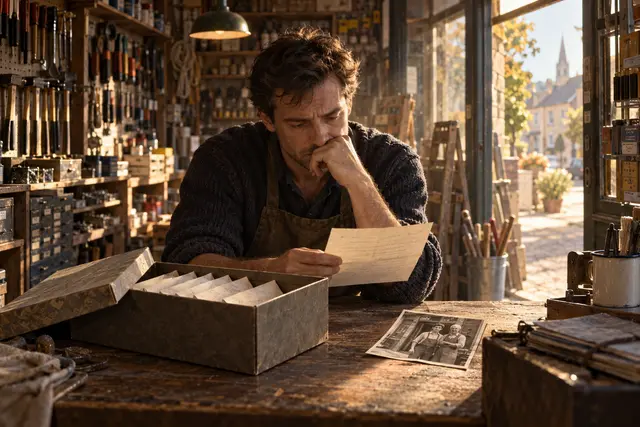
Eight envelopes were carefully aligned inside. Each contained a thousand euros. On the back, his father had written dates, all prior to the difficulties of the last months.
Paul counted them twice, unable to understand why his father had kept such a sum in cash when he had left unpaid bills behind. He photographed the box for the accountant, then put it back on the cash register. That money didn't settle anything yet.
Under the envelopes was a folded sheet.
He recognized the writing immediately.
Paul,
If you find that money, you probably decided to sell the store.
He stopped there for a moment, the paper between his fingers. His father had always had this way of predicting things a long time in advance, and even dead, he still seemed to be one step ahead of him.
The letter continued:
I'm not going to ask you to keep the shop. If you want to sell, sell. Don’t make the same mistake as I do in believing that you have to keep something just because you’ve dedicated a lot of your life to it.
Paul reread this sentence, then sat down on an old crate.
That was not what he expected.
He had imagined finding a justification, an explanation, perhaps even a few words to ask him to continue. Instead, his father seemed to give him permission to leave.
Money is for you. Not to save the store. I’ve set it aside so you can start somewhere else without having to think you owe me anything.
Paul put the letter on his knees.
For a few seconds he thought of nothing. Then a memory came back to him with a strange precision: he was seventeen years old and had just announced to his father that he wanted to go to study in another city. He was expecting an argument. His father had only nodded his head before he said:
“Then leave. You don’t have to live the life I chose.”
At the time, Paul took this phrase for disinterest.
He suddenly wondered if he was wrong.
He resumed the letter.
There's something else I want you to know. You probably thought I was keeping the store because I was unable to recognize that things had changed. This is not completely false. I was stubborn. I made mistakes. I’ve lost money that I should never have lost and I’ve sometimes made bad decisions just because I didn’t want to admit I was scared.
Paul had a little laugh.
This part looked much more like his father.
But then he lost his smile.
There are people I owe something to, even if it’s not a debt of money. You'll find their names in the desk drawer. If you want to understand why I kept this shop for so long, start with them.
2. Do not claim
The next morning, Paul opened the drawer.
There he found an old leaf covered with names, dates, and sums. Some amounts were large: two thousand three hundred euros, one thousand eight hundred, four thousand five hundred. Beside several names, his father had written a simple mention: Do not claim.
Paul knew some of these people.
He began with Bernard, who had had a small carpentry workshop a few blocks from the store.
When Paul asked him if he knew why his father had noted his name, Bernard remained silent for a long time before answering.
“Did your father ever tell you?”
"No."
Bernard sat more comfortably in his chair.
“Eight years ago, I was going to close. I had debt everywhere. Your father let me pick up some equipment and I promised to pay him quickly. I couldn’t. I sold my workshop a few months later.”
Paul looked at the paper.
“He said you owed him four thousand five hundred euros.”
“I owed them to him.”
“And you never paid them back?”
Bernard lowered his eyes.
“I wanted to do it. Several times. He refused.”
Paul frowned.
“Why?”
Bernard had a sad smile.
“Because he knew what it was like not having someone to give you some time.”
This answer did not satisfy Paul. She even made him want to get angry. His father had let thousands of euros escape him as their own financial situation had become increasingly fragile. For years, he had watched him work to the point of exhaustion without ever explaining why.
He went to see the other people inscribed on the sheet.
Each meeting revealed to him a different piece of his father.
A woman told him how he had given her several months to pay after losing her job. A young craftsman explained that he had been able to buy his first machines thanks to a credit that no one else wanted to give him. A man, on the other hand, did not seek to embellish the memory.
“Your father had a heart, yes, but he also had a great character. It could be unfair, especially with your mother. He always believed in holding on, even when holding on no longer made sense.”
Paul left with that phrase in mind.
The further he went, the less he knew what to think.
His father was not the good, generous merchant that some described to him. Nor was he the selfish man he had accused of being for years. It was a much more disturbing mixture of the two: someone who was capable of showing immense generosity and, at the same time, of letting his own people pay the price for his stubbornness.
3. The letter stayed there.
Then Paul found a second envelope.
It was hidden in the back of the old desk, behind a drawer that no longer closed properly.
This time, his mother’s name was written on it.
Paul stayed in front for a long time.
He knew he might not have opened it.
But he did.
The letter was two years old before his father died.
I know you think I'm staying here because I prefer the store to our family. You are right to blame me. But there’s something I’ve never been able to say to Paul: I’m afraid he’ll see me as a man who failed.
Paul had to stop.
He rereads the sentence.
Then the next one.
When he was a kid, I wanted to give him something better than what I had. I worked more. And then even more. Over the years, I’ve told myself that it’s for you. Part of the truth is that I no longer knew how to stop. I didn’t know how to get home without feeling like I was giving up on something.
Paul felt his eyes filled with tears.
He thought of all the times he had waited for his father.
To all those where he had stopped waiting.
Suddenly, a memory came back to him. A memory he hadn’t thought of in years.
He was eight years old. He was sick, feverish, lying in his room. In the middle of the night, he woke up and saw his father sitting by the bedside.
His father had placed a hand on his forehead.
“Sleep, I’m here.”
Paul closed his eyes.
The next morning, his father had already gone to work.
For years, Paul had remembered only his absence.
He now remembered that he had been there.
This discovery didn’t fix anything. She didn’t turn lost years into happy years, and she didn’t make wounds go away. But she made her father more real, and that reality was perhaps more difficult to accept than anger.
4. Another store
A month later, the candidate for the resumption of the lease returned with his draft contract.
Paul still had the eight thousand euros in the shoebox.
He could sell and leave.
He could also use the money to keep the store alive for a few months, without any guarantee that it would work.
He spent several nights thinking.
Eventually, he didn’t choose to save his father’s store, or sell it immediately.
He decided to completely change his way of working.
Before answering, he brought his accounts and the box to the appointment with the accountant. His mother came with him. They looked at what would have to be paid, what could wait with the agreement of the suppliers, and how much Paul could actually commit. His mother didn’t look at the recipe column.
“And what time will you be back?”
Paul began to say that the first few weeks would be special. She slowly pushed back the leaf.
“That’s what he said.”
He closed it at seven o'clock and wrote eighteen o'clock. They agreed to a three-month trial, with a spending limit and an appointment to redo the accounts. If it didn't hold, it would close. He let his mother take a copy.
He reduced the stock, negotiated with suppliers, turned part of the back shop into a workspace for local artisans, and abandoned some activities that were no longer profitable. The beginnings were difficult, and many of his ideas failed. Gradually, the store began to breathe again.
It wasn’t really his father’s.
It was his.
5. The First Chance
Almost a year after the discovery of the box, Bernard phoned him. By sorting papers for Paul, he had found a photograph. Paul picked her up after closing.
Bernard had released it from his album and placed it on the table.
“Your father lent it to me when I opened the workshop. He said it would bring me luck. I forgot to give it back to him.”
Paul took it.
His father appeared there at twenty-two years old, standing in front of his very first shop, with a man he did not know.
On the back, a few words:
The man who gave me my first chance.
Paul returned the photograph.
He would put it away when something caught his attention: a date, written in pencil, and the name of a street.
He knew that address.
It was the first shop. Bernard gave him the number of Louise, the daughter of the man photographed. She still lived in the building. Paul called him that evening, and they agreed to meet at the old entrance of the store.
The next day, Paul went there.
The storefront had long since disappeared, replaced by two apartment windows. Louise was waiting for him at the door, a double of the photograph in hand.
“You have the same eyebrows as Marcel.”
Paul looked at the double of photography.
“Did you know him at that time?”
She smiles.
“The whole neighborhood knew him. Your father was twenty-two years old when he moved here. He had almost nothing. A man gave him his first chance.”
Paul felt his throat tighten.
“What did your father do for him?”
The old lady thought.
“Marcel had been his apprentice before the bankruptcy. When he wanted to settle down, my father had no more money to lend him. But he still had tools and a supplier that still trusted him. He introduced him to Marcel.”
She paused.
“The supplier delivered without asking in advance. Your father paid for it with his first sales. Sometimes he would come back to see my father. He wanted to give her the tools. My father asked him if he was going to work with his bare hands.”
Paul thought of the names on the list. He thought he had found the reasons for his father’s difficulties, and then those of his generosity. He had not imagined Marcel on the other side of the counter, waiting for us to give him something to start with.
“He told you why he refused to be reimbursed?” he asked.
Louise shook her head.
“I’ll have to blame him without me.”
Paul had a little laugh. He arranged the photograph without expecting a final explanation from her.
6. Eighteen hours
That same evening, he was lowering the curtain of the hardware store when a customer arrived with a broken handle.
“I have five minutes.”
Paul looked at the room. He knew the model, the drawer, the two screws that would have to be added. It could have re-opened without even re-igniting the entire store.
His phone vibrated. His mother asked if he would always come to dinner.
He replied that he was leaving.
"Tomorrow at eight o'clock," he said to the client. Bring the plate too, so that we can check the gap.”
The man hesitated, then put the handle back in his bag.
Paul comes down the curtain. In his pocket, the edge of the photograph protruded from the envelope; he pushed it back with his thumb so as not to damage it.
“I understand, Dad,” he whispered. But I’m going to do things my way.”
He checked the lock once, then went to dinner.
End