1. A window side seat
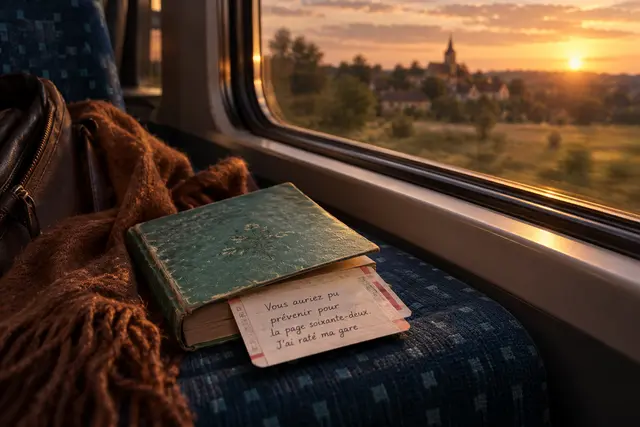
Élise took the book because it was about to fall. At the first shake, he had slipped to the edge of the nearby seat. She held out her hand just before he disappeared under the bench, then looked around. A couple were fighting softly near the doors. A student was sleeping against his bag. No one seemed to have lost anything.
The novel had a green cover, worn at the fold. A small label inside had a name, Gabriel, and nothing else. Between two pages, a ticket on the 18:12 train served as a bookmark. On the back, someone had written: “If you find it, don’t bring it back right away. He is on page forty-seven.”
She smiled despite her day. She came back from an interview that ended with “your profile is interesting”, a formula she now knew all the ways to promise nothing. She had planned to spend the trip mentally rewriting her answers. Instead, she opened the book.
On page forty-seven, a woman bought a house whose owner no one knew. Élise passed his station. She noticed it two minutes later and went down to the next one, to a village where she had never had reason to stop. The next train was in twenty-three minutes.
She took the pen from her bag and added on the ticket: “You could have told for page sixty-two. I missed my station.”
She decided to put the book back in the same place the next day. It was absurd. The wagon could change, the owner would never come back. However, she slipped the ticket between the pages and put the novel in her bag, above the application file of which she no longer wanted to see the cover.
2. A book without a bookstore
The next morning, she examined the novel. The title, La maison sans nom, appeared in small print on the edge. No portrait of author, no presentation on the back. Inside, a mention of printer and a date thirty years old. The name of the author, C. Sorel didn't tell her.
Élise used to work with a woman who could find any object from a photograph. She thought to write to him, then gave up. Their last conversation ended with her leaving the office. She didn’t want to turn a curiosity into a request for an explanation over the next few months.
Instead, she entered a second-hand bookstore. The bookseller took the novel with caution. He turned the first few pages and shook his head.
— Maybe a small edition with an author. The great circuits did not keep all the small lives.
He offered to buy it for three francs. She refused with a speed that surprised both of them. The book was not hers, she explained. She was just trying to find out if there were others.
— "Probably. Someone does not print just one.
As she went out, she thought that many things could exist without leaving a trace that was easy to find. A book, a job we were proud of, a relationship that hadn’t quite begun. She had not yet received any response to her ticket and was already starting to invent a story around her owner.
At six twelve p.m., she put the novel back on the seat in the second carriage. She stayed beside it until her station, in case someone came to claim it. Nobody did. On the platform, she waited for the green cover to recede behind the window.
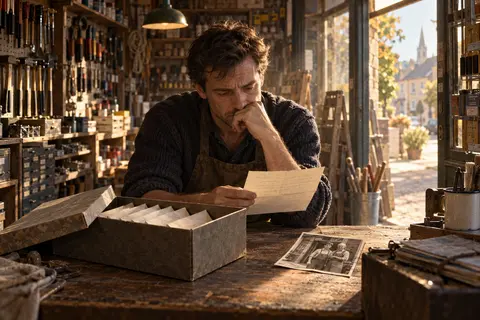
At home, she finally opened one of the boxes in her kitchen. She found two plates, a pie mold and a forgotten sketchbook. On the first page was a library drawn during his studies. She had imagined it in a disused station: books where people once waited, benches kept against the walls, a free passage between the tables.
She left the notebook on the worktop. For the first time in several weeks, she did something without knowing who she could show it to.
3. The things that are emphasized
On Thursday, the book came back. He was resting against the window in the second carriage. Élise looked at him before sitting down, as if too sudden a movement could make him disappear.
A new ticket exceeded page ninety.
“Sixty-two is a known trap. I decline all responsibility. Did you find a good coffee in the station where you landed?”
She replied that there was no coffee, only a recalcitrant dispenser and a magnificent view of a parking lot. Then she asked how he had recovered the novel.
The answer came on Monday. Gabriel went up from the line and down two stops before the station where Élise boarded. The first time, he forgot his book when he left. He had found him on Wednesday at the counter of the found objects, after a checker had picked him up at the end of the line the day before. Élise's word had made her decide to start over, this time asking for the employee's help.
“Her name is Samira. It demands that the plot advance and that I don’t turn his train into a post office.”
Élise laughed. The traveler on the other side looked up from his phone. She showed him the novel as a sufficient explanation.
They soon made a rule. On Tuesdays and Thursdays, Gabriel would entrust the book to Samira on the way down; Élise would take it back to the agreed seat, read the ticket, and then return it to the controller before her own stop. Samira would do the opposite with their response the next morning. The novel would spend the nights at the Lost and Found office. She had agreed for two weeks, on the journeys where she was on duty. Then they should learn to talk to each other like everyone else.
They began with the novel, its obstinate characters, the endings they would have preferred. Élise reproached the heroine for running away from all the important conversations. Gabriel replied that you could cross a country more easily than a kitchen when you had to admit something.
That phrase stayed with her all night. He had placed it in quotation marks, with no author's name; she thought he was gently making fun of his own lyricism. His kitchen contained three cardboard boxes still closed, the remains of a move dating back five months. She had been living alone since February, but had not yet chosen where to place the plates she had kept.
On the next ticket, she wrote, “What’s in your kitchen?”
4. What we don’t know yet
The next Thursday, the book was not in the seat. Élise walked the wagon from one end to the other and immediately felt ridiculous. She had no appointments, no special rights to a place or to a forgotten object. She sat down in the same place and took out her notebook to occupy her hands.
At the next station, Samira passed through the driveway. Élise recognized her with the name embroidered on her uniform. She opened her mouth and then closed it. Samira stopped by herself.
— Today, I am the one who is late.
She handed out the novel. A maintenance envelope had slipped between the pages, with the usual ticket. Samira specified that one day this correspondence would have to be given a more reliable address than a bench.
— "Do you know him well?" asked Élise.
— Enough to know he's paying for his tickets. For the rest, it will be up to you to check.
Élise appreciated that she did not sell Gabriel as a household appliance is recommended. Then she noticed that Samira kept her finger on a page, as if she knew precisely the passage where the book was open.
— Have you read it?
The controller had a brief smile.
— A long time ago.
Gabriel’s ticket contained a question: “You’re more like opening all the doors or first looking for the plan of the house?” Élise replied that she drew the plan and eventually forgot to come in. She hesitated before handing over the paper. It was a more accurate sentence than she would have liked.
In the novel, the heroine had just understood that the house was not abandoned. Several people held the keys and entered at different times, each persuaded to be the only guest. Élise was expecting a scam. She noted this assumption in the margin, then crossed it out. She did not ask permission to write in the book.
The following Tuesday, Gabriel surrounded the rature: “You have the right. He has survived much worse.”
Under the back cover, an ink stain spread in half-moon. Someone had written a name that the water had almost erased. It was not Gabriel. Élise distinguished only one S. She wondered how many readers had held the volume before them and why none had tried to erase that trace.
5. The Absence Map
There was a lemon tree that refused to produce lemons. A table too big. The drawing of a little girl hanging across, because it was forbidden to move the magnets. Gabriel had an eight-year-old daughter, Lison, at his home every other weekend and half the holidays. He did not hide this information; he simply had not yet found a place to place it between two comments on a novel.
Élise appreciated the accuracy. She was thirty-six years old and had little taste for encounters that began with a lighter version of reality. She replied that she drew interior plans, at least when a cabinet would hire her, and that she had kept an artificial plant in fidelity to the one that had offered it to her.
Gabriel would restore musical instruments. He hardly played any more, which Élise found curious. He explained that we could love to put others back in motion without knowing very well where to go ourselves.
The two weeks were up. Samira placed an envelope on the book with a final warning: “Friday. Station café. Half past six in the evening. I don’t take reservations.” She suggested the station where Élise boarded; Gabriel would have to travel two stops further. Each confirmed on a slip of paper. On Thursday, the ticket inspector left the novel with Élise: she could finally return it to its owner in person.
Élise stayed for a long time with this paper between her fingers. She now knew that Gabriel was having his coffee without sugar, that he was afraid of becoming a father who promises too much and that he had lost a piano competition at seventeen by forgetting to turn a page. She didn’t know the shape of her face. She could still preserve this story by leaving it on paper.
On Friday, she arrived at the café at six twenty-four p.m. She chose a table from which she could see the entrance. At six thirty, she ordered a tea. At six forty, she moved her bag off the neighbouring chair. At seven, she put money on the table and left with the novel.
She had no number to call. This lacuna, which she had found charming, suddenly seemed to her a very convenient way of owing nothing to anyone.
6. An explanation is not an excuse
On Monday, Samira recognized her on the dock. She had a closed envelope.
— He came on Saturday. He looked like someone who had slept very poorly.
Élise took the envelope without opening it. She spent the journey looking at the windows reflecting faces on the fields.
Gabriel had to look for Lison at school after a call from his former girlfriend. A fever, a doctor, a rearranged guard. Nothing spectacular, nothing demanding a medal. In the confusion, he had forgotten to prevent coffee. When he thought about it, the building was closed. He could have called earlier. He recognized him.
“I’m not asking you to find this romantic. I'll give you my number. If you want to write to me, even just to tell me you’re angry, I’ll answer directly.”
Élise reread the passage. His old relationship had been full of explanations so perfect that there was never room left for his disappointment. She could be upset here without becoming unfair. This possibility made him want to remember more than all the beautiful words of the tickets.
She waited until evening, then wrote that she was actually angry. A message to the cafe would have been possible. And she was glad that Lison was getting better.
Gabriel answered in three sentences, without trying to win the debate. They then spoke on the phone for 11 minutes. He had a deeper voice than she had imagined and a way of looking for her words that soothed her.
They chose a Saturday afternoon, near his workshop. This time, they also exchanged a photograph. Élise sent the one from a hike where she wore an orange cap. He replied with a clumsy self-portrait in front of a cello. Nothing in these two images looked like an advertising promise.
7. The missing page
The day before the meeting, Élise finished the novel. Or rather, it got to where it should have ended. After the page one hundred and twenty-six, a sheet had been cut flush with the binding. There were only a few letters left on the inside. The last sentence read, “The next day she came back with all the keys.”
Élise sent a photograph to Gabriel. He immediately replied, “I know. That’s why I’m looking for another copy.”
She put down the phone. For a few seconds, she found the whole story less charming. He knew the ending was missing and still invited her to read. Was that a way to prolong the game? She wrote the question less gently than she would have done on a ticket.
Gabriel called him. He had bought the book in a book box the previous year, with a contribution left for the association that maintained it. He had read it for the first few months after his separation. The last page was already missing. The note about page forty-seven dated from that moment: he had wanted to put the novel back into circulation, then had kept it in his bag instead of dropping it off.
— Did you really forget it on the train?
— - Yeah.
— I prefer to ask.
— "You are right.
This time, she heard in her voice something other than embarrassment. Honest fatigue. He was not the character of an elegant device. He had lost a book, liked an answer and tried to continue without knowing very well how to do it.
They discussed the absent end. For Gabriel, the heroine had to return the keys to the real owners. For Élise, she had to open the house to those who had received one. One read a repair, the other a beginning.
— It may be the same thing, he said.
She thought of the boxes in her kitchen. Then she told him that she had drawn a library in a train station once. He asked why “in the past.” She could not answer.
After the call, she pulled out her old sketch. The passage between the racks was too narrow; she erased it, moved two tables, and then started again the whole corner of the windows. When she looked up, the tea was cold. She placed the cup on a cardboard and continued until she ran out of light.
8. Out of the pages
Gabriel was waiting for him in front of the workshop, ten minutes early. He was a little smaller than she had imagined. She had shorter hair than in her picture. They both smiled at these tiny corrections that reality made to their correspondence.
The workshop smelled of wood and a hot glue, which he explained to her in too many details, and then interrupted to apologize. Élise asked him to continue. She loved people who come to life talking about what they can do.
They walked to a bakery and ordered two coffees. Gabriel chose the table near the window, then asked if she preferred the other. Élise replied that this one was very good. They sat down and watched, with excessive attention, the waitress rid the neighboring plateau.
— Do you come here often? she asked.
— For the bread. I don’t usually stay.
He moved his spoon. She looked for the man who had described the lemon tree to her and found, in front of her, only a man trying not to spill his coffee.
— "I have prepared three subjects when I come," he said suddenly.
— Me, two.
— - Do you have any left?
She laughed and shook her head. Her phone vibrated in her bag; she silenced him without taking him out.
— On paper, you never hesitated.
— I sometimes had a whole evening to write four lines.
— You can see less of them.
He finally smiled as he looked at her.
He asked her how her interviews had gone. She told him about the firm that wanted new ideas but a portfolio that looked exactly like that of its competitors. Fear of becoming too cautious. He did not offer her a solution. He asked what she would do if no one had to say yes.
She described a small municipal library, reading alcoves, and a table large enough to accommodate children drawing standing. Gabriel listened to him until the end, then took a ticket out of his pocket.
— “This one is a virgin,” he said. Just in case.
She drew the plan. Coffee is cooling down between them.
9. The reader of the last wagon
Upon returning from the rendezvous, Élise met Samira in the station lobby. The controller wore a civilian coat and dragged a small red suitcase behind her. She went to her sister for three days. Élise told him about the workshop, the coffee, the silences that had become pleasant.
— "Then can the book go back to the counter?" asked Samira.
Élise replied that she was still looking for the end. She took out the volume and showed the cut sheet. Samira passed a finger along the edge, unsurprisingly.
— “It looks like a razor blade,” she said.
— Do you know what was on this page?
An announcement of departure resounded in the hall. Samira looked at the sign and then at the cover. She suddenly looked less in a hurry.
— A bad ending, probably.
— It is a pity that we cannot judge it.
Samira smiled, but did not answer. She asked if Élise would be on the Tuesday train, and then took leave. His suitcase clicked on the joints of the tile.
On Tuesday, Samira handed him an envelope before starting his tour. No ticket this time. A typed sheet, some characters of which rose slightly above the others. At the bottom, a page number: one hundred and twenty-seven.
Élise stopped before she read. A letter accompanied the sheet. Samira explained that she had written the novel when she was twenty-three, under her grandmother’s name. A small printer had produced eighty copies. She had offered some to her relatives, placed some in libraries, kept the rest at the bottom of a closet.
On the first copy, she had cut the last page after a breakup. She could no longer bear the conclusion that the heroine was abandoning her house to follow a man who had never asked what she wanted to do. She planned to rewrite the ending. Then life had brought a job, a child, staggered schedules. The book had ended up in a book box, years later, in the middle of a move.
Élise rereads the letter. The name erased under the cover was not that of an old reader. It was the author’s.
“When Gabriel told me,” wrote Samira, “I thought I had to tell him everything. Then I saw your first note. No one for thirty years had told me that he had missed his station because of this book. I wanted to wait a little longer before I became the woman who wrote it again.”
The end joined was the news. Only a few lines. The heroine came back with the keys, invited the other occupants and asked them what they wanted to build together. The man she loved was the last. He did not bring a suitcase. He brought a shelf.
Élise laughed in the middle of the carriage, then wiped her eyes with the handle of her coat. She sent Gabriel a photograph of the closed envelope, so as not to spoil the discovery. “Tonight,” she wrote, “I’m finally readying the end for you.”
10. One sentence too many
They invited Samira to dinner the following Friday. Élise had emptied the last boxes of the kitchen and bought towels that did not come from her old apartment. Gabriel arrived with a gratin and a bottle of wine. Samira brought four intact copies of the novel into a shopping bag.
— “Survivors of the closet,” she said.
Élise brought them to the table. She had become accustomed to the marks of her own, to the ink stain, to the fold of the cover. The others seemed almost false.
Samira told the printer, the quote she had read too quickly, the boxes delivered on a rainy day. She had sold 11 copies. His father had bought three under different names, without changing his address.
— “He thought I wouldn’t look at the envelopes.
Gabriel laughs. Élise cut off the gratin and noticed that he had eaten almost nothing since the books had come out of the bag. Samira was leafing through a copy, looking for a passage.
— “There’s a sentence I’d delete right away,” she said. I thought it was so beautiful that I put it on twice.
She read:
— "You can cross a country more easily than a kitchen when you have to admit something."
Élise kept the gratin shovel hanging over the dish.
— - Twice?
— Pages 30 and 89. At twenty-three, I had no doubts about anything.
Gabriel put down his drink. He no longer looked at Samira.
Élise remembered the note, the quotation marks, her own answer on the cards. She thought a man had just told her something. He quoted a book from her. The book they read together. Maybe she should have recognized the phrase. That didn’t stop him from getting hot in the face.
— "That's one of my favorites," said Gabriel.
She put the shovel down.
— - Yeah. I know.
Samira understood that she had just entered into a conversation that did not belong to her. She closed the volume and asked where she could place her plate. Élise got up too fast to get rid of him.
They finished the meal by talking about something else. Samira gave them the name of an association that was looking for someone to design the layout of an old waiting room. A modest budget, no promises. Élise noted the contact on the back of an envelope. She needed a job for her hands.
When the controller was gone, Gabriel stood by the sofa.
— “I thought you knew,” he said.
— For that phrase?
— - Yeah.
— What about the others?
He took out of his pocket the tickets he had written to her. He had brought them together with a rubber band, like the bills we keep in case. This treatment hurt him in another way.
— Two quotes, he said. The one in the kitchen and the one on the people who keep all the keys.
Élise remembered the second. She had responded by telling him about her departure, the old relationship, a key that she had not managed to return for weeks.
— I was telling you about my life.
— - Me too.
— I don't know when.
He began to answer, stopped. She saw the moment when he gave up on finding a formula that would fix everything.
— The lemon tree exists. My daughter too. For the rest, I would like to resume without the book.
Élise smiled in spite of herself, then shook her head. She didn’t want a smile to force her to have already forgiven.
— Not tonight.
Gabriel arranged the tickets. He took away his still warm dish. On the threshold, he turned around.
— "The vending machine and the parking lot, was it really you?"
— - Yeah.
— That's what made me want to answer. Not the beautiful phrases.
After she left, she looked for page thirty. She had turned the paper, read it without holding anything back. The same text, copied on a ticket, upset her. She put her finger on the quotes. He did not invent the whole man. She gave him a voice that he didn’t give her.
11. Without draft
The next day, Gabriel sent a message: “Can I call?”
Élise replied that she was walking to the market and that he could try. He called immediately. For the first few seconds, they only heard the rubbing of their clothes against the phones.
— “I thought you were going to read the quote and tell me you loved it too,” he began. Then you told me about your kitchen. I didn't want to interrupt that.
— You could have said it later.
— - Yeah. After that, I had even less desire.
She bypassed a stall. A merchant handed her a quarter of pear; she took it without being able to thank him at once.
— “That’s what bothers me,” she said. That you knew what I believed and that it became practical.
— "I understand.
— Don't just tell me that you understand.
He's silent. She heard a car pass by, then the bell of a shop. He was walking too.
— “I was afraid you might find me less interesting,” he said. It's not very flattering to tell.
Élise stopped in front of the flowers. She would have wanted an answer that would allow her to decide immediately: sincere man, lying man, good story, bad story. Gabriel made it less convenient for him to store.
— “I laughed when I read the parking ticket,” he resumed. I thought I still wanted to receive something from you. After that, I spent way too much time trying to be the person you’d want to write to.
She looked at her reflection in the window of the florist. She too had rewritten her answers, removing a detail too sad, adding a joke after the fact. She wanted to please him before she even knew his face.
— "I did not pass my station at page sixty-two," she said.
The silence changed.
— What do you mean?
— I saw it coming. I could still go down. I thought I'd read to the next one.
— What about the parking?
— The parking was beautiful. I stand.
He laughs, then she. Disappointment does not disappear with laughter. But she stopped occupying all the space between them.
They meet again a week later. Gabriel showed Élise a wobbly table that he had been trying to fix for two years. She confessed to him that she did not know how to maintain a plant and that she had never believed in the potential of her lemon tree. They ate toast because he had forgotten the cheese for the fondue and none of them wanted to come out.
After a few weeks, she met Lison. They went to walk with a snack. The little girl took an interest in the orange cap, asked to try it, and then wanted to know why adults used books to leave words when phones existed.
— "We were looking for an excuse," said Gabriel.
— "For what?"
He looked at Élise.
— "To talk to each other.
Lison found this unnecessarily complicated. She went to the front, stopped at a puddle and came back to claim the cap because, she explained, the discussion had not yet established whether it was a loan or a gift.
Élise lent it to him.
12. The station she had seen
The library project would wait. The association needed money for electricity before talking about reading alcoves. Élise helped them make a simpler plan, then accepted a three-month mission to another city. He liked the contract. She checked the routes before calling Gabriel, and then found herself wanting to start by apologizing.
She told him the dates instead.
— Three months, he repeated.
— I'll go home some weekends.
— - All right. Give me time not to look happy.
She put down her bag. They talked for a long time, of trains, of Lison, weeks when the workshop would close late. They did not solve everything. When they hung up, no one had taken what he wanted.
In November, he accompanied her to the dock for her first trip. She had given him the orange cap, which Lison had washed with a strawberry-smelling product. Gabriel was carrying his heaviest bag. The green novel was out of the outer pocket.
— "You have not yet returned it to me," he remarked.
— "You wrote that it should not be reported at once.
— It is 128 pages long.
— You don’t count the tickets.
She handed him the book. He stayed for a moment without taking it, then opened the cover. Élise had slipped the new ending of Samira into a paper pouch. She hadn’t picked up the page. One could read and then look at the place from which the other had been removed.
— I give it back to you, she said. For real.
The train entered the station. Gabriel let the travelers pass before giving him his bag. She kissed him, went up and found a place near the window.
He knocked softly on the window. In his hand, the first ticket was unfolded. He had just found the words on the failed station. Elisha looked up to heaven and laughed. He pointed to the billboard, then mime someone looking at his watch. This time she had to go down to the right place.
The train started at 18:12.
At the first stop, Élise pulled out her phone. A message from Gabriel had arrived. A photograph showed the open novel on page sixty-two, with only one question: "There was not even a chapter end. Why did you continue?”
She watched the houses slide behind the window. She could talk to him about the light, his fatigue, the desire to delay his return to an apartment full of boxes. All this was true. But she mostly remembered the name on the label and the empty place next to her.
She wrote, “I was hoping you would come back.”
End