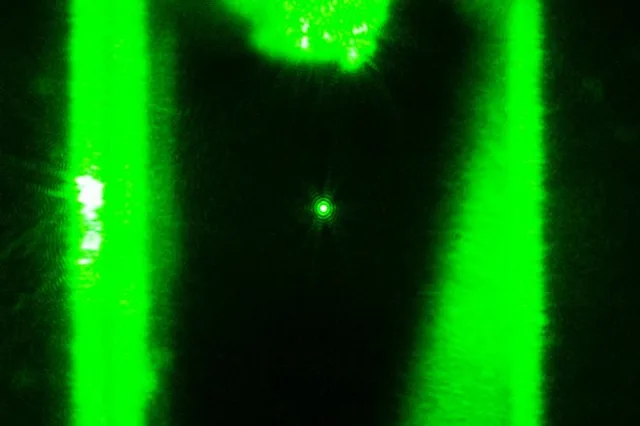
To hold an object, one imagines fingers or two metal branches. Optical clamps use something else: a focused laser beam. Under the right conditions, light can hold a tiny object and allow it to be handled without any hardware clamps around it.
The technique developed by Arthur Ashkin is based on the forces exerted by light. It operates on a microscopic scale and has found applications to biological systems. Cells and small beads can be studied in a suitable light trap.
A ball attached to a molecule is also used to measure minute forces. The researchers examined the step-by-step movement of molecular motors, such as kinesin. The trap provides a way to hold and track what our hands could not grasp.
This work earned Ashkin a share of the 2018 Nobel Prize in Physics. The image of an invisible clamp is faithful to the principle, provided to keep the right scale: it is not a projector that captures a ship, but an instrument capable of manipulating the tiny.
What we know
Microscopic optical trapping; no large human objects levitating within a radius.
To go to the source
- Nobel Prize — Optical Tweezers, popular information 2018 (new tab)↗
- Arthur Ashkin — Nobel Lecture (new tab)↗
References accessed October 11, 2026. Linked pages may be in another language.
Signaler une erreur ou apporter une précision