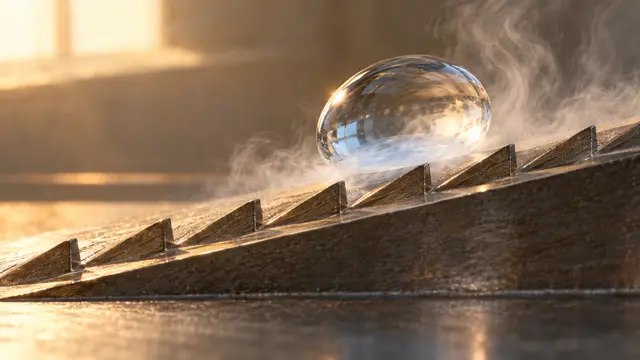
On a sufficiently hot surface, a drop of water can last longer than one would imagine. Its lower part vaporizes rapidly and creates a layer of gas that separates it from the solid. This cushion limits direct contact and allows the drop to slide. This behavior is called the Leidenfrost effect.
At the University of Bath, researchers have exploited surfaces whose relief forms small asymmetrical teeth. With proper geometry and temperature, the drops could be directed and even up a slope. The vapor produced by the liquid thus participates in its displacement. Any flat plate does not automatically offer this propulsion capability.
The team then presented a device regulating the temperature thanks to the direction of displacement of the drops. They cooled a region too hot or moved away from it in other conditions. The phenomenon therefore has an interest beyond a cooking show. The heat creates a gaseous layer, then contributes to the movement of the drop on its own steam.
What we know
The ascent requires a suitable surface and conditions.
To go to the source
References consulted on September 21, 2026. Linked pages may be in another language.
Signaler une erreur ou apporter une précision