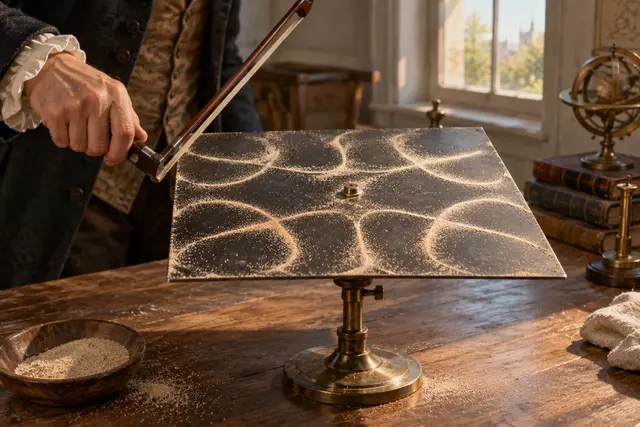
A metal plate, a little sand and a bow are enough to reveal a hidden geometry. When the edge of the plate is excited, the metal vibrates. The grains begin to jump and move. However, they do not remain randomly distributed: certain excitations reveal organized lines, the figures of Chladni.
The whole plate does not move with the same amplitude. The grains leave the regions that vibrate strongly and congregate near the nodal lines, where the movement is very weak. The sand therefore emphasizes especially the quiet areas. It reveals movement differences that are too fast to be tracked directly.
The figure depends in particular on the shape of the plate and how to excite it. Changing the conditions can make one drawing disappear in favor of another. It is not a secret alphabet contained in a note: each pattern reveals a mode of vibration of a specific object, made legible by the displacement of a few grains.
What we know
The patterns depend on the plate and its excitation.
To go to the source
- Exploratorium — Bells, plaques vibrantes (new tab)↗
- Swiss Science Center Technorama — Sound Patterns (new tab)↗
References consulted on September 21, 2026. Linked pages may be in another language.
Signaler une erreur ou apporter une précision