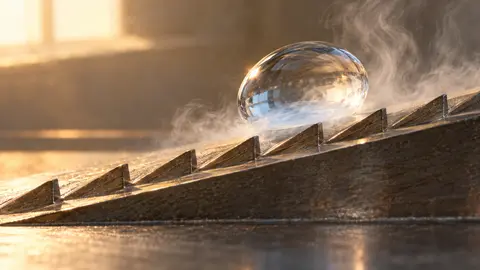
A drop of coffee often dries with a darker edge than its center. During evaporation, its contour can remain attached to the support. The liquid that moves towards this edge carries particles in suspension. When the water disappears, the particles are concentrated on the periphery.
In 2011, a team from the University of Pennsylvania studied this phenomenon with plastic particles. Researchers could transform spheres into elongated shapes to isolate the effect of their geometry. Ellipsoidal particles further altered the interface between air and water, attracted and accumulated in a network at the surface. The deposit then became more uniform.
The ring is therefore not a fatality imposed on any drop that dries. Interactions between particles, liquid and surface matter. The team was even able to modify the result by adding a surfactant. Behind an ordinary mark on a table appears a practical problem: how to regularly deposit an ink or a coating without concentrating its material on the edges?
What we know
The result also depends on the interfaces and support.
To go to the source
References consulted on September 21, 2026. Linked pages may be in another language.
Signaler une erreur ou apporter une précision