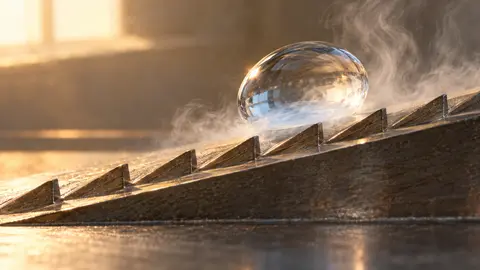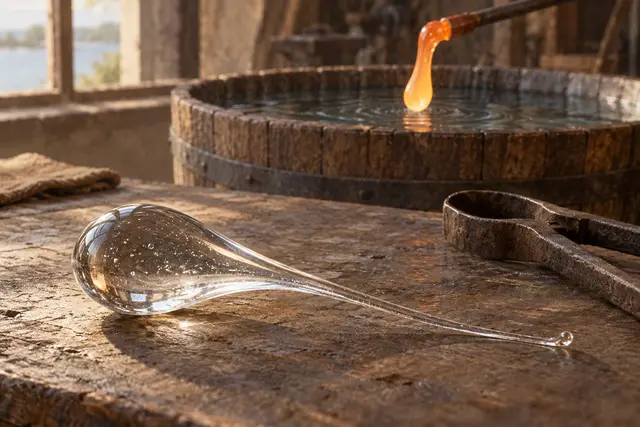
It looks like a transparent tadpole, with a thick head and tapered tail. Prince Rupert’s gout, however, has two almost contradictory behaviors. Its head supports significant efforts, while the rupture of its tail can cause the abrupt fragmentation of the whole. The resistance therefore varies according to the area requested.
This singularity comes from the rapid cooling of the molten glass in water. The outside and inside do not cool simultaneously. The surface is compressed, around a heart under tension. This envelope hinders the growth of cracks coming from the outside. The rupture of the tail gives access to the tense heart; the stored energy feeds a rapid spread of fractures.
Researchers are still studying the fragments to understand how constraints organize destruction. In 2022, a study compared fragmentation in different environments. The object is not a glass that has become invulnerable: it combines remarkable superficial protection with inner fragility. Its weak point allows to release what its surface held.
What we know
The resistance depends on the point and the stress conditions.
To go to the source
References consulted on September 21, 2026. Linked pages may be in another language.
Signaler une erreur ou apporter une précision