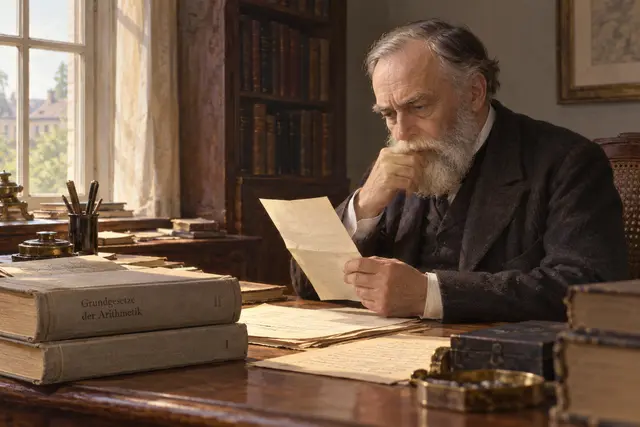
On June 16, 1902, Bertrand Russell wrote to the mathematician and logician Gottlob Frege. He begins by expressing his admiration for his work, and then exposes a problem to him. A contradiction appears in the logical foundations on which Frege builds his project: according to certain rules, we can affirm a thing and its opposite.
The second volume of the Basic Laws of Arithmetic is then in press. Frege must respond to an objection that does not concern an isolated miscalculation, but a possibility authorized by its system. He urgently adds an appendix to discuss the problem raised by Russell.
This contradiction with the imaginary story of a barber caught in an impossible rule is often explained. Here, the story is about the real historical event: a letter, a recipient and a book about to appear. The discovery would feed new research into the foundations of mathematics. A very short reasoning had reached a work of considerable magnitude.
What we know
Letter dated 16 June 1902 and addition of a certified appendix. The barber is an imaginary analogy, not a historical figure.
To go to the source
References consulted on 3 October 2026. Linked pages may be in another language.
Signaler une erreur ou apporter une précision