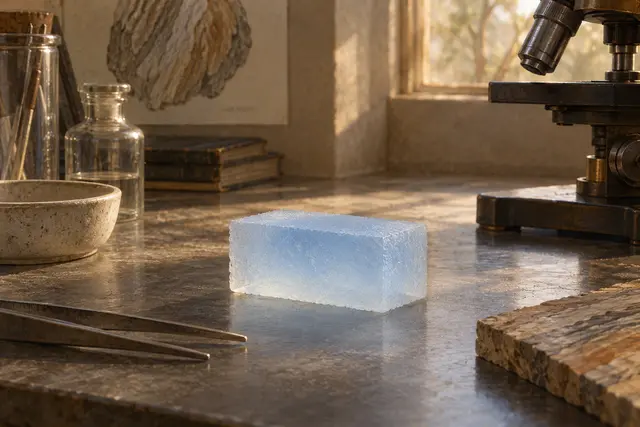
Its bluish appearance evokes a stopped smoke. Aerogel has a solid structure. In some materials developed at the Jet Propulsion Laboratory, this porous frame occupies a tiny fraction of the volume: up to 99.8% corresponds to empty space. Its lightness comes mainly from this architecture, not from the disappearance of matter.
This network has found particularly demanding use with the Stardust mission. It was necessary to collect cometary dust arriving at high speed, slowing them gradually and limiting alterations. The aerogel collector offered a very sparse environment in which the grains could leave traces of their entry before coming to rest.
Stardust encountered Comet Wild 2 in 2004 and returned its samples to Earth in 2006. Aerogel was also used for the isolation of certain space equipment. Not all aerogels have exactly the same composition or porosity. Their principle remains striking: an almost empty architecture can form a useful material, capable of protecting equipment or collecting dust.
What we know
The porosity varies according to the aerogel considered.
To go to the source
- NASA Jet Propulsion Laboratory — Ideas that Gel, 2002 (new tab)↗
- NASA Jet Propulsion Laboratory — Mission Stardust (new tab)↗
References consulted on September 21, 2026. Linked pages may be in another language.
Signaler une erreur ou apporter une précision