1. The customer above
We had almost pulled out the piano when the façade sneezed.
Dino dropped a curse. Madame Mado held the keyboard cover as if the keys were in danger of escaping. I leaned more on the handles of the cart: a house could catch cold, I was not going to let four hundred kilos go back on the stairs.
— "It is dust," said a voice above us. We could warn.
I looked up.
The giant of the façade rubbed his nose against his left shoulder. He was a man painted gray, more than three meters tall, with a curly beard and knees that looked like sacks of potatoes. He had always supported the advance of the balcony above the entrance. The work had almost completely removed this one. One last piece of carved wood lay across his shoulders.
The masons had finished dissociating the decor the day before. The building now stood on its new supports; the character was to be dropped off later. No one expected him to speak between the two operations.
— "Zélie," said Dino.
— I see.
— Do you hear that too?
— . Unfortunately.
The giant looked at us with a frown that dropped a small gray piece into Mado's hair.
— I said we could warn.
Mado raised his chin. At age seventy-eight, she wore orange pants and gave no automatic authority to people taller than herself.
— When you sneeze on your neighbors, you start by apologizing.
The giant thought.
— "Excuse me.
— "There. Zélie, the piano.
We continued to the truck. Dino walked backwards looking at the façade, which forced me to remind him that he had no eyes behind his heels. We installed the instrument, protected it and temporarily closed the tailgate.
The voice came back.
— Can you help me down?
The giant had advanced a metre out of its base, then had immediately removed it. Under his toes, there was about a meter between the stone and the sidewalk.
— “There’s a lot of emptiness,” he said.
Dino raised his arms.
— "You are literally the greatest man on the street.
— I see the problem very well.
2. The man who sounded hollow
The man in charge of the yard sat down in the chair that Mado brought him. He had first examined the new supports, then the giant, then his own hands. He assured us that he had not drunk anything.
— “Neither do I,” said Mado. And yet.
The giant was called Odon, after the name painted under his belt. He knew the street opposite, the habits of the postman and a faulty gutter that he described to us until Dino asked if we could talk about anything else.
The last room of the balcony no longer supported anything. The manager had it taken over by his equipment, and Odon stopped in the middle of a complaint. His foot remained raised; a finger always pointed to the number eleven.
Mado called him. Dino passed a hand in front of his face, and then we lowered the wood on his shoulders.
— “For years,” Odon concluded.
He was surprised to see us so close. For him, the conversation was not interrupted.
When I explained to him what had just happened, his fingers closed on the set with a crack.
— - We're keeping it.
— "It's cumbersome," said Dino.
— - Me too. Make a group price.
Mado called the new owner. He had planned a warehouse for the sculpture; she proposed her court, at least time to find better. The conversation lasted long enough for me to start counting down lost moving hours. Then Odon asked if the warehouse had a window and I stopped looking at my watch.
He could leave. remained to bring him down.
Dino gently hit his ankle. The hollow noise made the giant turn his head.
— You are in wood!
— “I am very solid.
Under the grey paint and plaster, a crack actually showed fibers. There was even a trap door on his back. Odon agreed to be examined after asking if we would like a stranger to look behind our backs with a lamp.
It weighed less than the piano. This discovery seemed to vex him more than the trapdoor.
The metre had enough to get him down, but Odon pales autantas much as a gray paint allowsas soon as he hears the word hanging. So we prepared a platform with a ramp. He pushed his toes forward, looked at the meter that separated him from the sidewalk and stepped back.
Mado put his chair in front of him.
— - We have time. I have cookies.
— I don't know if I'm eating.
— They are for me.
It took him almost an hour to get down. Mado had tied his red scarf at the end of a broom to give him something to look at. At first I thought it ridiculous; at the fourth small step, I watched the scarf with as much attention as he did.
When he finally touched the sidewalk, a passer-by applauded. Odon shrugged. Dino begged the man to go and rejoice a little further.
3. The sea between the houses
Odon walked with his knees wide apart. The sculptor had given him magnificent calves without foreseeing that they would one day need to cross each other. He protested against this, but still pushed his piece of house over his shoulders.
The wood rubbed it on the neck. We slipped a blanket under him, lifting him briefly; he continued to complain throughout the operation. I was busy protecting a window and I didn’t pay attention to it.
He liked the truck no more than the ramp.
— There is no window.
— "The journey is short," said Dino.
— The descent was also short.
We had to admit that our best argument had already been used.
Mado's house was near the port, less than two kilometers away. Dino would deliver the piano with our colleague who had come for the unloading; I would accompany Odon on foot. No other deliveries were scheduled that day. At first we had lunch under the awning of a café, the owner of which looked at the giant and then asked if it should count three or four cutlery.
Odon chooses water. The glass disappeared between his fingers, so a decanter was brought to him. He aims with a lot of concentration. A net came out under his knee.
— I don’t think I’m thirsty.
The boss put a mop next to his chair. Dino finally took his sandwich to safety.
The blanket was stuck in Odon’s beard. At his request, we removed it by resting the decor directly on his shoulders. I rolled it on the empty cart I had kept for our bags. Mado tied his red scarf to his belt, and then left to open his new home to the deliverymen.
We had not gone a hundred metres before a lady asked us where she could rent a similar suit. Odon looked down at her with so much sadness that she apologized to me, which offended him even more.
At the bakery, a saleswoman asked him for a cardboard box placed on a shelf too high. He handed it to her and stayed for a moment in front of the counter.
— Something else? he asked.
— No, thank you.
He looked at his hands as we left. I asked him if they were hurting him; he replied no, then stopped abruptly in the middle of the esplanade.
Between the roofs, he had just seen the sea.
— Is she moving all the time?
— "About.
— Who's holding it?
I thought he was joking. His face dissuaded me.
— No one.
He looked at the water without answering. We were still on the road, but I couldn’t offer him to leave until he wanted to.
4. The Blue Hat
A footbridge spanned the small street that went down to the port. For me, his full railings hid the void. Odon saw over and stopped several meters from the apron.
I showed him the detour. We could go down the streets, cross lower and go up. Or wait for Dino, if the truck now seemed less unpleasant.
He watched a bicycle cross the bridge. Three small shocks marked the connections of the ground; his fingers tightened to each.
— Do you want me to pass here?
— I want to get to Mado. The path, you can choose it.
He was looking for a place to sit. The bench groaned under him and he stood up, in awe of having damaged something. I offered him the cart, immobilized on the plate. He took a seat there with a care that would have made Dino laugh if he had been there.
A speck of his beard fell into his hand.
— - I'm breaking up.
— It is the painting. We can take it back.
— By putting me back up there?
I told him that you could paint someone on the ground. He made me repeat, then entrusted me with the brilliance so that I would keep it in my bag.
After a long time, he asked if he could cross seated. We called Dino. In time to get the approval of the municipal service for our charge and to prepare the passage, Mado joined us with a big blue hat. Her piano was in place; she had tried three chords and decided the rest would wait.
Two officers pulled the pedestrians away. Odon was installed on the cart, the decor protruding on each side. Mado was waiting for her at the other end; he had asked that she remain clearly visible.
We reached the middle when the wind took its scarf. Odon pulled his shoulder back, and the old wood hit an amount. One end broke. He wanted to hold her; the whole slipped behind his neck.
His body froze, leaning back, one hand in front of his face.
We stopped the cart. I kept my palm on his wrist before I understood that I was looking for a pulse in wood. Dino picked up the pieces. The biggest one crumbled when he wanted to pick it up.
Mado came close to us. We tried to place the fragment on the nape of the neck, but its raised arm prevented it from being properly placed.
— "We're bringing him back to the edge," said Dino. We'll get him right back there.
The wind turned Mado's hat. Holding him by his cord, he pulled him on his neck; she swore, untied him, and put him on Odon’s shoulder to free his hands.
— "...fall," finished the giant.
I pulled back so fast that I hit Dino.
Odon blinked his eyes. The hat rested against his sculpted collar; the broken wood still lay at our feet. I saw the cover under his neck, his voice that had continued as we lifted the stage.
— That’s what he wears, I said. Not necessarily the balcony.
Mado held the hat. Odon touched it with the tip of a finger.
— Is that enough?
— For the moment, yes. Don't take it off.
He looked down at the fragment that Dino was still holding.
— I’ve been carrying this horror all morning.
— "We did not know.
He thought, then slowly recovered.
— Neither do I.
Mado tied the hat so that it would not slip. We asked him to come back at the start or finish the crossing.
— I went to Mado.
— “She’s next to you.
— When she goes back there. I preferred it when I knew where to look.
She walked the last few meters talking to him. This time I looked at the giant and not the wagon: he was always afraid, and he let us go.
5. Behind the windows
In the courtyard of Mado, Odon sat under the awning. He wanted to get off the wagon alone, protesting against the people who were installing a vacuum everywhere. We stayed close to him without hurrying.
The piano could be seen through the open door. Mado settled down in front of the keyboard and played a fast piece whose name I did not know. Odon leaned towards the music. The hat threatened to slip; he held it without leaving his hands with his eyes.
— That’s what was behind the windows.
Mado resumed the beginning more slowly. He tapped on his thigh with two huge fingers, looking for the rhythm. Dino, who was preparing our equipment, stopped snapping the straps.
Later, Odon wanted to try the cover instead of the hat. Sitting on the floor, his back against the wall, he waited for it to be laid before removing the blue himself. He could always talk.
— rien And without anything? Just a second.
We reminded him of what had happened. He insisted, asked to be counted out loud, and then slipped the cover. His hand stopped on the way. I immediately put the hat back on.
He had heard nothing of our account.
The three of us remained in front of him as he touched the blue edge. He asked us not to remove anything without asking for it, even if it had to be cleaned or repaired. Mado promised him the first.
She offered him the hat. In exchange, he gave her a button dropped from the decor, which she wanted to use as a closet handle. I picked up the fragments at the foot of the wall. Odon asked me to leave them there; he would decide later.
6. The hat on the chair
We went down to the dock at the end of the afternoon. Odon wanted to walk. We stayed close to him, but he adjusted his pace, stopped whenever he wanted and asked to be told the small steps of the ground.
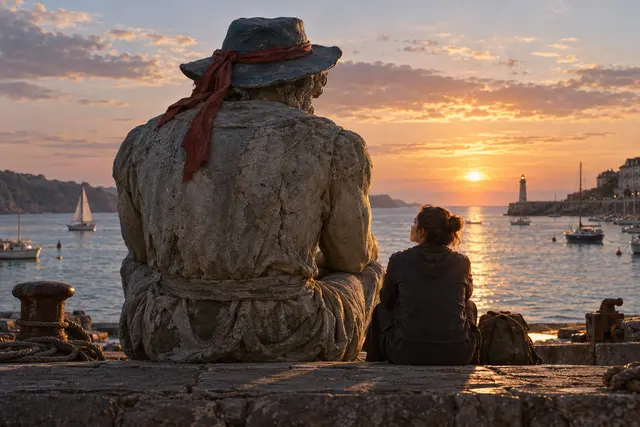
He wore the blue hat on one shoulder, attached to the red scarf to hold it. The set looked like a uniform designed by a person who had never met a sailor.
A child asked if he could stand on his back. Odon reflected, then replied that today he was already discovering how to carry his own legs. The child found this logical and left with his scooter.
At the end of the quay, the sea opened up entirely. The wind pushed small waves against the stones. A smell of salt, wet rope, and fish came up from the boats.
Odon sat away from the edge. He looked at a sailboat coming out, bending over, straightening up.
— Does he know he’s doing that? he asked.
— Those who are in it, yes.
— They look busy.
I had to leave before sunset. Mado stayed with him. Dino came to help me pick up the cart, and then stopped to observe our great passenger.
— How do you count it on the bill?
— We’ll talk about it tomorrow.
Mado had heard. She promised to pay for the extra time. Odon asked if he could help us wear something next time.
— “You can come to the depot,” I said. We'll see what you like.
— How high is the door?
I gave it to him. He made an unpleasant calculation with his knees, and then announced that he would come.
Three weeks later, he showed up with a hat made by a port-modist. The model had a soft part that rested on his shoulders. Mado had explained the problem to the milliner; she had only asked if the fitting costs would be reimbursed in the event of the customer’s petrification. The trials in the court went well.
Odon had returned the blue. He kept the red scarf.
He learned to push the carts, to announce his turns and never to grab a piano by its lid. He still wasn’t going up the stairs. For large pieces, he tended to propose himself before he was asked for anything. Dino sometimes had to remind him that an object could wait on the ground without losing confidence in humanity.
One Friday I found him standing against an empty cupboard. He supported her with both hands. We had left it there to replace a foot, with a perfectly sufficient hold.
— You can let her go.
— "I know.
— Would you like to take a break?
— And then you’ll need me?
I looked at the cabinet, then his big fingers clenched around the post.
— This afternoon, no. We only have ranking.
He lowered his head. I thought he was going to ask me how many records a giant could reasonably carry. Instead, he wanted to know if he could stay.
— "Of course. Dino bought biscuits.
— For him?
— "Almost certainly."
Odon dropped the closet. We spent the afternoon filing bills, which he found much more mysterious than the sea. He tried to find the customers in the lines: the lady at the piano, the gentleman who kept dry flowers in his buffet. He asked if I also noticed the color of the kitchens. I said no. He seemed to think that my work lacked rigor.
He returned the following week. The first Thursday when he arrived alone, I asked him what path he had taken.
— - The detour. There was a very nice smell of bread.
He had taken forty minutes more, bought a baguette for Mado and gave up eating it after a discreet trial. We found crumbs under his dorsal hatch for several days.
In November, Mado called me at the end of the evening.
— Can you come by before you go home? It is Odon who asks for it.
I arrived with the fear of finding broken wood in the yard. The giant was sitting under the awning, his back against the wall. Mado had set up his chair next to it. On his knees lay the blue hat he had given him back.
Odon looked at me, then at Mado.
— I want you to take it off.
I stopped in the middle of the court.
— Your hat?
— “Until tomorrow morning.
Mado says nothing. She must have received the same request before I arrived.
I put down my bag. The piano could be seen behind the glass door. A cloth covered the keyboard; the house was ready for the night.
— Do you want to stay still all this time?
— I am motionless every night. Only, I watch them go by.
He rubbed his thumb on the soft edge of the hat.
— On the façade, I listened. A car, a shutter. People came in, then the windows went out. I thought it was the same for them behind the curtains.
His voice had lost its usual protest. He did not ask that it be consoled from the gutter, the base or the birds. He was simply pointing to Mado’s windows, and behind them was something he had been deprived of without knowing it existed.
— “She explained sleep to me,” he said.
I sat on the edge of the wall. I thought Odon was asking us to take him back to the stone. I looked at Mado. She had already placed her alarm clock on the table, behind the glass door.
— You know you may not dream.
— I’m not dreaming now either. I would like to try not to wait.
Mado put his hand on his wrist.
— “At eight o’clock, I give you the hat. It is understood.
— Even if it rains?
— I put on boots.
— Even if you don’t need anything?
She looked up at him.
— Especially if I don’t need anything.
He asked me to stay while she did. He wanted us to be two to know. I acquiesce.
Odon arranged his legs, checked that his back was against the wall, and then placed his hands on his thighs. He held Mado for the last time.
— The red remains.
She showed him the scarf tied to her belt. He smiles.
— - So to...
She lifted the hat. The smile remained, a little wrong. I waited for a movement that we both knew was impossible, then Mado put the hat on his chair.
She offered me coffee. I stayed for a while, enough to hear the clock in the living room and understand how quiet the court was. Before leaving, I checked in spite of myself that the hat was still there. Mado noticed that.
— “Eight hours,” she repeated.
The next day I came back with breakfast. At eight o'clock, she was already in the yard. She had put on her boots, although it wasn’t raining.
Odon took his breath of wood as soon as the fabric touched his shoulders.
— Tomorrow, he finished.
He looked at us. I was holding the bag from the bakery. Mado had changed his sweater. The clear sky occupied all the space between the roofs.
— Is it tomorrow?
— "Yes," she said.
He stayed for a long time without speaking. Then he asked if the piano could start before work.
— “Today there is no work,” I replied. It's Saturday.
Odon looked at the empty yard, his hands free, his hat on his shoulders.
— I have to learn on Saturdays.
End