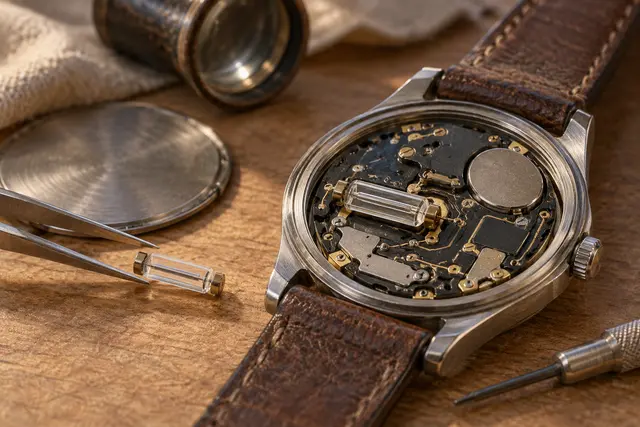
A quartz watch doesn’t just display a mineral name. It contains a crystal whose vibrations serve as a reference. The material is piezoelectric: a mechanical stress can produce an electrical voltage, while an applied voltage can deform it. This relationship makes it possible to closely associate a physical movement with an electronic circuit.
The circuit maintains the oscillations of the crystal and exploits its regularity. In many watches, the usual frequency is 32,768 vibrations per second. The electronics divide this rhythm to obtain pulses corresponding to the seconds. Even the progression of needles can thus depend on this rapid mineral movement, hidden in the case.
Quartz does not provide free energy for operation. It serves as a resonator, while a power supply compensates for losses. Its frequency can also vary with the conditions, especially the temperature. The object is remarkable without being perfect: to measure a time that we do not see, it counts the repetitions of a deformation much too fast for our eyes.
What we know
The crystal regulates the rhythm; a feeding maintains the movement.
To go to the source
- NIST — Everyday Time and Atomic Time, partie 3 (new tab)↗
- NIST — Timekeeping and clocks FAQs (new tab)↗
- NIST — Time and Frequency from A to Z, quartz (new tab)↗
References consulted on September 21, 2026. Linked pages may be in another language.
Signaler une erreur ou apporter une précision