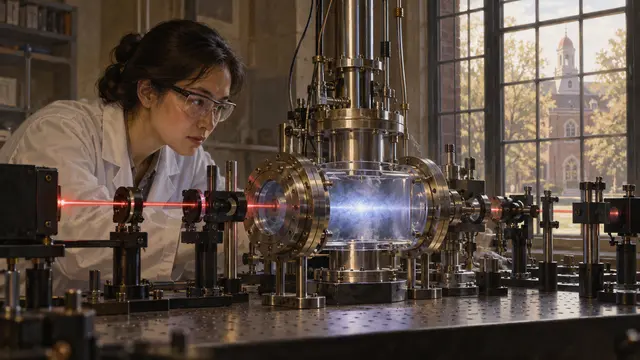
Light in a vacuum moves at a dizzying speed. But an impulse that passes through matter raises another question. At Harvard, Lene Hau’s team obtained a propagation of seventeen meters per second in a gas of ultracold atoms, a result published in 1999.
The medium and a control laser change the way the pulse propagates. Experience is not about changing the constant that describes the speed of light in a vacuum. It exploits a very special interaction between light and atoms.
The team also studied the storage of optical information in atoms and its restitution in the form of a pulse. Saying that the light is “stopped” then becomes a shortcut to explain. The most surprising result is precisely this controlled transformation: a message carried by light can wait in the matter before returning to its path.
What we know
Pulse propagation speed in a medium, no change in velocity in vacuum; optical storage distinguished from still photons.
To go to the source
References consulted on September 21, 2026. Linked pages may be in another language.
Signaler une erreur ou apporter une précision