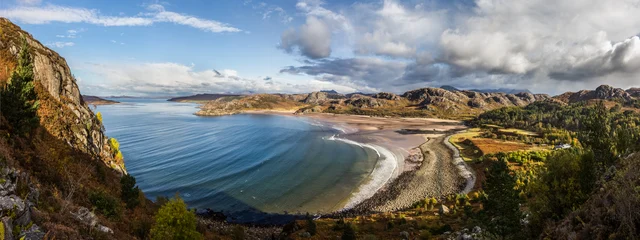
From the Scottish coast, Gruinard looks like an ordinary islet. Yet this island has been closed to the public for decades. The danger did not come from an animal hidden in the cliffs, nor from a legend: it was in the ground.
In 1942 and 1943, during the Second World War, the British authorities conducted tests of biological weapons with anthrax, the coal disease. Sheep used in experiments died. The place had been chosen for military tests; their consequence would last far beyond the war.
The spores of the bacteria could persist for decades. A study published in Nature in 1981 recalls that samples taken after the war had still revealed viable spores. The landscape might have seemed peaceful: this appearance was not enough to establish that the terrain was safe.
In May 1986, an official response to Parliament confirmed that the island had remained closed since the tests and announced a decontamination operation. The work is conducted that summer and then subjected to an independent evaluation. In 1987, the authorities explained that they also wanted to check the return to agricultural use before returning the site to its owners.
Gruinard was finally returned to them in May 1990. Between the first trials of 1942 and this restitution, forty-eight years have passed. The frightening story of this island does not need a curse: a military experience had left an invisible danger lasting enough to deprive several generations of access to a piece of their coastline.
What we know
1942–1943 tests, decontamination carried out in 1986, restitution in May 1990. Forty-eight years is the gap between 1942 and 1990, not the duration of a continuous contamination. No current health risks or human deaths on the island claimed. Landscape photography in 2012, not essays.
To go to the source
- Parlement britannique — Gruinard Island, 13 mai 1986 (new tab)↗
- Nature — Bacillus anthracis on Gruinard Island, 1981 (new tab)↗
- Parlement britannique — contrôle de la décontamination, 9 avril 1987 (new tab)↗
- Parlement britannique — décontamination de 1986 et restitution de mai 1990, réponse du 16 décembre 1994 (new tab)↗
- Photographie — Synchronium, Gruinard Bay Panorama - October 15th 2012 (new tab)↗
- Licence de la photographie et des versions WebP — CC BY-SA 3.0 (new tab)↗
References accessed October 11, 2026. Linked pages may be in another language.
Signaler une erreur ou apporter une précision