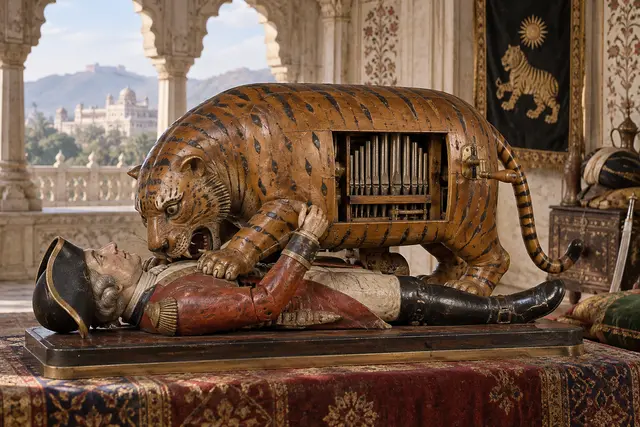
A tiger leans over a man lying on his back. The scene seems frozen in the wood, but the object has a handle and an opening on the side. Behind it is an organ. By operating the mechanism, one could produce sounds and raise and lower the arm of the human figure.
The object was made for Tipu Sultan, ruler of Mysore in southern India between 1782 and 1799. The tiger was an important reason for its power. The man represented is European: the automaton thus takes on another meaning when placed in the confrontations between the kingdom and the British East India Company.
In 1799, Tipu died during the assault on his capital. The tiger is one of the objects carried after the British victory and is now in the collections of the V&A. Its singularity therefore goes beyond the mechanical spectacle: an object designed in an Indian court to stage an opponent has become a piece exhibited among the winners.
What we know
Attested mechanical object and context; no real attack scene nor dialogue attributed to the sovereign.
To go to the source
References consulted on 3 October 2026. Linked pages may be in another language.
Signaler une erreur ou apporter une précision