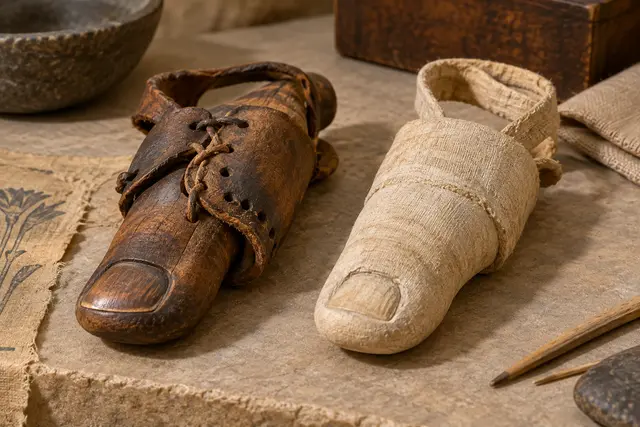
Two Egyptian objects look like big toes: one combines wood and leather, the other is cardboard, a mixture of canvas, glue and plaster. Was it only to restore a complete appearance to a deceased person, or could they have served during his lifetime? Their presence in a collection is not enough to decide.
Researcher Jacky Finch had replicas made for an experiment presented in 2011 by the University of Manchester. Two volunteers deprived of their big right toe tested them in a walking analysis laboratory, with reproductions of Egyptian sandals. One of the participants worked particularly well with both models.
The results support the possibility of functional use; they do not resurrect the ancient owner to ask him how he was wearing them. The interest of this investigation lies precisely in this border. To understand an object that has been motionless for centuries, researchers had to give it back a movement, with feet of today.
What we know
Experiment on two volunteers and replicas; ancient function sustained, not direct observation of ancient usage.
To go to the source
References consulted on 3 October 2026. Linked pages may be in another language.
Signaler une erreur ou apporter une précision