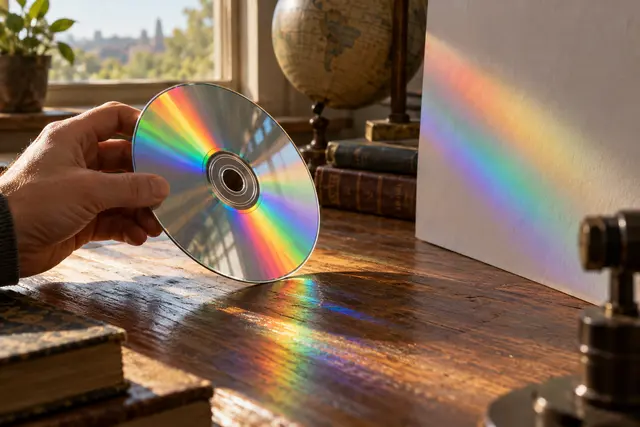
The colors of a compact disc change when tilted. A red area can turn green and then disappear. If the disc was simply painted, this displacement would be difficult to explain. White light contains different wavelengths; the small regular reliefs of its reflective surface redistribute them according to the direction of observation.
The Exploratorium proposes to observe this phenomenon by projecting the reflected light on a screen. The waves coming from neighboring reliefs overlap. Depending on their lag, they strengthen or diminish. This organization produces interference colors. The disc behaves like a diffraction network: the directions in which certain wavelengths dominate are not all identical.
The pattern changes when the source, disk, or observer moves. No dye travels to the surface at this time. The same tiny details that escape direct vision are enough to transform ordinary reflection into a colorful spectacle. The disc shows its reliefs indirectly, through the way they make the waves cooperate.
What we know
The colors result from interference, without rainbow pigments.
To go to the source
References consulted on September 21, 2026. Linked pages may be in another language.
Signaler une erreur ou apporter une précision