1. After the last reminder
The spectators were waiting for their coats when Damien Leroux was found. It was twenty-two thirty-six. In the big room, someone continued to fold the chairs; near the exit, a woman complained that her scarf was no longer found. The volunteer who had just opened the small office behind the cloakroom did not scream. She stepped back in line and asked for a phone with a voice that silenced three conversations.
Damien was president of the association that organized the concert. He had spent the evening shaking hands, carrying crates and promising that the next edition would be even better. He was now lying near his desk, with a head injury. The rescue confirmed his death. The cloakroom was isolated; the remaining coats remained on their porters, with the indecent air of objects that normally continue their function.
Captain Roxane Derval arrived with Lieutenant Rémi Solal. She asked that the identity of the people still present be noted and that what they had seen be immediately distinguished from what they had learned in the queue. The first versions were already numerous. Damien had a fight with a musician. A young volunteer had left his post. An envelope was missing. Someone was talking about a robbery before the drawers were checked.
A woman dressed in a fluorescent vest came forward. Carole Vautrin, treasurer. She could provide the contact details of each, the schedules, the lists. She held against her a notebook filled with checked boxes, some of which already concerned the storage of the next day. Roxane asked him to keep it: a planned evening and a really lived evening did not always tell the same thing.
She added that her coat had been stolen. A large dark green coat, almost blue under some lights. She had reported it at about twenty-two o'clock, before Damien was found. This disappearance may have proved that a person foreign to the team had entered behind the counter.
— “Do you have your ticket?” asked Roxane.
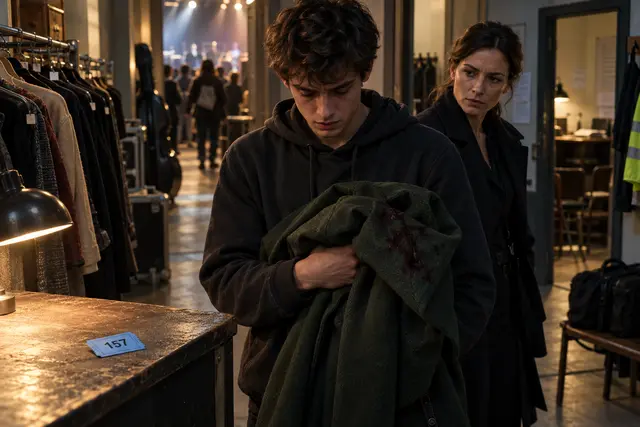
Carole searched the waistcoat pocket and produced a small blue rectangle. Number one hundred fifty-seven. The captain placed it in a pouch after photographing it.
— We'll check everything, she said. For now, an absent coat does not tell us why a man died.
Carole nodded eagerly. She pointed to the back of the corridor: the young volunteer in charge of the closure was called Théo. He was twenty-two years old and a big black bag. Roxane looked at the boy sitting against the wall. He stared at the ground with that stillness that can mean both fear and the effort to appear innocent.
2. Four tickets
Théo was talking while looking at his shoes. He had replaced Fabienne in the dressing room so that she would listen to the last piece played by her daughter, then left her post at about twenty-two hours ten. He had gone to smoke in the yard with a young woman.
— Eight minutes, he said. Maybe ten. I haven’t watched it all the time.
— What about when you came back?
— I waited for the tickets to be returned.
Roxane asked him why he had not reported his absence. He rubbed the edge of his pocket with his thumb. She waited, then he took out four twenty-euro bills and put them on the bench.
— It was in the envelope. For small expenses. I had to put them back.
Rémi noted his statement. Behind them, we opened another room to allow the last spectators to wait for calm. Théo followed the sound of the chairs, as if he were looking among these people for someone who could interrupt the interview.
His bag had remained in a recess of the service corridor, along with two others and cartons of programs. The corridor gave access to Damien's office without going through the cloakroom counter. No one was watching the cases there.
Under Théo's sweatshirt, the investigators discovered the green coat rolled on itself. The boy got up so suddenly that Rémi asked him to back off.
— It was not me who put it!
He repeated the sentence, then silently saw the dark traces on the fabric.
— What time did she say it was stolen?
— "Why?" asked Roxane.
— I don't know. To understand.
He had grabbed the cord of his sweatshirt and pulled it up the neck against his throat. Roxane asked to be found the young woman of the court and the people who had circulated near the bags. She left the notes on the bench until they were photographed.
In the office, Damien’s phone and wallet remained in place. The disorder was limited to a displaced chair, some papers and a box of badges. A heavy metal door stop was near the body.
Roxane stopped in the frame. The door came back slowly to her under a stream of air. She held it with her fingertips before coming out.
3. The number that didn’t serve
Fabienne recognized the blue ticket before she was shown the coat.
— A hundred and fifty-seven? Nope. I stopped at one hundred and thirty-four.
She returned several clothes after the concert. She remembered faces less well than small difficulties: a lost scarf, two coats on the same hanger, a man convinced that his wife had the receipt. Roxane asked her to take the notebook with her.
Tickets went in pairs, one half to the customer and the other half to the hanger. In the unused pages, the one hundred and fifty-six directly preceded the one hundred and fifty-eight. Carole's ticket came from that hole.
— "I was able to skip a page," said Fabienne, suddenly less certain.
— Do you think so?
— - Yeah. When they stick. But Carole...
She stopped and looked at the back of the dressing room.
The volunteers’ clothes had their own clothes. On an empty hanger hung a carte blanche: CAROLE. Fabienne remembered slipping the scarf into a sleeve so that it would not fall. They had talked about heating, Carole saying you could save a few degrees instead of opening the doors.
Roxane returned to the treasurer. She had already found a list of numbers and wanted to know who to hand it over to.
— You told me you received this ticket when you arrived.
— - Yeah.
— vue Fabienne saw you using the volunteer porter.
Carole looked down at the blue rectangle.
— I had to take it afterwards. When I looked for my coat.
— "For what?"
— Keep the number. I was upset, Captain. You can imagine...
Roxane pulled his chair closer. Since her arrival, Carole had always had a document to tender, a person to designate, a detail to check. Now she was reading a perfectly flat page.
— The number of which location?
Carole did not answer. She looked towards the recess where Théo was no longer.
4. Two hundred euros in a pocket
Étienne, the double bass player, did not deny the dispute for long. Damien owed him one thousand eight hundred euros for a previous performance and had only brought two hundred. He had counted them in his hand, in front of a pile of cups, as if he were advancing enough to take a taxi.
— I told him I was going to talk about it in the microphone. That’s what people have heard.
— "Did you play?" asked Rémi.
— The others were waiting for me.
He took out the tickets. They wrapped a receipt folded into four.
— I checked the word down. Even then, we had to check.
Roxane photographed the paper. A videographer had recorded the interview of the group in a box after its passage; with the other markers of the evening, these images placed Étienne far from the office during the decisive period. He asked if he could get his instrument back, and then immediately apologized for asking the question.
— “There is no choice between being upset and needing to work,” said Rémi.
The musician put his money in his pocket.
Noa, a volunteer waiter, had brought water to Damien at twenty-two hours five. He had just sent his wife a message announcing his delay. Damien had asked him to look for Carole: he was waiting for the documents.
— I met her in the corridor. She had her coat on her arm.
— Are you sure about the clothing?
— The lining, above all. Small diamonds. She had folded it upside down.
This description was noted before he was shown anything from the mantle found.
In Damien’s phone, a morning message asked Carole for the complete readings, not just her chart. Three dates and the name of a company followed. The company belonged to his brother.
The checks took several days. Sixteen thousand euros had been paid for equipment and transport for which no one could find the benefits. Carole eventually recognized the transfers. Her brother had to pay back, she said. He was expecting a payment himself.
— When? asked Roxane.
Carole quoted a month ago, corrected herself, and then wanted to explain the difficulties of the company. She had presented Damien with the same moving calendar until he demanded the readings.
She then acknowledged that she had entered the office, but said she had left him while he was alive. His coat would have been used to fetch a pouch in his car. Roxane asked him to describe this cover. Carole changed the color before the end of her answer.
5. Nineteen, twenty, twenty-three
The delivery camera showed neither the desk nor the bags. Carole was seen coming out at ten-seventeen, dressed in her coat, and then disappearing behind an angle without reaching her car. A door located out of field allowed to return near the recess.
At 22:23, she was crossing the visible corridor again, wearing a fluorescent vest.
Rémi stopped the image.
— Between the two, she could come back through the little door.
— - Yeah. But we don't see her doing it.
Fabienne brought them an additional reference: her message at twenty-two, sent to pick up her daughter. While she was writing it, Carole had approached, already in a vest, ticket in hand, to report the theft.
Roxane wrote the time on the sheet. The office would not be open until 16 minutes later.
The blood found on the mantle was that of Damien. The young woman of the court confirmed part of the absence of Théo; two spectators had seen them together. The bag was still accessible. When Roxane asked the boy if Carole knew where he was putting his things, he replied that she had shown him the bench herself.
— “She had seen me near the envelope,” he added.
— Taking the money?
— "My hand. I don’t know what she understood.
He said nothing more about his last exchange. Roxane noted his hesitation next to the information to be resumed.
The second half of the ticket was found in the basket of the counter. No hanger, no garment, no testimony corresponded to the deposit one hundred and fifty-seven. Fabienne continued to flip through the pages, as if she could still fix her evening by finding a numbering error.
Roxane gently took the notebook from his hands to store it with the collected pieces.
— You showed us what to check.
— What about Damien? He often asked that the door be closed. For air currents.
The captain looked at the office. She remembered the movement of the panel against her fingers and the weight of metal dropped to the ground.
She asked that we arrange a new interview with Carole.
6. The coat on the shoulders
Carole asked if she could take off her vest. She still wore it on the photographs taken during the night, and then handed it over for this new interview, over a clean sweater. Roxane pointed to the back of his chair.
The treasurer began by maintaining that she had left Damien alive. When Roxane presented her with the camera record, she asked to see what happened next. There was none: neither the desk nor the bags were in the field. Carole looked for a long time at the fixed image of her own figure, closed coat, hand on the handle of the exit.
— “There,” she said, “I didn’t know yet.
— What is it?
— That there was some on it.
Her lawyer leaned towards her. They spoke in a low voice. Roxane left the photograph of the coat on the table. On their recovery, Carole no longer tried to explain the stains with a rescue gesture.
Damien had asked her to hand over the accounting access credentials and resign. The other managers would receive the statements the following day. She had offered to sell her car, take out a loan, and then make her brother repay the money. He had replied that she was offering him the same money three times over: money she did not have.
She put a hand in front of her face, as if to prevent her from finding exactly this conversation.
— I had my coat. I was leaving. He told me that leaving was no longer enough.
She recognized that she had grasped the weight of the door and struck Damien. He had fallen against the office. She waited for him to get up. She couldn’t tell how long, and then specified that she had looked at her shoes, rather than her face. Roxane made her describe what she had heard, touched, and then did. The claim that she didn’t want to kill him didn’t settle any of these questions.
At the delivery exit, under the white light, she had seen the blood on her sleeve. She came back through the second door. In the recess, the bag of Théo was open; his sweatshirt exceeded. Carole had pushed the coat under and folded the garment over it. She doesn’t talk about her choice first. Roxane had to ask him why this bag, among the three that were on the bench.
— He was in the envelope. I had seen him.
— Did you think we’d find that money too?
Carole fixed the edge of the table.
— - Yeah.
She had asked for a vest to hide any marks on her sweater and returned to her place among the volunteers. She knew now that the office would be opened. Someone else had to have had his coat before.
— "And the hundred and fifty-seven?" asked Roxane.
The treasurer looked up at the photographs of the two fragments.
— That number was stupid.
— It did not correspond to any deposit.
— I know now.
Roxane came back the minute she had taken the notebook. Carole rubbed her thumb with the fingernail. His first response was almost inaudible.
— It wasn’t me who took it away.
— Who, then?
— - Théo.
Rémi stopped writing for a moment. Roxane asked him to resume. She kept her eyes on Carole, who had just started rubbing her thumb again.
Carole had already placed a piece of evidence in the boy's bag. Attributing the fake ticket to him now could prolong the same gesture. She had to describe a scene that the other elements would put to the test.
She talked about the counter, a program between them and a sum. Then she gave the code of her phone and indicated a message that she had not erased.
7. The price of paper
At 22:19, Théo had written: Eight hundred tomorrow. And forget the four notes.
The recipient was Carole. The conversation kept on his phone was examined; Théo was also asked to return his as part of the procedure. The message did not say what he had seen. He said there had been a transaction a minute before the missing coat was reported.
Roxane called him for another interview. This time, she did not ask him to recognize the bag or to repeat where he had smoked. He put the photograph of the ticket in front of him.
— Why eight hundred?
The boy looked at the door.
— What did she tell you?
— I ask your version.
He started by talking about his debt. Rent, car repair, deadlines. Roxane stopped him before he made an inventory.
— The ticket, Théo.
He had taken it well in the notebook. On his return from the court, at about 22:18, he had seen Carole near his bag. She had just dropped the sweater. He asked her what she was doing. She replied that she was looking for the adhesive roll. He knew where the scroll was: he had put it himself on the counter.
Carol was away. Théo had opened the bag, recognized the green coat and closed. He didn’t unfold the fabric. He claimed to have seen no trace. Roxane noted this limit without accepting it as a certainty: the garment had been rolled, but she could not look at Carole under the outer lamp.
— Why not take him out?
— She had seen me take the four tickets. I thought she scared me.
— By hiding his coat in your things?
— I said after I stole it too.
He had followed Carole to the counter. She asked him to be quiet. He understood, in her voice, that what she had just done could cost her more than her own flight. For once, he wasn’t the one to beg. He asked for eight hundred euros.
Carole replied that she didn’t have that amount on her. Then he sent the message right there in front of her, so she couldn't claim to have overheard. He thought he had a proof; he had just made one against himself.
— What about the paper?
— She wanted to wear her coat. She said that otherwise...
He interrupted.
— "Otherwise what?"
— I don't know. That had to be explained. She asked me for a ticket.
Théo had flipped through the notebook. He remembered the corner that resisted, the two rectangles still attached. He gave one to Carole and threw the other into the basket. She didn’t choose the number. He didn't look for a real deposit. Neither of them, in that minute, had thought of Fabienne or the little white cards.
— Did you sell him a fake alibi?
— A cloakroom ticket.
The words came out too fast. He almost looked at them, as if they had landed between him and the captain and he could still take them back.
He thought he was involved in a robbery story, he said. He wanted to get rid of his own risk and get money. Then the volunteer opened the office. From that moment on, he had no longer dared to touch his bag: he was afraid that someone would see him take off his coat. When he was questioned, he confessed to the four tickets. This little real fault had seemed to him the last shelter where to hide the other.
Roxane asked him to resume the interval between the message and the discovery of the body. We should not confuse what he had learned at twenty-two thirty-six with what he knew seventeen minutes earlier. But it was no longer enough to say that he had put nothing in his bag for having said everything.
The interview lasted until the early evening. Carole had struck Damien, hid the coat, and picked the boy to carry the suspicion. The message did not erase any of these acts. He only showed that in preparing her lie, she had met someone willing to sell her a piece of paper.
Over the next few days, the investigators confronted the two stories and the schedules. The boy had not confessed what he knew before he was presented with his message. We should check her words as carefully as Carole's. He was not the author of the mortal blow. He was also no longer the witness who had just kept quiet for fear of four bills.
A few weeks later, Roxane returned to the Orms room for clarification on access. The activities had resumed with a reduced program. The association repaid what it could; two workshops had closed. On one poster, Damien’s name was printed below the concert name. No one had decided to take it off.
Fabienne was packing tablecloths. She asked if the ticket had actually found Carole.
— “He allowed to check his history,” Roxane replied.
— I should have noticed it right away. The one hundred and fifty-seven... We had not even reached the hundred and forty.
She pulled the drawer out of the counter. There was a new book. On his cover, Fabienne had written the date and the first number. She had also moved the volunteer carrier, which blocked the passage to the office a little. The place seemed safer to him; Roxane did not take this little relief from him.
— “Have you seen Théo again?” she asked.
Fabienne shook her head. She still believed that she had only been reproached for the four bills. Roxane did not report the interview. The persons concerned would receive the information by the means provided; the cloakroom did not have to become again a queue where everyone completed the story of the previous one.
She put on her coat. Fabienne held the door to him and asked him, with sudden fatigue, if Damien could have lived if someone had come in earlier.
Roxane did not know. It was not going to turn a possibility into certainty to properly complete this investigation.
In her car, she picked up the timeline again. 22:05: Damien asks for his statements. 22:17: Carole at the exit. 22:19: the message. 22:20: the fake theft. 22:36: the office opens.
She stayed for a moment on the last interval. Seventeen minutes during which the coats had been returned. A woman was looking for her scarf. Spectators thanked the volunteers. Behind the counter, Damien’s phone was waiting on his table.
At first, Roxane believed that the blue ticket was a clumsiness committed by a panicked woman.
It was a sale.
And while we were discussing the price, no one had opened the door.
End