1. The Man Who Changed His Window
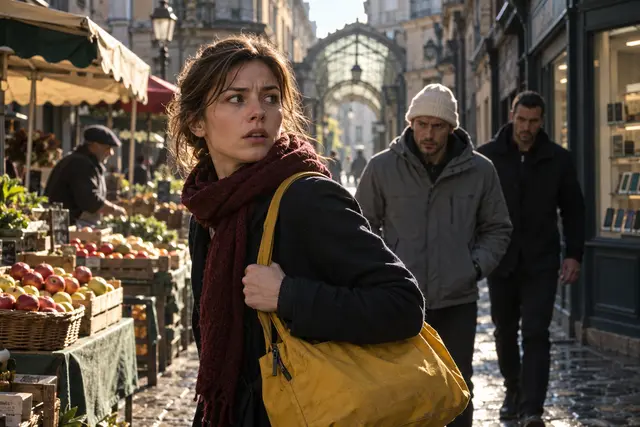
The first time, Ysée noticed it in front of a phone store. The second, he was looking at children’s shoes. At the third window, a funeral home, she stopped believing that they were doing the same shopping. The man wore a white cap despite the sweetness of the morning and kept his hands in the pockets of his gray jacket.
Ysée slows down. It also slows down, with a clumsiness that made the coincidence even less credible. In his yellow bag, a metal box banged against his hip. She changed the shoulder bag and continued to the Place du Marché, where the merchants finished installing their stalls. It was nine o'clock. She had taken the package twenty-one minutes earlier.
Arno had given it to him in the small courtyard of their agency, between a box of catalogues and two bags of costumes. A rectangular cookie box, decorated with yellow flowers, closed by a transparent adhesive tape. He wrapped it in brown paper and hand-written it on the tour sheet. Urgent delivery, passage Neuf, door four, to Madame Morel. The recipient had to give a four-digit code: eight, zero, four, one.
He had added a second sheet below, for support. Ysée had signed at the place indicated, as for the other parcels, and claimed his copy. Arno had tapped the extinguished printer; he would give it to him on his return. She had photographed the tour instructions with her phone, especially so as not to confuse the numbers in the code.
Ysée had been working for him for seven months. They had known each other since school, lost touch and then found each other when she looked for a job. He owned three delivery bikes, a van and enough optimism to sometimes replace the parts that were missing. She mainly did the center runs on foot. The work was irregular, but Arno paid on time and let him choose his mornings. It had counted.
— “Don’t shake her too much,” he said.
— Do you drink nitroglycerin?
— Things that are better than our wages.
She thought it was a joke on luxury biscuits. He added that he would be in the neighborhood later. As she left the yard, she saw her white van go in the opposite direction.
Now the man in the cap was approaching. He gave her a sign, as if they had already spoken.
— Are you from Passage Nine?
She did not answer. He pointed to the bag.
— We were waiting for you. There was a door error.
Ysée stood next to a merchant who was unpacking apples. She asked for the code. The man gave him two figures, stopped and smiled.
— “You won’t complicate the morning for a box.
This time she looked at his hands. He just took them out of his pockets.
2. The door four
Passage Neuf connected Rue des Cordes to the west to Place du Marché to the east. Ysée had entered on the side of the Cordes, had walked along three storefronts and found door four under a dirty glass roof. A sheet taped to the glass announced an old bookbinding workshop. Behind, the room was empty. Clear markings remained on the walls, where shelves had been removed.
She rang, waited, and then asked the woman who was cleaning the shop next door if Mrs. Morel was working there. The woman shook her head.
— They left three weeks ago. I don't know what's coming.
Yeshua called Arno. He was surprised and then asked him to wait. A number error, probably. She had to come out of the passage and wait for him in the square. During this call, the man with the white cap stopped under the canopy, several meters away. She noticed it without giving it any importance.
In the square, he was now close enough to touch his bag. Ysée retreated against the stall.
— “Give me the name of the sender,” she said.
— - Arno.
That stopped him. The apple dealer looked up, then resumed unpacking. The man took the opportunity to reach out to the strap. Ysée restrained her.
— I call him.
— “You have already done it.
She pulled out her phone. The man grabbed his wrist, without spectacular violence, with the unpleasant precision of someone who had decided that the conversation was over. Ysée suddenly pulled his arm. The phone hit the edge of the stall and fell on the cobblestones. The merchant shouted. The man let go, surprised by the noise more than by its resistance.
Ysée picked up the device. The screen had split and remained black. She slipped the phone into her pocket and left between two rows of stalls, without waiting for another address error to be explained to her. Behind her, the merchant questioned the unknown. He didn’t hold it for long, but enough to give it a few meters.
She knew the exits from the square. To the north, Bellay Street went up to the museum garden; to the south, a narrow street led to the old textile workshops. She chose the south. The shops opened early and she had worked two years in a costume workshop. She would find someone there.
A second man appeared at the corner, very tall, dressed in a black jacket. He looked at the yellow bag before looking at his face. Ysée immediately turned into a side aisle, with the cold certainty that the exits had been distributed.
3. Behind the Curtain
At the bottom of the driveway, a metallic curtain rose with a slow rumble. Ysée slipped under and found himself facing Marcel, the fabric merchant who once delivered his costume workshop. He held his coffee against his chest.
— "Close. Please.
He looked behind her and put down the cup. The black figure had just entered the courtyard. Marcel pressed on the command; the curtain stopped, then went back down. Ysée stepped back until she felt a roll of cloth on her back.
A foot appeared under the metal and withdrew. Someone hit.
— That is a mistake!
Marcel did not answer. He led her to the landline. Before she dialed a number, her own device vibrated: the screen was black, but she manages to stall by groping.
— “Where are you?” asked Arno.
She spoke too quickly of the cap, of the wrist seized, of the other man. He swore.
— I'm coming. Don't give anything to Milan.
— - Who?
— The guy in the hat. He is an intermediary. I'll fix it.
She looked at Marcel, who was waiting next to the counter. Arno knew the man’s name. He didn’t ask what he wanted or even if she still had the package.
— "Rue des Tinturiers," she said.
— What number?
She hung up without answering, then called the police with the landline. Giving the address required several attempts: she had known this store for years, but had never been interested in the number above the door.
Marcel pulled the lock overlooking the courtyard. He returned with a stool that Ysée did not have time to take. A window broke in the reserve.
The merchant remained motionless for a second. Then he grabbed his elbow.
— - In front. We're out front.
They passed between the reels. Ysée heard footsteps behind the inner door, a shock against the wood. She clenched the strap of her bag so tightly that her fingers began to hurt.
4. The Known Face
In the street, Marcel shouted that they were robbing his shop. Two passers-by stopped; one pulled out his phone, the other held his dog by the collar. Through the window, Ysée saw the man in black looking at the group, then backing back into the store.
A white van suddenly stopped near them.
— "Come up!" cried Arno.
He took a step forward before he remembered what he had said. He was out, his coat badly buttoned, his hands extended towards the bag. Those hands had carried her old refrigerator and waited for hers one evening to pull her out of a ditch where her car had stopped. She wanted to give him the box with everything else: men, fear, decisions she couldn’t make.
Instead, she pulled out the brown paper.
— Not here, he said.
The ribbon resisted. She tore it with the nail and opened the lid. Six velvet pouches surrounded a packet of cookies. A heavy bracelet slipped into his palm; a jewelry label hung from the clasp.
— Did you send me with that?
— It wasn't supposed to...
— - All alone?
He looked at the people behind her. Marcel was getting closer.
— "I am his employer," said Arno. Thank you, I will accompany him for his testimony.
— They come here.
Arno turned his head towards the end of the street. Ysée closed the box. She still wanted him to ask her if she had a pain in her wrist, to take care of her once before looking at this bag.
The man in black came out of the shop. Arno stood in front of Ysée.
— Brice, not here.
She stepped back. He knew both.
Next to the store, a hairdresser opened her door when she heard the screams. Marcel pushed Ysée towards her and the passers-by followed. Arno also tried to enter; the shopkeeper blocked his way while the dressing table closed the lock.
In the living room, three customers stood up under their black capes. A hair dryer continued to blow on an empty chair. The hairdresser cut it, showed a place away from the window and asked Ysée if she needed to sit down.
She felt her knees give way only when the chair was behind her.
5. People in the mirror
Marcel reminded the police to specify that they were two doors away. In the mirror, Ysée saw Arno near the van, between the two men. The white hat spoke fast. Brice kept her eyes on the living room.
Ysée's phone vibrated. Arno raised his behind the window.
She dropped.
— "Listen. They think I've doubled them. I had another buyer. The woman did not come.
— Morel?
— That is the name she gave.
— Did you know the workshop was empty?
— It was a rendezvous point.
Ysée saw the door four, the traces of the shelves, his own hand resting on the doorbell. He had let her wait there while he was looking for an explanation.
— Why did you choose me?
He talked about the tour, his bag, people who would have no reason to be suspicious of a delivery girl. She let him go to the end; it was difficult, but she wanted to hear him say it.
— Are the jewels stolen?
— “I didn’t ask for an invoice, Ysée.
Behind him, Milan was banging his hand on the van. Arno walked away a step and lowered his voice.
— You have to give them back to me. I can still fix this.
She looked at her wrist, marked with red, and then at the box on her knees.
— - Nope.
She hung up. The hairdresser touched her shoulder briefly without asking what she had just heard.
Brice tried the handle. The first blow shook the whole door. The customers retreated, taking their bags and clothes with a silent rush. A mother took her little boy in her arms.
Yeshe wanted to get up. His bag slipped, the lid opened and the pouches spread at the foot of the chair. Two biscuits broke near a wheel. She bent down to pick up, furious at her trembling fingers, and saw in the mirror a blade shining against Arno's cloak.
Milan was holding him near the van. Arno stopped moving.
— “The knife,” she said to Marcel. He has a knife.
The trader gave the information. Ysée remained crouched, a pouch in each hand. She saw Arno again as a child, sharing with him a cake crushed in the school bus. She would have liked not to hold on to him at all; the fear of being hurt was added to that which he had put on in his morning.
A siren went up from the crossroads. Milan left Arno and waved to Brice towards the side passage. Ysée indicated to Marcel where this passage opened, then remained behind the counter with the others.
Arno followed them. She saw him slipping, catching up to the wall and leaving. He could have stayed in front of the living room. She kept this image for a long time, her coat open and this race towards the two men.
The police arrived. The sounds of pursuit passed out of their sight; no one tried to look. When an agent came in, Ysée began to tell him about the morning from the beginning. He first asked her how many men she had seen and where the box was.
She handed it to him, explaining that the pouches had fallen. His voice stopped in the middle of a sentence. The hairdresser brought her water; she had to hold the glass in both hands.
Through the window, she saw Arno brought back between two policemen. He was looking for her. She sat down.
6. The biscuits that remained
The rest took place in rooms where the hours lost their sharpness. Ysée gave his version, started again to specify a route, remembered a sentence when asked for a color. Messages and calls from his damaged phone could be examined later. For now, she mostly had her memory and the other witnesses of the morning.
He was told that the three men had been intercepted. The jewelry came from a theft committed a few days earlier. Their identification would require detailed checks; the label of the bracelet had made it possible to quickly reach the store concerned. She didn’t know everyone’s role that day. Arno had acknowledged some of the facts on the phone with her, but she could not decide that this version contained everything he had done.
Her sister came to pick her up at the end of the afternoon. She had brought a vest, a useless charger, and a packet of cookies. Yusuf laughed before he could explain why. Her sister looked at her, hesitated, and then put the package on the back seat without opening it.
They returned through another part of the city. Yet Ysée recognized a sign, a crossroads, the stop where she went down for the agency. She felt that every place could now hide a second version of itself. Her sister offered to sleep at home. She immediately agreed, without pretending to need just a shower.
The next day, Marcel called him. The glass and the spare door were damaged, some tissues soiled. He had taken the necessary steps and had not reopened the entire morning. Jesse began to apologize. He stopped him and asked if his wrist was better. Then he told her that a client had demanded her curtains despite the police officers, convinced that a small setback should not change the date of her dinner.
The hairdresser had finished two cups in the afternoon. Another client had left with her locks under a towel, and then returned the next day. These details did Ysée good in a way that he could not have asked for. She asked Marcel how the curtains were. He threw himself into an explanation about an understudy that was too short, and she could finally listen to a story that didn’t concern her.
She put her broken phone on the kitchen table. A call was still written in her head, with the explanation she would have liked not to have heard: no one would be suspicious of a delivery girl. She finally turned off the device. For one night, she didn’t need that voice to come back.
7. The second sheet
Ysée did not return to work for Arno. The agency suspended its activity, and the steps concerning its due hours took more time than it would have liked. She took some assignments in the costume shop where she had worked in the past, and then looked for a more regular job. No bag of jewelry had improved his bank account. His first purchase was a used phone.
The police kept the former for the time of the examinations to which they had given their consent. She was asked what she remembered from her messages, calls, agency documents. She pointed to the photograph taken in the courtyard. She almost forgot to do it. Throughout the flight, the device appeared to him as a black screen, not as something that had still kept part of the morning.
A few weeks later, he was shown a document found in Arno’s papers.
She recognized his signature before reading the rest. The small stroke she made under her name was slightly larger than the box, as often when she signed standing.
Above, his name was in the sender section.
— “I didn’t bring the box,” she said.
— We ask you to explain this sheet to us.
She brought the document closer. She saw the bag of costumes again at her feet, Arno holding the two pages against the edge of the desk, the spot he had pointed at. The signature was his. She did not recognize the function she was given.
— I received the package to deliver it. I signed up for that.
— Did you read that line?
— I don’t remember seeing her.
She wanted to say that he had been hiding the line. She was not certain. There had been two sheets of paper, his hands, her own; she remembered the pen that did not write properly, not every centimetre of paper. She made that clear. For once, she would not fill in the gaps to make her story easier to hear.
Arno had presented another version of the delivery. According to him, the box belonged to Ysée; he had only helped her organize the handover. He claimed to have ignored the origin of the jewelry. His statement did not settle anything on its own. There were the witnesses, the messages, the journeys, the other pieces to compare. But he tried to give her that place.
Jesse asked to read his sentence again.
“A personal race that she asked me to do her as a service.”
She thought of the refrigerator, the car in the ditch, the evenings when he had accompanied her. Even now, he was using a memory that could have been true.
He was then shown his own photograph, retrieved from the phone. The tour instructions, written by Arno, were clear. The second sheet went beyond an angle: enough to recognize the document, not to know what she had seen when signing. The photo didn’t say everything. However, she gave a specific moment and shape to what she was describing.
— Take charge, she said. He said he was in charge.
She repeated the words, then told how she had asked for her copy. The printer turned off, Arno’s gesture, the promise to give it back. She had not invented these details in response to what was being shown to her. She had told them from her first deposition, like ordinary things that preceded fear.
When she left, she sat on a bench before calling her sister.
Until then, she had thought that Arno had chosen her because she could cross the city without attracting attention. That was the first half of its usefulness. He had also prepared a paper for the day when someone would look.
His sister answered the second call.
— Do you want me to come?
Ysée looked at the people passing by. A man was wearing a grey jacket. She followed him with her eyes until he turned, then forced herself to look elsewhere.
— - Yeah. But not because I can't go home. I don’t want to say that on my own.
They ate together in the evening. Her sister placed the cookies on a plate. She had come to understand that it was not necessary to banish them from the house.
Ysée had yet to answer questions. She learned that Arno’s exchanges with other people contradicted her account with a simple favor. She did not immediately know all the elements of the case. She also did not know whether Mrs. Morel had ever carried that name. She stopped looking for this answer on the mailboxes every time she crossed a new street.
Arno tried to send him a letter by a common acquaintance. Jesse asked not to be brought to him. She, however, noted the person’s name and date, and then passed them on to her lawyer with the rest. She did not know if the letter contained an apology or a new version. She no longer had to open it to make it easier for him.
A month after this second audition, she returned to the salon. The hairdresser’s name was Nadia. Ysée had to ask her after the events; on the morning of the flight, she had confided her life to a woman whose first name she did not know, while a childhood friend arranged her sentences outside.
Nadia showed her the mark near the bolt, almost invisible since the paintwork had been redone. Marcel arrived with three coffees. He set his down at the same distance from the edge as he used to, and Ysée asked him whether he was afraid of spilling it on his fabrics.
— Depuis For years. I continue to maintain the suspense.
She's laughing. He did not wait for her to stop asking Nadia for sugar.
They talked about their work. At the costume workshop, Ysée had taken over the retouching. She liked to be able to flip a coin, look backwards, understand what each point held. Sometimes the races still bothered him. She did, however, with the others, and whole days passed without her watching the windows.
As she left, she crossed the Place du Marché. The apple salesman recognized her. He wanted to offer him a fruit, chose the most beautiful, and then changed it because he had just seen a mark near the tail. This meticulousness did him more good than a new promise that all would be well.
She looked at passage nine. Door four was empty.
His yellow bag had been returned, with the strap a little twisted. She had washed it, repaired it and left it in a closet for several weeks. That day, she took it back. It contained a box of buttons, a notebook and the apple.
At the workshop, the costume designer handed him the shopping sheet and a pen.
Ysée put down the bag before taking the document. She read the lines, checked the sum and signed. The costume designer waited without telling her that she could trust him.
Then Jesse opened the box.
— "These are too yellow," said the costumer.
She took one, approached the cloth, changed her mind. They looked for the light from the window.
End