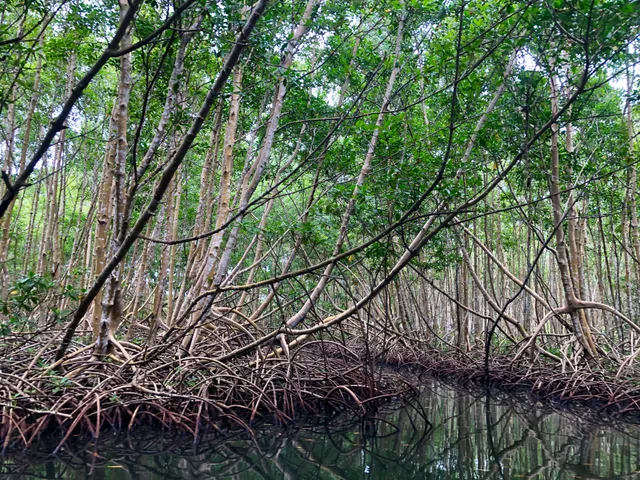
In the waters of a Guadeloupian mangrove, fine white filaments appear on plant debris. They can evoke tiny worms. However, the examinations reveal something much more surprising: each filament is a single bacterial cell, visible without a microscope.
Olivier Gros noticed them in 2009, while studying organisms associated with sulfur-rich sediments. Research published in 2022 describes this giant bacterium, Thiomargarita magnifica, and its peculiarities. The size does not come from a multitude of aligned cells.
His internal organization has another surprise in store. Many copies of its genome are found in structures surrounded by a membrane. This arrangement differs from the ordinary image of a bacterium whose DNA would simply be free in the cytoplasm.
Most bacteria remain invisible without a microscope. However, this species forces us to look at a filament large enough to attract the eye.
What we know
A filament corresponds to a cell; no chain of bacteria or sea worm.
To go to the source
References accessed October 11, 2026. Linked pages may be in another language.
Signaler une erreur ou apporter une précision