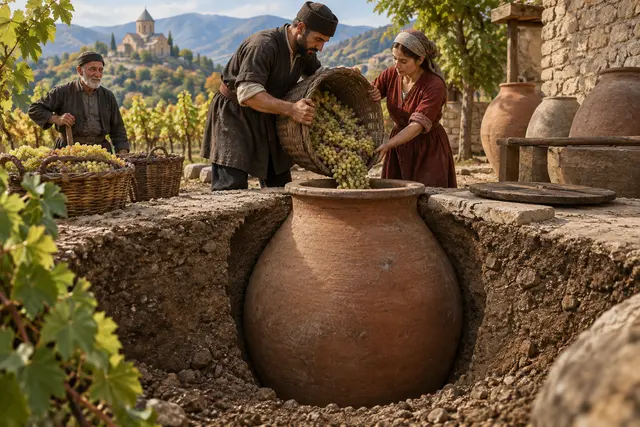
The cellar can be there without a row of barrels. In the Georgian method of qvevri, the main container is a large egg-shaped clay jar, buried in the ground. It is used to make the wine and then to preserve it. His role therefore combines an object of pottery and a technique of winemaking.
The 2013 UNESCO dossier mentions five to six months in the jar. This stay includes fermentation and maturation, with durations varying according to the practices. The heritage also includes the care of the vines, the collective harvest, the choice of clay, the manufacture of the containers and their cooking.
Families, relatives and neighbours participate in this transmission, often observing the gestures of elders. Practices take place in diverse communities and social opportunities. It would therefore be misleading to turn a heritage description into a uniform recipe for all producers. Behind the invisible jar remains a network of clearly visible skills, from the vineyard to the potter.
What we know
Fermentation and total stay are not confused.
To go to the source
- UNESCO — Décision sur la méthode traditionnelle du qvevri, 2013 (new tab)↗
- Agence nationale géorgienne du vin — Pratiques du qvevri (new tab)↗
References consulted on September 21, 2026. Linked pages may be in another language.
Signaler une erreur ou apporter une précision