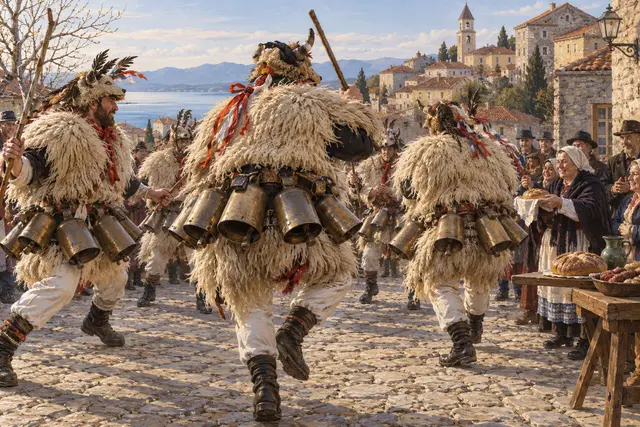
In the Kastav region of northwestern Croatia, groups roam the villages during the carnival period. Sheepskin covers their shoulders and bells are tied around their waists. The movement becomes sound: the leaps and rhythmic contacts between the participants set the bells in motion.
Upon arrival, the ringers can form circles in the square. The locals offer them food and rest before continuing the course. The costumes and characters that accompany the walk vary between groups; there is not a single outfit valid for the entire region.
UNESCO registered this practice in 2009. Behind the impressive pace of the participants, it describes a way to renew the links between villages and to integrate the newcomers. The bell therefore not only signals a party: it accompanies visits, reunions and a circulation of hospitality that the sound makes impossible to miss.
What we know
Regional tradition with variations; distinct from the Slovenian Kurenti, already present in the collection.
To go to the source
References consulted on 3 October 2026. Linked pages may be in another language.
Signaler une erreur ou apporter une précision