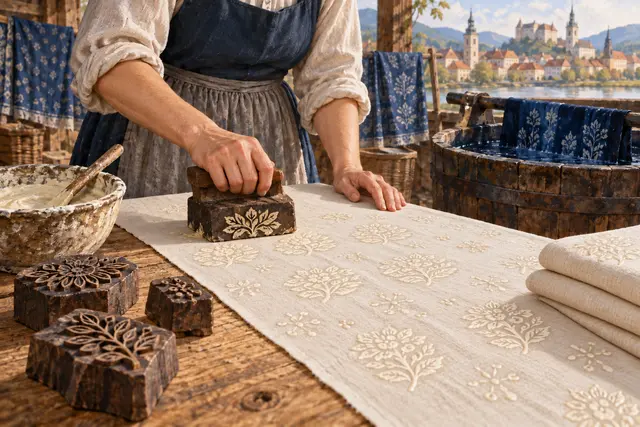
On the finished fabric, clear patterns stand out against a blue background. The eye may believe that they were painted after dyeing. In the technique of Blaudruck and its related traditions, the order of work is however reversed: some parts of the fabric are protected before receiving the color.
The craftsman applies a reserve paste with blocks bearing the patterns. The areas covered in this way are resistant to indigo dyeing. After removal of the reserve, the drawing appears in contrast with the colored background. The recipes and blocks are transmitted in workshops whose practices have a history of their own.
This know-how shared between several European countries was registered with UNESCO in 2018. He recalls that a drawing can arise from what the hand refuses to color, rather than from what it adds. White does not wait for its turn at the end: it is prepared from the beginning, then revealed when blue has found its place around it.
What we know
Stock printing and dyeing, not white paint added systematically after; several national traditions.
To go to the source
References consulted on 3 October 2026. Linked pages may be in another language.
Signaler une erreur ou apporter une précision