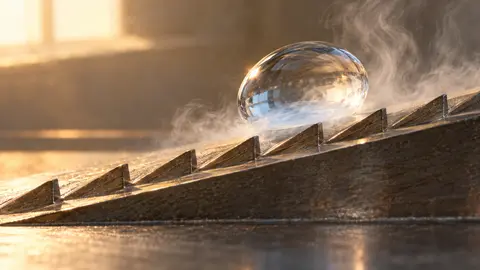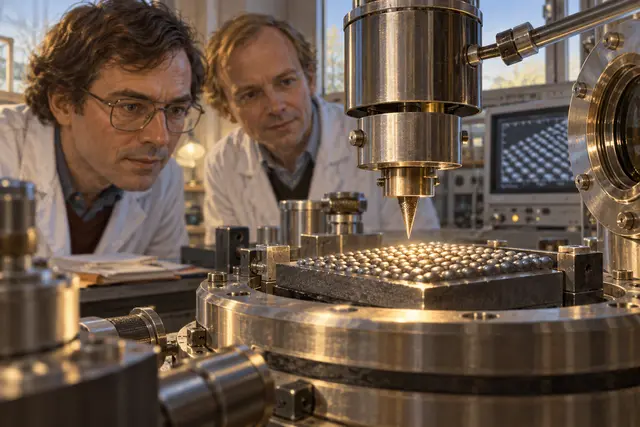
To observe a surface on a very small scale, we first think of powerful lenses. The tunneling microscope follows another path: a conductive tip approaches extremely close to a surface, without the need to touch it as a finger would.
Under the right conditions, a current can pass through the tiny space that separates them thanks to the quantum tunnel effect. The sensitivity of this current to the distance makes it possible to probe the surface. Gerd Binnig and Heinrich Rohrer recount the development of this instrument in their 1986 Nobel Lecture.
The expression “cross a barrier” easily evokes a person passing through a wall. The actual experiment involves electrons and microscopic distances, in a controlled device. It is precisely this transition from theoretical strangeness to a reproducible tool that makes history remarkable: a counter-intuitive property becomes a practical way of examining matter.
What we know
Tunnel current in a microscopic device; no observable passage of a human body through a wall.
To go to the source
References consulted on September 21, 2026. Linked pages may be in another language.
Signaler une erreur ou apporter une précision