1. The unknown address
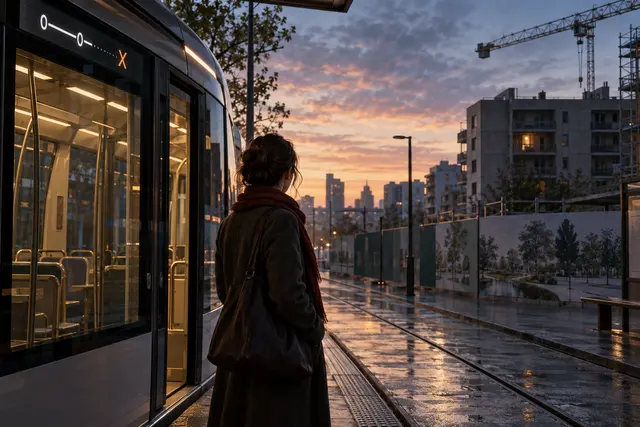
The tram refused to take Salomé home. It wasn’t a traffic incident: the train was rolling normally, travelers would check their wristbands and the voice from the ceiling would announce the stations with its usual softness. Simply, when Salomé asked for the Aulnes to stop, her screen replied that this destination did not exist.
She tried the name of the street. Then the number of the building. Then the old name of the district, preserved especially by the inhabitants old enough to have known the buses to driver. With each attempt, the system offered him the garden of Aulnes, a landscaped space whose inauguration was scheduled for the following Sunday.
It was Monday. Salomé had left her apartment at 8:12. She had left a cup in the sink, a window half-open, and her father sleeping in the blue armchair. A garden shouldn’t have grown so fast around him.
She went down two stations further on and finished on foot. Behind the fences of the construction site, the three buildings were still there. A truck unloaded elements of pergola; two workers consulted a plan. At the foot of Building B, Omar, his father, was chatting with the access terminal.
“She claims I’m a visitor,” he said.
“Do you have your bracelet?”
He showed her his wrist. She immediately regretted the question. Omar was seventy-two years old and had a cane, not a sudden inability to understand the objects he used every day. He had been driving buses for thirty years, then teaching new drivers how to stay calm in front of angry travelers. The patience with which he fixed the terminal should have warned him that he had already tried all the simple solutions.
Salomé presented her own bracelet. The door opened. A bright line welcomed him to the temporary residence B. She did not remember that she had ever lived in something temporary.
In the hall, an ad was floating above the old billboard. The city congratulated the residents for their unanimous adherence to the relocation program. All departures were accepted. No person domiciled remained in the perimeter to be transformed.
At the bottom of the text shone a small green circle. Salomé knew this circle very well. She had been working for six years for the municipal service in charge of verifying public claims before authorizing it.
His father looked up at the words that said he was no longer there.
“Can you explain that I’m still waiting for my kitchen?”
2. The Green Circle
At Bellombre, it was no longer said that an announcement was official. They said it was green. The Veracity system compared each administrative statement to the corresponding registers. If he found sufficient data, a green circle accompanied the sentence. If he could not conclude, the circle remained gray. Salomé had defended this distinction in countless meetings.
She still believed that night. A city capable of writing that she was ignorant of something seemed preferable to a city that answered with confidence to everything. But no machine produced its own definitions. People chose what to look for, in what files and under what words. It was precisely his job to reread these choices.
She called her colleague Basile from the kitchen. As she spoke, Omar tried to open a box of biscuits whose lid had become deformed. The noise of the metal rubbing against the metal made the conversation strangely domestic.
Basil confirmed the validation. The Aulnes program had obtained the agreement of all the residents selected in the balance sheet. One hundred and eighty-three people. He added that he had wondered why Salomé no longer appeared in the pending applications.
“Because I didn’t accept. I was offered accommodation forty minutes from my father’s care center. I asked for another offer.”
“I know that. I'm looking."
She heard him work. The silence lasted long enough for Omar to finally open his box and push a cookie onto a small plate.
“Your file is classified as temporary accompaniment,” says Basile.
“Temporary until what?”
“Until the situation is resolved.”
He had read these words exactly as they appeared. She recognized that tone. It was adopted when a formulation did not respond to anything, but when repeating it still allowed us to believe that we had found information.
Salomé asked him the total number of people registered before the program. He could not send her the file from home. He could look at the old tracking chart, which remained in their meeting documents. Two hundred and thirty-nine names were there.
She wrote the two numbers on the back of an envelope. 183. 239. Fifty-six people had disappeared from the sentence, without the green circle ceasing to glow.
“Maybe some moves,” Basile said.
Salomé looked at her father, who was chewing slowly, facing the window overlooking the palisades. There were probably moves. There was also a man in slippers that the city had just turned into a grammatical exception.
3. Those who remain
The next morning, Salomé took a day off. She wrote to her manager that she had to solve a problem related to relocation. She hesitated before sending the message, because the words were accurate and yet gave a false idea of the urgency. This problem was beginning to look like the ones she was looking at at work.
Omar wanted to accompany him to meet the neighbors. She proposed that he rest. He replied that he was just tired of being settled while he was resting. So they left together, taking the elevator that the maintenance company had to stop maintaining at the end of the week.
On the fourth floor, Irena opened holding her granddaughter Mina by the shoulder. They had accepted a new home, but the keys were not available. The contract provided for entry the following month. The city had counted them among the acquired departures. In fact, they still lived here, with their boxes, their plants and an open homework book on the table.
At the third, two brothers were waiting for an offer to keep their workshop on the ground floor. In the second, a man was hospitalized; his sister was trying to understand the messages addressed to his bracelet. The first one, no one answered. The doormat was still there, but they could not deduce that a resident was behind the door.
Salomé only noted the situations that were told to her with the agreement of the people concerned. Omar took his old driver’s notebook and drew three columns. Gone. Here. Unknown. He had never liked paintings that confused empty seats with absent travelers.
In the courtyard, Mina asked them if the trees of the future garden would be taller than her building. She was holding a printed summary image for the school. Families walked between young trunks, in a light without season. At the place where his room was, a basin had been drawn.
“Can they do the pelvis when we have our keys?”
Omar replied that this seemed like a good question. Salomé thought it was even simple enough to become very embarrassing. Why was it necessary to explain to a child what the adults in charge of the calendar did not want to put in a sentence?
In the evening, they had not found fifty-six people. They had established that twenty-three still lived in the three buildings, met nine residents already gone and left several marked lines unknown. Salomé looked at the last word without trying to make it disappear. So far, he was the most honest part of the account.
4. The demonstration
On Wednesday, her manager, Daria, received her before the service meeting. Salomé had prepared the two counts and a request to suspend the public message. Daria read them without contradicting her. This lack of resistance first gave him courage. Then she noticed that her manager looked more at the names of the files than their content.
“You’re personally concerned,” Daria says.
"Yes. That’s also why I found the mistake.”
“And that’s why you can’t do your verification alone.”
The rule was reasonable. Salomé would have called her back to someone else. She asked that another member of the service take care of it immediately. Daria promised to open an incident. The term seemed too small to accommodate a courtyard, three buildings and a child waiting for keys, but it was through him that we had to start.
An hour later, Salomé attended the demonstration of the Aulnes program. The director of urban transformation, Veyre, presented Sunday’s inauguration as proof of a transition without conflict. Accepted relocations scrolled on a screen. Each name was a confirmation. Every confirmation was true.
It was this that troubled her the most. Nothing in the picture needed to be invented. Irena accepted. The two brothers refused the first offer. Salomé had asked for an accompaniment. But the table showed only the acceptances; the other situations now belonged to another category of files.
“What kind of people do you all use the word for?” she asked.
Veyre smiled as if he were greeting a specialist question.
“On the residents of the program.”
“Before or after the change of status?”
The smile froze slightly. He explained that the residency status of the program was for people who signed their new proposal. The others had a separate accompaniment. The membership rate was therefore accurate within the chosen scope.
Salomé looked at the green circle. One hundred percent of those who agreed had agreed. The city had built a victory in which it was mathematically impossible to count a refusal.
She then asked Mina’s question, almost word for word. Veyre replied that the inauguration was symbolic and that no one would be put in danger. The new message immediately received a grey circle. Salomé felt a brief, absurd and immense relief when she saw the machine finally confess that it could not certify anything.
5. The note she had signed
Basil brought him a paper file at the break. He had asked to be assigned to the incident, since Salomé could not handle it herself. He didn’t seem satisfied with getting what he wanted. On the cover, he had drawn in pencil an arrow to a version number.
“You need to read last year’s note.”
She recognized his signature before recognizing its content. A year earlier, their department had adopted an amendment to isolate incomplete files during the reviews. The objective was banal: to prevent a missing piece from blocking the publication of useful statistics. Salomé had approved the principle, provided the number of exclusions was visible.
The condition was well in the note. In the implemented version, it had become accessible information in a secondary report. The main message could therefore be certified without showing what had been removed from its calculation. No one had technically withdrawn their reservation. He had been moved far enough to stop bothering her.
“I should have followed the implementation,” she says.
Basil did not comfort her. She was grateful to him. He showed him the following steps: a new definition of the residents, a balance sheet limited to closed files, and then the resumption of this balance sheet in public announcements. Each transformation had a different author. None of them contained the entire disappearance.
Slight slip after slight slip, the map had ended up receiving the garden as an acquired state. Transportation systems used this card. Maintenance used the construction schedule. Access terminals used administrative statuses. A green phrase had led behind her a small army of ordinary decisions.
Salomé wanted to copy the files to show them to the neighbors. Basil arrested him: they contained personal information about the entire neighborhood. He prepared a redacted report and a precise record of the transformations. She had to be able to expose the problem without exposing the residents she wanted to help.
She returned with her own note, which she had the right to consult, and a feeling more painful than anger. It wasn’t just the person who discovered the mechanism. A small part of the mechanism was named after him.
Omar took the envelope containing the two numbers. Salomé had placed her signed note next to it.
“Did you know that Veyre?”
“From meeting to meeting. Not like that."
He put the envelope of the dish in his hand.
“And that phrase, is it you?”
She nodded. He sat there for a moment and asked if he could show Irena the two leaves. Salomé would have preferred him to choose only the envelope. She held them together.
6. Friday was approaching.
On Thursday morning, the elevator failure turned the administrative incident into eight stories of stairs. One room had to be replaced. The claimant had suspended the order because the building was listed as free. Salomé called the service, got one kind person, then another who promised to call back.
Irena came down with a bag of laundry and went up without him. The two brothers helped a neighbor to carry his groceries. Omar stayed in the apartment, furious to depend again on the arms of others. Salomé discovered that one could spend a whole day getting courteous answers without any doors reopening.
At noon Daria told him that the circle of contentious assertion would turn gray during the examination. It was a first correction. Salomé asked if the maintenance schedule would be restored. This decision depended on another service. The transport plan? Another one. The inauguration? Veyre’s office maintained that it concerned only part of the site.
She went down into the courtyard and found Mina drawing on the back of the garden image. The little girl had reproduced the three buildings, then added the windows of those that remained. Many were closed. Some had a name.
“You didn’t put everyone in,” Salomé observed.
“I don’t know everyone.”
The answer reminded him of Omar’s notebook. She asked Mina for permission to use a copy of the drawing at the residents’ meeting scheduled for the evening. The child agreed, as long as it was not a contest. She hated that adults would turn her drawings into proof of her talent when she was just trying to show them something.
At the meeting, about twenty people settled in the old common room. Salomé explained what she knew, including her signature on the note. She expected the anger. She came, but not from everyone or in the form she had imagined.
The two brothers wanted her to re-establish their studio. Irena wanted keys. A neighbor simply wanted to be able to receive his nurse without the terminal sending her back. No one asked for a great speech on the truth of machines.
They established three immediate requests: maintain access and maintenance, publish the actual number of people still present, postpone any intervention on the inhabited spaces. Salomé wrote them on an ordinary sheet. There was no circle in the text. Anyone who wanted to sign it could do so.
7. The personal offer
Veyre called Salomé on Friday at eight o'clock. He had read the interim report and wished to prevent the situation from deteriorating. Accessible housing had just been released near the health centre. She and her father could visit in the afternoon. He understood that their expectation had created tensions.
She remained silent. For several seconds she thought neither of the neighborhood nor of Veracité. She thought of a bathroom in which her father could move easily, a maintained elevator, a transport stop that would know their address. The offer touched exactly the fatigue she had been hiding since Monday.
“Is it related to stopping my steps?” she asked.
Veyre said no. He did not formulate any conditions. He added that a concrete outcome would certainly restore serenity. Salomé heard the whole sentence, including the part that was not in it.
She talked to Omar. He wanted to visit. She became irritated before she understood the injustice of her irritation: she could not demand that he give up suitable housing to give more strength to his own position. The city had made him a variable; it had to be careful not to turn him into a symbol.
So they visited the apartment. The windows looked out onto a sports field, the kitchen was small and the bathroom door quite wide. Omar asked if he could install his blue chair near the radiator. The person in charge of the visit answered yes. He turned to his daughter with a cautious joy that clenched his throat.
They asked for a written proposal, without signing on the spot. In the evening, Salomé informed the inhabitants of the offer. A few faces closed. She did not try to convince them that they were wrong to be wary. She said she would continue to support the three joint requests and that her future departure should appear on her actual date, not before.
"Are you going to count us again?" asked Irena.
“Yeah. And I'll come to Monday's meeting."
Irena withdrew her contract without replying. Salomé looked for a more convincing promise, but a neighbor’s son interrupted them to find out who would help her run the races. She took two bags.
On his way home, Salomé found Basil at his door. The full report was ready. It had an additional detail: the garden had been announced to the financial partners before the rehousing offers were reviewed. Sunday’s inauguration was not the result of unanimous agreement. It was a deadline that the data was made to look like.
8. The place of the camera
On Saturday, Veyre’s cabinet held the ceremony. It would stand in front of the first parcel, already cleared, and would present the program as a transformation step. The corrected ad was more cautious, but the broadcast images still showed the finished garden. The city no longer explicitly said that all were gone. She kept letting him see.
Salomé asked the inhabitants to speak. She received a negative answer: the program was stopped. A dedicated meeting would be held later. This last word struck her like a door that is pushed back without ever closing her completely.
Omar offered to attend the ceremony. The three buildings still had an exit to the square where it was to take place. It was not necessary to hide or interrupt someone to occupy his own neighborhood. Irena brought the copies of the three applications. The brothers prepared seats for those who could not stand.
Salomé spent the afternoon rereading the report made public by his service. Daria had agreed that the timeline should appear entirely, as well as the responsibilities of each step. The note of Salomé was mentioned there. She felt a brief temptation to ask for a clarification that would have made her fault less visible. She let it pass.
The conclusion did not promise that a better definition would solve all the city’s problems. It required that any quantitative assertion should set out its starting population, exclusions, and date. It distinguished a signed agreement, an available accommodation and a departure made. Three things that the official account had compressed into one.
At 6 p.m., a technical team came to check the audiovisual installation in the square. Salomé watched the giant screen light up. It projected a panoramic version of the future garden, perfectly adapted to the angle of the main camera. The real buildings, behind, were coming out of the frame.
She moved to the camera. From there, Building B disappeared behind the edge of the screen. A lighted window reappeared when she took a step to the left: that of Irene’s kitchen.
Mina handed him a copy of his drawing. This time, the girl had added a caption under the windows: People met on Thursday. The others, we don't know yet.
Salomé laughed. Not because the situation was funny, but because a child had just written in twelve words part of what his service had taken six years to make difficult.
9. The Sunday of presents
It took them forty minutes to get down Omar. He had refused to be carried; the two brothers walked with him, one in front, the other behind, and placed a chair at each landing. In the fourth, he asked that they stop telling him that they had time. In the second, no one spoke. Salomé was waiting downstairs with her jacket, unnecessarily light in her hands.
They were thirty-two in the square, counting relatives who came to help. Salomé told the journalist who approached them: thirty-two people present at the time, not thirty-two forgotten inhabitants. The reporter raised an eyebrow, then noted the distinction.
Veyre spoke at eleven o'clock. He spoke of continuity, adaptation and quality of life. Not all words were false. Some families had obtained better housing; the first plot was effectively liberated; the neighborhood needed work. This mixture made the contestation more difficult than a simple denunciation of a lie.
When the images of the garden appeared, Omar stood up slowly. He didn't scream. He asked why his elevator was no longer serviced when he had not moved. Several people turned to him. Veyre invited him to contact the competent department after the ceremony.
“I did it,” Omar replied. “My daughter too. People are kind. The elevator is still standing.”
The reporter asked if any residents remained in the buildings. Veyre replied that some residual situations were being accompanied. Irena then raised her contract and explained the date when her keys would be available. One of the brothers talked about his workshop. Each gave his own situation, without letting Salomé tell everyone in their place.
The camera frame changed. For the first time, we saw together the projected garden and the windows still inhabited. No technological revelation could have produced such a simple image.
Salomé gave the report to the journalist. She explained the transformation of the categories and her own initial participation. Veyre tried to return to the corrected calendar. Daria, present at the bottom of the square, confirmed that his department had withdrawn the certification of the old announcement and requested a revision of the systems that depended on it.
The ceremony did not end with unanimous applause. Some guests left, others asked questions, several residents refused to talk to the cameras. A meeting was scheduled for the next day, with maintenance and relocation services. Salomé asked that the immediate engagements be written before their departure.
Omar sat down. He had painful legs and seemed disappointed that the elevator was not already working. Salomé took his hand. He never asked her to win an abstract battle. He wanted to be able to go home without every floor reminding him of his fatigue.
10. Le Gris
The elevator room arrived on Tuesday. Access was restored before that. The postponement of the work on the occupied buildings gave the inhabitants of the time, not an identical solution for all. The two brothers still had to negotiate their workshop. Irena received her keys on the announced date, and then returned for a plant she had forgotten.
Salomé and Omar moved in three weeks later. She herself grasps their departure in the shared follow-up on the day when they returned the keys. Until then, two people remained counted at their old address. This small act gave her a disproportionate satisfaction, which her father understood without her needing to defend it.
The Aulnes program was the subject of a public review. Veyre first retained his position and then lost the direction of the project. Salomé would have preferred a faster and sharper consequence. She learned to distinguish this wish from the record of what was really happening. The report established questionable choices, misleading presentation, and an insufficient chain of controls; it did not read minds.
At the service, the display rules were changed. The quantified statements had to show what they meant and what they excluded. Administrative statuses could no longer, alone, remove an address from the map. Basil insisted that known abnormalities remain visible during treatment. Daria asked him if this would not give the impression of a less reliable city.
“It will give a less simple impression,” he replied.
One month after the move, the shared follow-up still reported an unanswered address: the first floor apartment in front of which Omar and she had stopped on Tuesday. The letters had returned, the calls remained unanswered. The owner of the dwelling, René Delmas, had died the previous winter. An agent had offered to close the line. Salomé asked for one last visit.
She chose seven in the morning. In the evening, the window remained black; perhaps she had spent too much time knocking at hours that suited her own schedule.
A woman walked down the corridor when she arrived. She wore white shoes and a bag with a work jacket. At the sight of Salomé, she stopped, then pretended to look for something in her bag.
“Do you live here?”
The woman did not answer.
Salomé put her bracelet under her sleeve. The gesture immediately seemed ridiculous: she could not become less administrative by hiding her screen.
“My name is Salomé. I lived in the eighth. With my father.”
“I know.”
The woman had her face drawn from those whose day ends when the others begin to speak. She pulled out a key, without approaching him from the lock.
“You were there on Sunday with the cameras.”
"Yes. We are trying to find people.”
She was going to say forgotten. She stopped before distributing another name to the people.
The woman finally opened. In the entrance, a mattress was rolled against the wall. Above, a calendar from the previous year had medical appointments. René Delmas had to write very closely: the letters overflowed the boxes.
“I am his daughter. Éva. I came back when I needed someone at night. After that, we needed someone on the day, too.”
She now worked at night in a sorting center. His old room had been rented to someone else. She had not signed her father’s lease, had not declared her return. When she died, she had continued to pay the rent from her account, without knowing if it gave her the right to stay. She had not asked.
“When I saw the letters for the relocation, I thought I had to leave for the people who had the right.”
Salomé remembered the two numbers on the back of the envelope. She had repeated them so much that they had ended up sounding as solid as the buildings. Two hundred thirty-nine names. Fifty-six missing from the record.
Éva did not appear in either group. His dead father was still there.
Salomé asked how long she had been back.
“Two years.”
Two years. They had taken the same elevator. Éva had seen Omar in his chair, in the sun, in front of the entrance. Salomé had certainly held the door to this woman, and then told reporters that she had found those whom the city no longer saw.
She took out her notebook.
Éva retreated immediately.
“Where are you going to write my name?”
The point remained suspended above the paper. Salomé could correct a count. She could not promise Éva a lease, or relocation, or even that making her presence visible would have no consequence. She explained what she could do: look with her for an interlocutor, first without transmitting her identity, understand her situation before filling in a box. It would be faster than adding a line.
Éva put down her bag. She did not invite him to sit down, but she left the door open.
“I finish at six. If you call in the afternoon, I can’t hear you.”
Salomé recorded only a schedule, then closed the notebook.
In the return tram, she opened the follow-up. The total starting population was 239. She would have replaced that number with 240. The gesture was simple, almost consoling. Then she thought in the name of René Delmas, at the other doors, at all the hours to which no one responded.
She reported the data as unverified and wrote to Basil asking for the census to be resumed, explaining what had been lacking in their method without identifying Éva.
The answer came before he stopped.
“Even the count you gave us?”
She looked at the question for a long time. Her finger remained on the screen, just above the words she wanted to nuance.
“Especially this one.”
End