1. A cabbage in the bouquet
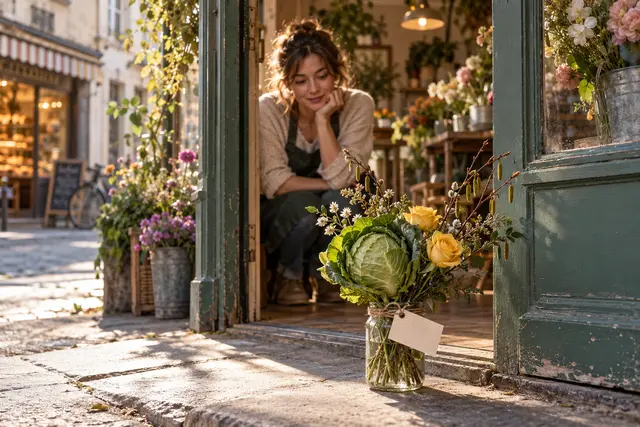
On the Monday when someone dropped a cabbage in front of his shop, Aude had decided to become an organized person. She had bought three filing cabinets, listed her expenses in a chart, and promised not to eat standing on top of bills. Cabbage did not compromise this program very much. The hazel branches, the two yellow roses and the little word that accompanied it, more.
The whole was in a jar of jam. A piece of string held the stems with a touching stubbornness. On the map, it read: For a day that does not have a name. No signature. The cabbage was leaning to the left; a rose on the right seemed to be trying to leave the group. Aude looked at the two neighboring facades, the closed bookshop, the bakery already full. No one claimed this arrangement.
She took him home. She asked the neighboring shops if anyone was waiting for this bouquet; no one knew. For six months since she took over The Gardens of Esther, everyone had an idea of what she had to sell. Cheaper bouquets, but bigger. Plants that needed nothing. Natural blue flowers. Compositions available on Sundays at seven o’clock, because birthdays have sometimes surprised you for thirty years. She suspected an anonymous demonstration meant to prove to her that her job was easy.
Esther came down from the apartment from above at nine o’clock with a letter received by mistake. She had held the shop for thirty-four years before giving it to Aude. In retirement, she had offered herself an absolute rule: not to give her opinion without being asked. She kept the rule for about four minutes per visit.
— “It lacks air,” she said in front of the pot.
— Good morning to you too.
— "Hello. It still lacks air.
Aude showed him the word. Esther read it, passed the thumb on the string, and then rested the card. She offered no explanation. She had a date and left avoiding the look of her former employee.
At noon, a client came in for a birthday bouquet. She picks tulips, then points to the pot.
— “What is this for?”
Aude almost answered: I don't know. Instead, she re-reads the map and says:
— “For nothing in particular.
The client smiled.
— That’s what I need, for me.
Aude offered him the pot. After her departure, she remained in front of the empty square with the strange impression of having sold for free the only thing of the day that she could not have made.
2. The perfect order
On Tuesday, Claire and her mother came to discuss the wedding. Aude had prepared samples, three shades of ribbon, and a quote of which she knew every line. This order represented several weeks of turnover. It would not solve all year, but would allow him to replace the refrigerator without asking the repairman for a new delay.
Claire’s mother wanted white, a symmetry visible from the entrance of the room and no flowers that evoked a poorly maintained countryside. Claire was looking at a rosemary branch in a bucket. When Aude asked her what she liked best, her mother replied. Aude let her finish, then asked Claire a new question by calling her by her first name.
— Do you want to hold a bouquet throughout the ceremony?
— "No," said Claire, with immediate relief.
His mother turned her head.
— But all the brides...
— I want to have my hands free. Thomas cries easily. I'll probably have to give him a handkerchief.
Aude laughs, and Claire laughs too. They agreed on a small composition that could be posed. The centrepieces of the table remained to be specified. The mother returned less pleased than her daughter; Aude considered it an acceptable result. She sent the quote in the afternoon, without turning the rosemary into a manifesto.
The following Monday, a second arrangement awaited him outside the door. Three branches, seasonal flowers, a leaf too big and a card: For someone who has not asked permission. The jar was still an old jar of jam, but the composition breathed better. Somebody heard Esther. Or someone would learn.
Aude asked the baker if she had seen the deliveryman. She had only seen a man from behind, early, as she prepared her window. A man with a bag. Half of the neighborhood corresponded to the report, the other half could borrow a bag.
This time, Aude placed the flowers near the box with a small label: Offered to those who need it today. She did not publish a photograph of it, did not transform the gesture into a commercial operation. She wanted to see what would happen.
A woman came in, read the label, came out, and then came back ten minutes later.
— Do you have to explain why? she asked.
— - Nope.
The woman took the bouquet. Aude did not learn his first name or the size of his day. It annoyed him for a second, and then seemed right. She opened her painting to note the pot out, hesitated on the column where to place it and closed the binder. The client had already turned around; Aude still did not know why she had returned.
3. The Business of Those Who Are Well
By dint of observing the sidewalk, Aude discovered that her neighborhood had many more people in a hurry than she thought. She knew their purchases, rarely their departures. Rita, who was driving a bus, passed by at 6:15 a.m. with a dented thermos. The bookseller fed a cat he pretended not to love. Gaspard, Esther’s brother, went down the street twice a week, looking straight ahead, without entering the shop.
Aude had met him at the sale. He had advised his sister not to resume the trade if the young woman failed. The young woman was present. Esther replied that she knew who had paid her bills for thirty-four years. Since then, no one has been happy to mention it.
The third bouquet arrived on Thursday. Aude had thought he understood a rhythm; the donor seemed to want to disprove it. Very ordinary herbs accompanied four flowers, some already open. The card said: For those who are well and who are tired of being forgotten. On the back, a small mention had been crossed out: try four.
She took the pot to Esther. His former boss looked at him for a long time, then pretended to look for his glasses.
— “Do you know who put them down?” asked Aude.
— “I know who never dropped it while I was downstairs.
It was the kind of answer that could feed twenty guesses without confirming any. Esther refused the flowers and offered coffee. His apartment was cluttered with books about birds and devoid of bouquets. Aude was surprised for the first time. She thought a retired florist lived in a greenhouse. Esther wanted to leave for three days without asking anyone to water her career.
In the shop, Rita often admired the compositions but only bought plants for others. Aude offered him the third bouquet. The driver asked if it was really free, and then chose to leave a few coins in the piggy bank of an association near the cash register. Aude let her do it, without presenting this choice as an obligation.
The next day, Rita returned with the empty pot. She had transferred the flowers into a carafe and wanted to return the container for further use.
— My husband thought I had something to tell him. Then my daughter asked me who was dead.
— "And so?"
— “Then I told them that no one needed to die to decorate my kitchen.
She wanted to learn how to make one. Aude replied that she could show him two gestures. Rita shook her head:
— A real session. I'll pay. You also have a kitchen.
4. The Price of a Good Idea
Aude calculated the cost of a workshop for six people. This calculation proved less romantic than the mysterious cards. It needed flowers, tools, time, space and a way to clean up after the participants without working until midnight. Once she had registered, she increased the price she had initially imagined and was immediately ashamed.
Esther read the sheet at his request.
— It lacks your preparation time.
— If I add it, it becomes too expensive.
— "Maybe it's becoming impossible. It’s not the same thing.
They resumed the project. Four people instead of six, on a Saturday in the late afternoon, containers brought by each, a limited but sufficient selection of plants. Aude would not promise to save every bouquet or every day. It would teach a simple composition. Rita booked immediately. The bookseller signed up for his wife; Aude asked her to check that she wanted to come. He returned in the evening to write his own name.
The third inscription was that of a man who placed coins on the counter while looking at the tools. Gaspard. He asked if there was any room left, added that he did not need any special treatment, and then became confused when he realized that no one had offered any.
Aude looked at him better. A string went out of his pocket. It was not a proof, but she suddenly wanted to laugh. She did not. She gave him practical information, as well as to others.
— You can bring a container that you like.
— Even if it’s not made for that?
— Especially if he is standing up.
He left with an air of relief. Five minutes later, Esther came down. Aude announced the inscriptions to him. At the mention of his brother, his face closed.
— Did he tell you what he wanted?
— Learn to make a bouquet.
— He was sixty years old to ask me.
This sentence was too heavy for Aude to answer with a joke. She waited. Esther explained that Gaspard had always presented the shop as a charming occupation. He had a real job, schedules, responsibilities. She had flowers. At each family party, it was assumed that she could be absent, since she was her own boss. Every birthday, he was asked to bring the decoration.
— “I’m tired of finding out now that I had hands,” she concluded.
Aude understood then that the mystery was perhaps not to know who deposited the flowers. It was to know who he was trying to talk to.
5. The flowers don’t make anything.
On Friday, Claire called. His voice was so tense that Aude first thought of cancelling the marriage. It would happen, she explained, but the budget had changed. His mother took away the money she had promised to spend on flowers. She could not bear the rejection of the great white composition. “If you know what you want so well, you can pay for it,” she said. She had spent the evening reviewing expenses with Thomas. They had to reduce the decoration.
Aude looked at the refrigerator, whose engine vibrated like a trapped insect. For a few seconds, she felt a perfectly selfish disappointment. Then she opened the quote. Nothing had yet been bought for the great compositions. They could reduce the order, keep the elements already prepared and agree on a new service. Aude explained the time involved and what remained to be decided. Claire didn’t ask for everything to become free.
— “I’m afraid it’s sad,” she said.
— Fewer flowers do not automatically make people sad.
— Can you put that phrase on your bills?
They're laughing. Claire would come to pick a few containers with Thomas the following week. Aude hung up, repeated his calculations and decided to postpone the replacement of the refrigerator. The current repair could still hold. She was not happy with the change, but preferred a reduced order that would be paid for at a panic-funded party.
A new bouquet was waiting on the threshold when she returned from lunch. This time, the card had only one name: Esther. Aude went up. His former boss took him, examined the stems, and then returned him.
— - I don't want to.
— You can keep it without...
— - Nope. I can't keep it either.
Aude blushes. She was about to explain to a woman what a gift should make her feel. She goes back down with the pot. When she saw Gaspard in the street, she went out without running.
— She does not wish to receive it.
He did not ask how she had guessed. He looked at the shop, then at the apartment.
— It’s missed, then.
— The bouquet or the conversation?
He reflected on this distinction with an attention that almost pained him. Then he took the pot.
— I’ll be here on Saturday if you accept me.
— Your place is reserved.
He left holding the flowers too close to his chest. Aude wanted to tell him to loosen his arms. She would be waiting for the workshop. For once, the council could have an hour.
6. Four people and a sink
On Saturday, Rita brought a teapot without a lid. The bookseller, whose name was Julien, had chosen an immense vase; Aude lent him a more suitable one. The fourth participant, Salima, arrived with a bowl that she had broken and then had repaired. Gaspard was wearing a jar of jam. No one asked him why.
Aude began by showing them the plants. She explained how to observe their outfit, prepare the containers and compose without compressing them. She had imagined a concentrated silence. Rita recounted a turn where her bus always seemed too wide. Julien compared two leaves to novel characters. Salima found that a branch resembled her leader and immediately set it aside. Gaspard clenched his lips so as not to laugh.
When Aude asked what they wanted to try, he said, “Do something that doesn’t sound like an excuse.” The others shut up for a second. Then Rita said that she was trying not to reproduce a stuffed vegetable. The silence broke. No one asked for a confession to deserve his place around the table.
Gaspard had found his first flowers in his garden and bought the others at the market. He had been practicing since January, following sometimes contradictory explanations. He had filed the first trial in front of the shop because he did not dare to offer it directly to Esther. He thought she would come down, recognize him, and know what he meant.
— “She’s not in charge of reading thoughts,” Aude said softly.
— I am beginning to notice it.
The little cards came from him. When Aude told him to whom she had given the first bouquet, he had a little movement of annoyance.
— I thought she would keep it.
— You did not write his name.
He looked down at his pot.
— - Nope. I wish she had understood without having to say it.
He laid his string. By moving a rose, he dropped two leaves and wanted to put them back in the pot.
— “These, in the compost,” said Aude.
— Even if they are still good?
She showed him the bald stem that he had stuck in the middle. He looked at her as if he had discovered a miscalculation.
— My sister did this while we were talking to her. I thought she was half listening.
He started again his knot, less tight.
Julien asked him why he had written these sentences instead of Esther’s name. Gaspard pulled the string, then released.
— With her name, she knew I was expecting something.
— - And you were waiting?
— - Yeah.
Salima raised her bowl. A puddle appeared underneath.
— My repair, on the other hand, is waiting for nothing. Aude, can we save the table before the family?
Gaspard caught the nearest rag. They swung aside to mop up, then picked up their bouquets.
In the end, the four arrangements were not the same. None of them would have appeared in a decoration magazine. Rita squeezed her teapot against her as a prize and announced that she would return, provided she was not asked to progress too quickly. After they left, Aude cleaned the sink with a smile. She was tired for a reason she chose.
7. A window without victory
The next day, Esther asked how the workshop had gone. Aude talked about the teapot, the vase that was too big, and the amount of leaves found under the case. She did not give Gaspard's explanations. It was not a commission that had been entrusted to her, and she was now wary of her desire to fix everyone.
— “Did he pay?” asked Esther.
— Like the others.
— - Fine.
This tiny approval pleased Aude more than a long speech. She proposed a second workshop the following month. Three places were reserved, then the fourth remained empty for ten days. Success was not repeated on command. She bought only the necessary equipment and continued her ordinary work, which had much more packaging than a romantic person could imagine.
Claire and Thomas came to choose the reduced decoration. They brought a box of small pots borrowed from their relatives, all different. Claire’s mother was not there. She had proposed to restore her participation if we went back to the first quote. Claire refused, then asked Thomas to make half the calls to the family: she was tired of being the only one to explain their choice. Thomas looked at the rosemary, felt it, and asked if it would not make him hungry. Claire replied that they would be used to eat, precisely for this eventuality. Aude found them more fun together than on the impeccably prepared dossier of the first date.
By storing the pots, she had the idea of a showcase of creations made during the workshops. No contest, no note. Each could give a title to his arrangement, say on what occasion he had imagined it or tell nothing. The compositions would be photographed with their agreement, then the participants would take them away. No bouquet would stand up to the weeks of exposure she was already seeing in her head; the photographs, yes.
Rita chooses: I asked for my Saturday. Julien: The book I finally gave up. Salima refused any personal sentence and simply wrote: The Blue Bowl. Gaspard hesitated for several days before passing on: I am learning something where I am not the best.
Aude called him to ask if he accepted his name under the picture. He answered yes, then called back to ask that she also put the name of the workshop. She thought it was useless. He insisted: he had not made this bouquet alone, he had learned with someone.
When Esther saw the model, she stayed in front of this line for a long time. She didn’t comment on the title, just the credit.
— “At least this time he didn’t forget the person who was working next to him.
Then she asked if Aude still needed her old displays for the exhibition. She could lend them, provided they were picked up before her bird-watching class.
8. The Bad Morning
On the Saturday of the wedding, the refrigerator stopped. He chooses six hours twelve, an hour precise enough that Aude then hates her every time she sees her again on her phone. She had controlled the temperature the night before. The repair took less time than expected. The flowers were not lost, but leaving them that way while she set up the room would have exposed them to a hot day.
She phoned the repairman, then a florist from a nearby neighborhood with whom she sometimes exchanged supplies. Nadia could accommodate some of the buckets in her cold room, provided Aude brought them quickly. She asked for participation in storage and transportation. Aude accepted, relieved that there was a solution whose conditions were clear.
Gaspard had to come and find an arrangement for him. He arrived in the middle of the trip and offered his car. Aude confided only what could be transported without damage in his trunk. He charged, waited for his instructions, and did not turn the aid into operations. Esther went down, observed her brother, and then checked with Aude the list of what remained.
The three of them found themselves in a shop filled with buckets, damp papers and ancient silence. Gaspard took off his jacket. A leaf stuck to his cheek. Esther took it away with a brief gesture, then stepped back as if she had touched a hot plate.
— “You can take the pots by the door,” she said.
He executed. Aude did not have time to give this movement the meaning it would have once lent it. She had a delivery to prepare and a client waiting for a party, not the healing of a family.
In the room, Claire arrived without her dress to check the last details. She found the small pots already arranged on the tables, different but consistent, each leaving room for dishes and elbows. She looked at them without saying anything. Aude suddenly feared that they would appear too modest.
— "It's like us," said Claire.
Her mother came behind her. She walked around the tables, touched a ribbon and asked where the great composition would be. Claire said there would be none. His mother did not argue. She waited for her daughter to join Thomas, then approached Aude.
— Do you have any flowers left in the shop?
— Not to redo the whole room.
— Only the entrance. Something we see when we get there. I take the difference at my own expense.
Aude looked at his watch. She still had to pick up the buckets stored at Nadia's and wait for the repairman. She calculated, however, almost in spite of herself, the remaining stems, a borrowed support, the time of a round trip. With an additional order, the participation requested by Nadia would be covered. A little more, even.
— “I can pay now,” added the mother.
She had already taken out her wallet. Aude recognized a note in the open compartment and immediately hated noticing it.
— Claire must agree.
— "It is a surprise. I know my daughter.
Aude turned to the small pots. Claire asked to be seen between the branches. They had checked the heights together, sitting on each side of a table. She also remembered her own gesture in front of Esther: you can keep it without... She was certain, then, to propose something good.
— “I’ll call her,” she said.
The mother closed the wallet.
— You make everything complicated.
— I can ask him in front of you.
This time the woman did not answer. Aude called Claire, who came back holding a box of candles. She explained the proposal without embellishing it or denying it in its place.
— No, said Claire. Mom, we've had this conversation before.
— I wanted it to be beautiful.
Claire placed the box on the table. She took out a candle, then a second, which she aligned very carefully.
— - Me too.
The silence lasted long enough for Aude to hear the music trials in the next room. She waited. She had neither a fair enough bouquet nor a joke good enough to settle it.
The mother ends up asking where to put her bag. Claire showed him a chair and handed him the remaining candles. She took them. Their joint work was initially steep, punctuated by questions about the saucers. When Aude left the room, they always had the candles. None had reported the incident forgotten.
As he left, Aude saw Thomas, who was already wiping his eyes in front of a badly hung garland. She added two handkerchiefs to the little basket of the bride. Some predictions were verified with comforting accuracy.
9. What was left in the pot
The window opened a week later. Aude had planned some juice, some biscuits and an hour of presence of the participants. Twelve people came, and four others were late. There was no sudden crowd or providential article. Two passers-by came in because they liked the blue bowl. A woman asked for a quote for a workshop between colleagues. A boy wanted to know if weeds could be beautiful. Aude replied that they had to learn their name first.
Esther arrived with binoculars around her neck, forgotten after she left in the morning. She looked at the photographs, recognized the cake bought from the baker and took a chair. Gaspard stood on the other side of the shop until Rita asked him if he was waiting for a bus to leave. He laughed and sat at a reasonable distance from his sister.
When the others were busy commenting on the teapot, he spoke to her. Aude heard his first name, then moved to serve the glasses. Later, Esther told him only what she wanted to share.
Gaspard had apologized for never coming to help at busy times, while assuming Esther would be free for their parents and family parties. He talked about two specific Sundays that she still remembered. He had not summed it up in a formula about the men of his generation. He did not ask her to acknowledge, in return, the times when he had been right.
— It was new, she said.
— What did you say to him?
— "That I had heard. That I didn’t know yet what I would do with it.
Aude nodded. She now knew that flowers didn’t simplify every sentence.
When she closed the shop, she discovered the first jar of jam on the counter. The customer to whom she had offered it had brought it back during the small reception, with a new card. Thank you. The bouquet arrived the day I decided to keep my dog despite the hair on the couch. Nothing dramatic. Just a decision.
Aude burst out laughing. For weeks, she had imagined behind each jar a great pain or secret courage. A woman had simply chosen the hair. The gesture was no less good. She hung this card inside her closet, where she kept the documents she didn’t want to turn into advertising.
Outside, Gaspard was waiting for Esther. She closed her coat, pointed to the bakery, and went ahead. He followed her without taking her arm. They were walking at the same speed, which was already a conversation.
10. An order, at last
Three months later, Aude replaced the refrigerator with a revised second-hand model. The money came from several orders, a few workshops and little spectacular savings. She had given up opening on Sunday mornings outside special periods. The first unhappy customers got used to it, or went elsewhere. She learned to bear this second possibility without considering it as a verdict on her existence.
The workshops were held twice a month. Not all of them were complete. Gaspard came less often: he practiced at home, missed compositions and sometimes brought a photograph to understand his mistake. He asked Aude if she had five minutes before she took out her phone. Sometimes she answered no. He was coming back another day.
Esther did not begin to love all her bouquets. She found her roses still too tight and her containers often sad. They ate lunch together from time to time. Once he had accompanied her to watch the birds and had spent two hours looking at the wrong tree. She had told the episode to Aude with a joy that belonged to childhood.
Claire sent a photograph of the wedding. On a table, a small pot overflowed with rosemary. His mother laughed with Thomas, who actually held a handkerchief. Aude retained the image with the other achievements of the shop after obtaining their agreement. She added no legend about perfect marriages. The pot was enough.
One Monday, Esther came down and waited for a client to leave. She asked for a bouquet. Aude took his notebook, very seriously. It wasn’t every day that we received an order from the person who had taught you how to cut the stems.
— "For what occasion?"
— - None.
— What colors?
Esther is thinking. She wanted something alive, a little messy, without the disorder serving as an excuse for laziness. Aude noted with application: alive, a little messy, difficult client. Esther read over his shoulder and approved.
— For whom? asked Aude.
— “My brother. He began to learn cooking. I would like to encourage him before I have to eat at home.
Aude proposed two yellow flowers. Esther added a branch. They stood back together to look, then the old florist took off her hand and let Aude finish. She paid without discussion and carried the bouquet in a very simple package.
At the threshold, she stopped.
— You know, the first one, with the cabbage?
— - Yeah.
— He was really awful.
— "I know.
They're laughing. Then Esther left with flowers that someone had finally ordered, for a day that still had no name.
End