The Bronze Rabbit
When Captain Inès Garrigue entered the hall of Saint-Orme, a girl asked him if the police had the right to eat the evidence.
— "It depends on the evidence," replied Inès.
— But not my bird. He fell, but we can fix him.
The child's mother took him away before Inès could ask which bird it was. On the tables of the contest, sugar gardens and impossible fruits glowed in the spotlight. No one touched it. A hundred people waited behind the ribbons stretched by the first agents, in this immobility of the holidays that a disaster has not yet managed to silence.
Émile Roncet, president of the jury, had died in the small office behind the stage. He was sixty-seven years old and had a face that the whole region knew: for thirty years, he had explained on local television that a paste felt the fear of the one who worked it. Inès had always wondered how one could enjoy cooking after such a sentence.
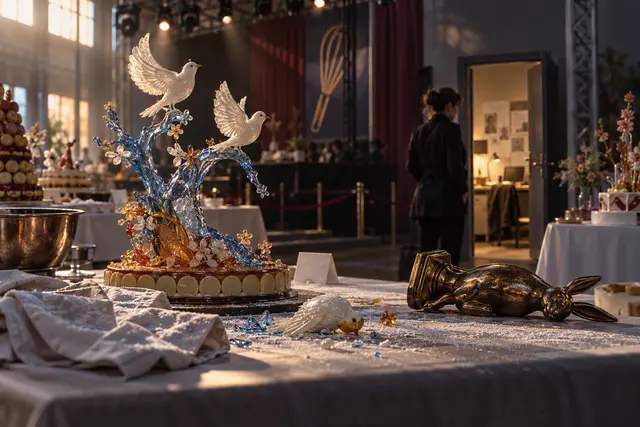
His colleague Mathis summed up what we knew. A confectioner had discovered the body at 15:16. Traces on the head evoked a blow. The trophy of the contest, a bronze rabbit the size of a bottle, was on the floor near the chair. The doctor and technicians arrived. We only moved what was needed during the rescue attempt.
— "He was still speaking in the loudspeakers at about three o'clock," added Mathis. Many witnesses heard it. The person who found him had an appointment with him.
In the doorway, Inès saw the dead man's arm. A white powder marked the sleeve of his brown jacket. Here, it seemed as banal as dust in a construction site. She asked that it be photographed before any manipulation.
Above the desk, a poster proclaimed: The taste to transmit.
Under the poster, the secretary's drawer was open. Next to a phone facing the table, a clean rectangle was drawn in the dust, as if a flat object had recently been removed.
In the hall, a man took the microphone to ask for calm. His deep, warm voice immediately fills the space.
— We will all show dignity.
Inès looked at Mathis.
— We'll start by asking him to turn it off.
The woman who didn’t cry
Her name was Alba Lenoir. She wore a white jacket, black pants and shoes marked with flour. She had discovered her former master lying behind the desk, called for help, and then tried to follow the indications of the phone help until the arrival of a volunteer trained in the first gestures. She told it bluntly, her hands lying flat on her knees.
— Did you know him for a long time?
— “Since I was sixteen. It's been 22 years.
She did not specify whether these twenty-two years constituted a bond or a sentence. On a nearby chair, a canvas bag was folded around a rectangular object. Inès asked what it contained. Alba hesitated, then took out a green-covered notebook.
The recipes were written with many hands. Some pages had old stains, conversions, pencil remarks. On the first one was a name: Madeleine.
— “My mother,” said Alba. She worked in Roncet's kitchen before opening her own shop. He kept his notebook. He claimed she had given it to him.
The famous cake with pears and buckwheat, signature of Émile Roncet, was there. The recipe was published under his own name. Madeleine had been dead for eight years. Alba said that she had asked for the notebook several times, without getting more than a joke about the children who were rewriting their parents' memories.
— "And today?"
— He told me to come at 15:15. He said he wanted to talk before the prize-giving. When I found him… I saw the notebook in the drawer. I took it.
— Before you call for help?
Alba closed her eyes.
— After. When someone else took care of him. I know what it looks like.
Inès did not answer. She made note of the approximate time, asked who had seen the gesture, explained that the notebook had to be kept for investigation. Alba held him for a second before returning him.
— Did you threaten him?
— "I told him I would speak during the ceremony if he continued to say that this recipe had come to him in a dream." I'm not going to take him out because he's dead.
Outside, someone said his name too loudly. Through the door, Alba heard. She did not turn her head, but her hands finally left her knees to grab the edge of the chair.
An exemplary father
Gabriel Vannier was the man in the microphone. A former radio host, he had organized the contest for five years and published videos dedicated to young artisans. His 17-year-old son Jules participated for the first time. Gabriel was wearing a midnight blue jacket and a shirt without a tie. On the reverse, a pin in the form of a kitchen whip gave its elegance a deliberately modest look.
— “Émile was demanding,” he said. That made him enemies. But he never counted his time with young people.
He glanced at the room where Alba was waiting. Inès asked him to tell his own day.
Gabriel had welcomed the participants, set the final details, launched the opening at 3pm, and then animated from the stage until the announcement of the drama. He had heard Émile say his welcome word through the loudspeakers. The president of the jury had to speak from the office, using a wireless microphone, before joining the tables.
— Did you see him talking?
— I was preparing the next one. I wasn't in his pocket.
The radio heat had cracked. He immediately put it back in place.
— "Excuse me. It's a terrible day. My son is completely upset.
Jules was waiting near the sound system. Tall, the hair still wet from a recent shower, he seemed to apologize for occupying a body that had become too long. On his forearm, a small burn was protected by a bandage. He observed less of his competition piece than the cables under the console.
His work represented an open aviary. Three white birds rose from a branch of blue sugar, above a citrus cake. The fourth bird had lost its head. A sign indicated that the sets should be made by the candidates and that the elements prepared before the competition would be declared to the jury.
— “Very good work,” said Mathis.
Jules blushed in a way that didn’t look like pleasure.
— “Have you been interested in pastry for a long time?” asked Inès.
— My father has always loved that.
He stopped, understanding that he had not answered the right question.
A lady wearing a purple apron came to ask if she could put desserts back in the cold. Inès arranged this with the technicians, table by table. The life of a party continued to demand absurd gestures: one did not let the cream turn simply because a man had just died.
The voices that remain
By five p.m., the timeline seemed almost reassuring. Alba had been seen in the corridor at about three fourteen p.m. Jules admitted approaching the office shortly after three ten p.m., without going in, he said. Gabriel maintained that he had stayed on stage. Three volunteers remembered his voice. A shopkeeper swore she had heard Émile at precisely three oh two p.m., because she had sent a photograph to her sister at that moment.
No one saw the president of the jury during his speech.
Inès asked for the records of the management. Jules worked with the usual technician, who was absent for part of the afternoon for a family emergency; the young man had ensured the diffusion of music and announcements while waiting for his return. He explained the folders, the files, the backup of the show. His phrases became clearer as soon as he spoke of his.
In the general recording, Émile joked about the schemes, touted the contest, thanked the partners. Then a little cry passed through his voice:
— My bird!
Inès straightened up.
She brought in the mother of the girl she met when she arrived. She explained that Fanny had broken a set during the morning rehearsal. About nine and a half. She had touched him despite the instructions and had started to cry, convinced that she had destroyed the whole contest. Jules reassured her. We picked up what we could.
At three o'clock, Fanny was at the other end of the hall, near the pancakes, with her grandmother.
Inès went back to see Jules.
— The speech was recorded.
The boy looked at the console, then at the door.
— - Yeah.
— "Why didn't you say so?"
— No one asked me like that.
She waited. Jules pinched his lips.
— My father asked me to broadcast it. He said that Émile was late, that we had just kept the rehearsal for that. It wasn't... I didn't think it changed anything.
It changed a lot of things. For four minutes, an ancient voice had filled the hall and each had assigned him a body busy talking somewhere behind a door.
The technician found the morning file. He had recorded it to test the levels in the hall. Inès listened to both tracks: the same cry of Fanny, the same hesitation in front of the name of a partner, the same crumpled paper. Mathis lowered the sound of one, then the other. The voice continued without changing.
Jules looked at the door through which his father had come out.
— He knew it was this one, he said. He showed me where to click.
Inès kept the two recordings.
Gabriel could have been wrong when talking about a live speech. He could also have made that mistake for them.
Inès asked that the father and son be separated in the interviews.
The bird without a head
On Monday morning, the laboratory had not yet responded to the samples. The doctor only confirmed that death could correspond to the niche studied; he could not provide the exact minute that everyone seemed to expect from him. Inès preferred this limit to too convenient certainties.
Mathis had found Cédric Dumas, a pastry chef specializing in artistic sugar whose videos Jules was following. An order number appeared on a package found under the young man's table. Dumas had sold the aviary to Gabriel Vannier, completed ten days earlier.
— “For a demonstration,” he told me. Not for a candidate.
He had engraved his initials under the base, as always. Émile knew his work and had sent him a photograph on Sunday at 2:43 p.m. Only one question accompanied the image: "Is that you?" Dumas, who was away, had answered only after the announcement of the death.
Jules made the cake. The decorations, which were an important part of the note, did not belong to him.
When Inès presented these elements to him, he did not protest. His mother accompanied him. Separated from Gabriel for four years, she had discovered the contest on a publication where her son smiled in front of his aviary, shoulders held by his father.
— “I didn’t want to participate anymore,” said Jules. He said we'd announced too much. Then I could choose what I wanted.
— What did you want? asked her mother.
— The sound. Training. Not that.
He pointed to his hands as if they did not belong to him. He liked to cook, he said, but he didn’t like every cake to become a proof of his future.
Inès asked him what he had done near the office. The boy began to cry before he even tried to answer.
He had come in. Émile was already on the ground. Jules had seen on the desk the box of the decor and one of the printed photographs of the base. He knew his cheating was discovered. Instead of calling immediately, he took the box and the photograph, and then went out.
— I thought he had fainted. Nope. I don't know what I thought. I was afraid of my father before I was afraid of him.
His mother did not try to finish the sentence in his place.
The brown sleeve
The sugar on Émile’s jacket wasn’t from a handful of flour, but that wasn’t enough to name anyone. In a hall full of pastry chefs, a powdered garment was a fragile track. Inès returned to gestures.
Who had seen Émile touch the aviary? The lady with the purple apron, Mireille, remembered that he had examined its base after lunch. He had raised one side of the decor, asked to be brought his phone and placed his arm in the sugar spilled by the broken bird in the morning.
— “He tried to clean with his hand,” she said. It made it worse. People always want to rub.
He then took off his brown jacket and hung it from the desk hanger because it was hot in the spotlight. Mireille had seen him come out in a shirt to cross the hall. In a photograph taken at 2:52 p.m., he was actually wearing his light shirt, sleeves up.
The body was found with his jacket.
It could be explained simply: he had been cold, wanted to present himself correctly, put on his own clothes. Inès only asked the technicians if anything, in the position of the fabric, caught their attention.
The answer came later. The right sleeve was turned inside, at the wrist, and the back lining formed an unusual fold under the arm. Maybe it's a dress-up clumsiness. Nothing that allows, in isolation, to slice.
But Mireille brought another memory. Gabriel had left the corridor during the broadcast of the speech, with a brown jacket on his forearm. She thought he was helping Émile get rid of the office. Then, during the next piece of music, he had returned to the same door, without a microphone in his hand.
— "Why didn't you say it yesterday?" asked Mathis.
— “Because you asked me where he was when Émile was talking. I replied that I heard Gabriel announce things. Now you ask me what I saw. It's not the same question.
Inès took the remark without defending himself.
They all heard a lot on Sunday. From the beginning, she wanted to know which ones actually had legs.
A failed film
The evidence did not come from a hidden camera. She came from Mireille’s phone, posed against a basket of towels. The volunteer wanted to film the audience’s reaction to her niece’s mounted play. She had started the recording too early, then forgot about the device by going to pick up trays. Above all, we could see a pole, the back of two people and a strip of corridor behind the stage.
Mireille began by saying that her video was unusable. Nevertheless, she had kept it, at the insistence of her niece, who wanted to keep the sound of applause.
The investigators looked at her without moving too fast. The board broadcast the beginning of the recorded speech. Gabriel entered the corridor. Two minutes later, he came out with the brown jacket on his arm. He stayed out of the field for a moment, then went back the other way. Finally, he came back alone and joined the scene, where his voice became really present, with the variations of the microphone he moved while speaking.
At the end of the corridor was a water point used by the volunteers. The passage remained free. No one had constantly watched her, and Mireille refused to complete what she had seen with what seemed to be hoped for from her.
— I can’t tell you if he washed his hands. I was wearing trays. I can only show you where he went.
Inès thanked her for this limit. Since Sunday, he was willingly offered certainties that grew with each story. Mireille’s caution left them with a less spectacular but usable testimony.
The video showed neither the office nor what had happened there. But she destroyed her story of a continuous presence on stage. She also confirmed the memory of Mireille, detail by detail.
On his phone, Émile had kept a message addressed to Gabriel at 14:47. He demanded his passage to the office before the opening. He had just recognized Dumas' aviary. Jules had to withdraw his candidacy and Gabriel had to explain publicly why. Émile refused to let the boy carry the fault of an adult alone.
An older draft referred to Alba. He prepared a short presentation to return Madeleine’s notebook in front of the participants and correctly attribute the recipe of the cake to the pears. He asked that this not be turned into a "big apology session."
Inès rereads this formula. Even about to correct a wrong, Émile wanted to choose the size of the repair.
Alba had a real reason for anger. Jules had lied and moved objects. Gabriel had requested the broadcast of the recording, met the victim at the moment he denied, and then manipulated his jacket.
Mathis returned to Gabriel's photographs. On those taken before the opening, the blue wrist of his jacket was clean. In an image of the microphone being put back in place, after returning from the hallway, a white trail marked the same setback. The sample taken from his clothing contained sugar. This did not distinguish this sugar from that of the neighboring tables. On the other hand, the moment when the trace appeared corresponded to the transport of the brown jacket.
Inès placed the images in order. Émile in a shirt at 2:52 p.m. Gabriel enters the hallway during a recorded voice. The clothes on his arm. Back to the office. Finally the white wrist in front of the microphone.
— "He says he didn't leave the scene," recalled Mathis.
— “Then let’s ask him who owns the jacket he’s carrying.
She removed the photographs of Alba and Jules from the table. Their lies had not disappeared. They had ceased to act as evidence against them for that journey.
The Father Behind the Presenter
Gabriel first admitted to carrying a jacket to put it away. Then he said he brought it back because Émile was asking for it. He then claimed that Mireille confused the moments, before being presented with the video.
The interview continued in the presence of his lawyer. Inès promised him neither indulgence nor secrecy. She asked him why he had told a live speech when he had personally requested the release of the rehearsal file.
— I was thinking about something else.
— "To what?"
— "To my son.
He finally uttered this phrase with his tired man’s voice, without looking for the timbre that silenced a room.
Émile had shown him the initials under the decor. He wanted to cancel the candidacy and explain the fraud, because Gabriel had already sold a series of videos to a partner about Jules' rise. He accused her of using her son as a window.
Gabriel had spoken of error, then of cruelty. Jules would be humiliated. The other kids would laugh at him. Émile had replied that the lie was the father's and that he would tell it.
— "He was going to destroy everything," murmured Gabriel.
— The candidacy?
He did not answer immediately.
— The partners. The next contest. Everything I'd put up.
The shot was gone during the fight, with the trophy resting on the desk. Gabriel said he squatted and looked for a reaction. His hand was stained when he got up. He had taken the hanging jacket near him to hide his wrist by going to the water point. It was then that sugar had marked his own sleeve. After washing, he had returned to the office, wiped his still wet hand in the lining, and then tried to put the garment back on Émile.
— “Why give him his jacket?” asked Inès.
— I wanted him to look... I don't know. Same as before.
— You could call someone.
He remained silent for a long time. The minute he left the office for the first time could have been used for that. He chose to hide his wrist. Then, each gesture sought to make the previous one less visible, without forming a coherent plan.
The technicians had found traces consistent with his story in the lining of the jacket; the analyses and other findings still had to be confronted with his statements. Inès did not turn every confession into immediate truth. There remained gestures to be specified, durations to be checked.
Gabriel had left the trophy behind the chair. He had joined the stage at the end of the music, then continued to present the party.
— I thought someone would find him right away.
— “And you kept talking.
He looked at his hands.
— I knew how to do that.
What does not come back
The investigation did not erase the lies of others. Jules had to explain several times why he had not called for help when he discovered the body. His schedules, movements, and removed objects were examined. It was not enough that his father recognized a blow so that everything else lost its importance.
Alba picked up the notebook when its preservation was no longer necessary for the investigations. Émile's family did not dispute that he had belonged to Madeleine. A local article finally told the story of the recipe, with simpler words than those of the speech ever uttered.
Alba was asked if this posthumous gesture allowed him to forgive.
— It is not a posthumous gesture. It's a notebook I'm given back. For the rest, I have no one to end the conversation with.
She regretted speaking so harshly to the reporter, and then decided not to ask for a more lovable sentence. She had spent enough time rounding the corners so that others could forget them.
In the cleaned hall, the tables were dismantled. The perishable works were removed. Jules' aviary had lost a second bird; the sugar could not bear the moisture left by an open door. The boy came to pick up his equipment with his mother. He didn’t want to take anything from the set.
Mireille gave him the small head repaired by Fanny, placed in a box of matches garnished with cotton. The child had left it for him before returning home.
— "She said you had comforted her without scolding her," explained the volunteer. It did him good.
Jules took the box. He stayed for a long time looking at her.
When Inès saw him again for a clarification on the control room, Jules had the box of matches in his pocket. He was dragging the drawer out of his thumb.
— If I had called right away...
He did not finish. Inès let it pass for a moment.
— I don't know, Jules.
— Everyone says that.
— Doctors are looking for what they can establish. I can't give you that answer.
He closed the box. She asked him if he wanted to meet his mother or stay a little longer. He got up.
His mother was waiting in the hallway. The boy joined her without putting on his photographic smile.
Inès returned home with a smell of sugar that she thought she still smelled in her hair. His father had left a burnt pie on his table. She ate one part of it standing, then another, without looking for what she proved.
The whole voice
The following spring, Saint-Orme organized a meeting of artisans in the same hall. There would be no ranking. Gabriel was waiting for his trial; the association had changed officials. Inès passed there with his father, who wanted to understand why his slippers always opened on the wrong side.
Alba held a stand near the window. On a slate, she had written: Cake with pears and buckwheat, recipe by Madeleine Lenoir. The notebook remained in his kitchen. She was working with a stained photocopy that she had annotated with her own hand.
— "Do you change it?" asked the father of Inès, tasting.
— She did it all the time.
He seemed upset that a famous recipe was not finally something to be obeyed without thinking. Alba gave him a second, smaller part, to compare two attempts. They immediately began to discuss the pears.
At the bottom, Jules was installing a microphone. He was in technical training and agreed to come with a comrade. His mother was reading near a door. She looked up as he passed, then returned to his book without asking him if everything was okay.
Inès saluted him. He showed her the cable that had to be replaced. He spoke quickly, then asked her if she had two minutes. She followed him to the management table, left in the care of her comrade.
In his portfolio, he kept a letter he had received a few days earlier. He did not give it to her; he only took out the corner, enough to look again at the first line.
— My father wants me to come see him.
Inès waited. She did not come to take a statement and did not know what he was looking for with her.
— He wrote that he had lost everything by trying to protect me.
The boy put the paper back in its place.
— I know what he said during the investigation. Mom explained it to me. Partners, videos. But when he writes it, I start looking for what I should have done.
He looked at the microphone between them. She remembered Gabriel demanding dignity from a whole room, as he had just left Émile behind a door. She could not tell this image to Jules as a response to everything he felt for his father.
— Did you answer him?
— "Not yet.
He asked if she thought he should go. She told him that she could not make that decision for him. He would need to discuss it with the people who were with him, outside of the investigation. Jules nodded with a little disappointment. Then his comrade called him to try the microphones.
He raised the level of a track and launched a file. Alba’s voice resounded in the hall: an announcement she had recorded the day before to present the demonstration. Inès felt his stomach tighten. The sound was good, too easy for a person behind the curtain.
Jules saw his eyes.
— It's just the presentation. After that, she speaks live.
He stopped the file before it was finished and checked Alba's microphone. The baker lifted an inch from her table. Everything was ready.
A few minutes later, Fanny passed the control room. She had grown up since the contest and was wearing a jacket whose sleeves almost covered her fingers. She asked Jules if he still had the bird.
He opened the small box of matches placed near a coil of cable. The glued head stood between two pieces of cotton. Fanny had a satisfied smile, then went to join his mother in the front row.
Jules’s comrade pointed to the broadcast box. It was time. The boy put a finger on the fingerboard, pulled it out and took the microphone.
— "Hello. The demonstration will begin.
His first sentence sounded lower than expected. He rectified the level, swallowed his saliva and looked at Alba.
— The cake is a recipe by Madeleine Lenoir. Alba, his daughter, is going to show it to you.
Then he lowered the microphone. He had neither the warmth nor the ease of Gabriel. He had spoken too close to the cup and the first word had blown into the speakers. Alba thanked him, waited for the conversations to stop, and began to break his eggs.
Inès joined his father. He had already taken out a notebook to record the proportions. During the demonstration, she heard Alba tell a failed essay, without making a lesson about her mother's genius. In the end, Jules discreetly adjusted the sound. He listened to a person who did not ask him to become the proof of his talent.
When Inès left, the boy was sitting behind the console. His father's letter lay in front of him, next to the bird's head. He had started an answer on an ordinary sheet. She did not approach to read.
Jules called her before she reached the door.
— “I think I’ll go see him,” he said.
She nodded.
— But I'm not going to say thank you.
He still had the pen in his hand. Inès wished him a good end of the day and joined his father in the street.
Behind them, a hesitant voice announced that there were pieces of cake left near the window. She said a word, got the wrong stand, and then corrected herself.
This time, no one spoke in the boy’s place.
End