1. Hand in the sleeve
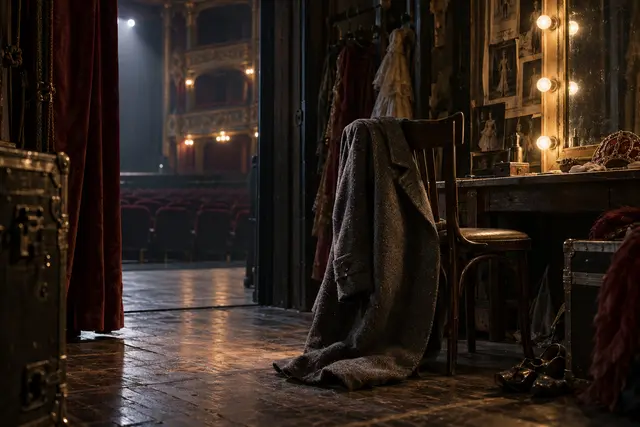
The hand closed on Célia’s wrist as she removed the coat from her coat hanger.
She let go of everything. The garment fell on the parquet, heavy and inert, with this soft noise of the doubled fabrics. There was no one behind the closet. In the right sleeve, she found a curved metal fastener. She straightened it with the tip of a screwdriver, then looked at her wrist. Four red marks drew parallel lines.
She took a photograph before thinking about what she was photographing.
— "A staple?" asked Bastien.
He stood in the door of the boxes, a box of projectors in his arms. His company was due to empty the Théâtre des Amandiers before Monday. Célia was working for the municipal museum, which had accepted a selection of costumes. Everything else would go to a warehouse while waiting for a sale. They had two days, a van and three lists that never contained the same objects.
— "Probably.
She showed him the tie, not the marks.
The theatre had been closed for eight years. A crack had condemned the balcony; too expensive work had condemned the rest. In town, everyone said they had attended an unforgettable performance here. No one seemed to remember his last ticket.
Bastien put down his crate and lifted the coat.
— Beautiful fabric. It looks like your grandfather's.
— “All the grey coats look like my grandfather’s.
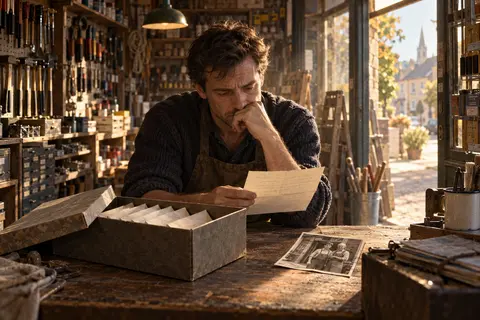
He smiled, but she was only half joking. His grandfather died in the spring. By emptying her apartment, she had discovered how many memories were attached to almost identical things: a button, a lining, a smell that disappeared as soon as one sought to retain it. She had accepted this project to work on clothes that belonged to no one she had loved.
At the collar, a label had a name: ÉTIENNE RAVEL.
She noted it on her card. On the other side of the room, someone applauded three times.
Bastien raised his head.
— Suzanne is calling?
Suzanne, the former superintendent, had opened the building to them at nine o’clock. Since then, she has been sorting through files in her office. They walked behind the scenes. On stage, the working light lit up the first red chairs. Further away, the rows were lost in the shadows.
— Suzanne?
No answer. Célia skirted the curtain. A door was slowly knocking at the bottom of the floor. She immobilized him with the rubber wedge next to him.
When they returned to the lodges, the gray coat was on its hanger.
2. One hundred and twelve
Suzanne was seventy years old and had a way of manipulating the keys that made every door personal. She knew the one that had to be pushed from the knee, the one whose handle threatened to stay in the hand, the one that had never closed despite twenty years of complaints.
— "Have you put away the coat?" asked Célia.
— What coat?
To the description, Suzanne put down her keychain.
— The grey stays here.
— It is on the museum’s list.
— Then the list is wrong.
Célia waited for an explanation. Suzanne pulled a file out of a pile and opened it randomly. Her fingers slipped on leaves that she didn’t read.
— “I can note a reservation,” said Célia. But it takes a reason. A loan, an owner, a fragility?
— He has already traveled too much.
Bastien entered with a plan of the room.
— We are missing a chair. One hundred and twelve in the register, one hundred and eleven in the drawing.
— "Twelfth row, court side," replied Suzanne. A strapon. Don't worry about this one.
— We move all the furniture.
— Not today.
For the first time, his voice had ceased to be weary. She looked at Bastien as one looks at a child already too close to the edge. Then the phone rang in his bag. She walked away to answer, closing the office door behind her.
Bastien blew.
— Do you do half of the work and take half of the truck?
Célia consulted her photograph of the wrist. On the screen, the marks seemed less sharp. She wondered if it was possible to be afraid of a place because an elderly woman refused to leave it. She also wondered why this explanation, however reasonable, seemed so unsatisfactory to her.
They kept the inventory to two. Beaded dresses, yellow shirts, a fox suit whose head smelled of glue. In each garment, Célia was looking for a label. The names returned: Léa Monnier, André Sala, Claire Derenne. Several had been removed and replaced. One jacket had five overlapping identities.
The coat of Étienne Ravel had only one.
At noon, Bastien went out to get sandwiches. Célia stayed to finish a box. She heard one chair fall back into the room, then another. The noise approached the scene, row after row, as if a huge person was rising in pieces.
She's not going to see. She slowly finished her label, pressing hard enough to cross the carton.
3. A repetition without date
In the afternoon, Suzanne agreed to talk about the coat.
— He served in a room. A man came back to dinner after years of absence. His wife had put on her blanket every night. In the end, it was clear that she knew he was dead.
— What title?
— The title has changed several times.
She responded too quickly. Célia noticed, but did not want to turn a costume collection into an interrogation. She asked only for a photograph of the performance, for the museum file.
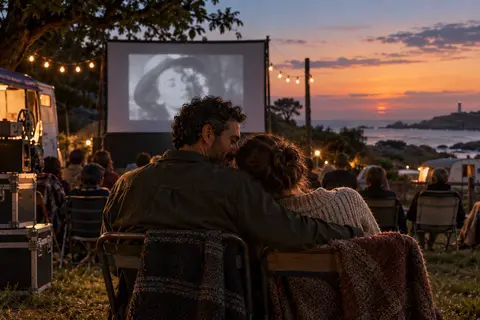
Suzanne brought him an album. On a lighted stage, a man in a gray coat stood in front of a table. To her left, an actress raised her hand to her face. The cliché had something painfully ordinary: a chair a little too modern, a tablecloth that crept, an artificial bouquet placed near a bottle.
— Étienne Ravel?
— - Nope. Marcel.
— So Étienne, is that the character?
Suzanne closed the album.
— That’s the name in the coat.
Célia put her hand on the cover before she could take it away.
— Was there an accident here?
Suzanne looked at the four marks on her wrist. The old woman did not ask what had made them.
— There was a representation of too much.
She slowly released the album and returned to the office.
At four o'clock Bastien took the last projector off the face. The main electricity was to be cut the next day, after the passage of a technician. For the evening, they would only have the service lights and autonomous lamps of the team. Célia asked him to stop. They had enough crates for a first trip.
He accepted immediately.
They loaded eight boxes and two porters. Suzanne remained near the door throughout the operation. When Célia greeted her, she checked the visible contents of the van before responding.
At the museum warehouse, Bastien opened the back doors.
The grey coat hung from the first porter.
He was still wrapped in the transparent cover that Célia had left on a chair, at the Almond trees. The transport label bore her handwriting and a number that she had not assigned.
Bastien looked at her, then looked at the coat.
— I didn’t put it there.
In the closed cabin, three applause resounded.
4. The Passenger
They did not leave the coat in the warehouse.
Later, Célia would blame herself for not calling anyone. At the time, the question was not to convince an outside person. She was not to leave this garment in a building where, the next morning, an agent would open the reserves alone.
Bastien lowered the crates and the second carrying. They left the first one in the van, wearing the grey coat, without being able to decide to remove the three dresses that hung next to them. Célia locked the warehouse. They went back into the cabin. It was still daylight, but the rain had cleared the streets. At the first fire, the seat between them collapsed slightly.
Neither of them looked at me immediately.
— "Do you feel it?" murmured Bastien.
A scent of wet soap. Not a cellar stench, not a smell of decomposition. Something domestic, clean, that made the sunken place more unbearable.
Célia called Suzanne. The ringing lasted long enough for her to see the traffic lights change twice.
— "Bring it back," said the old woman, even before she spoke.
— What did you give us?
— "I have not given you anything. Come through the entrance of the artists. And don't ask him anything.
The communication stopped.
The seat went up when the van turned into the theater street. Bastien parked in front of the side entrance. He had the face of a man who tries to hold back several questions with his teeth. Suzanne was waiting for them under the marquise, without an umbrella. The rain stuck her hair to her forehead.
— Were you alone?
— “There were two of us,” said Célia.
— I don’t ask you how much you were in the beginning.
She opened the service door and pushed them back to let the door pass. The coat swayed in its cover. As they approached the backstage, Célia heard a friction that did not follow the wheels: soles on the ground, close behind her.
Suzanne led them to the back box. She removed the cover, checked the inside label and locked the closet.
— Now you are leaving.
Bastien laid his hand on the handle of the exit. He pulled it out, then pushed it. On the other side, we also shot. The metal slowly deformed under his palm.
In the room, someone scraped his throat.
Suzanne closed her eyes.
— Too late, she said.
5. The role
They settled in the office, because it was the only room whose door led directly to a small outside staircase. Suzanne opened the door. Instead of the steps and the brick wall, they saw the corridor of the lodges.
She closed without surprise.
— There is no point in running. We're back in the house.
— “What house?” asked Bastien.
— The one in the room.
Célia sat down. She no longer felt able to stand without this weakness becoming visible. The office smelled of old coffee, paper dust and the scent of soap that had accompanied them in the car.
Suzanne pulled out a black-covered notebook from a drawer.
— Marcel played Étienne. His son had died a few months before the rehearsals. In the text, the character returned to find his wife. Marcel wanted his son back. He started changing sentences. To speak in the silences where he had only to wait.
— And someone came back?
— "Something answered.
She opened the notebook. Corrections intersected in several inks. On the last page, a sentence had been crossed out until it pierced the paper.
— soir On the evening of the last one, the audience recalled the actors. Once. Twice. At the third salute, Marcel saw his boy in the back of the room.
Suzanne put down the notebook, unable to continue for a few seconds.
— He came down from the scene. When the lights went up, he was no longer there. People have thought of a malaise, a flight. The police searched. So did I. For months.
— What were you to him?
— - His wife. The one who played his wife too.
Célia relives the gesture of the actress on the photograph. She thought she was reading a theatrical convention. She now understood why Suzanne had closed the album.
— So why keep all this?
— "Because, after his disappearance, the coat returned to the lodges. Every time we took him out. And because some nights, when I was alone, I heard it.
— Marcel?
Suzanne looked away.
— At first, I thought it was him.
Above them, someone hit the ceiling with the tip of a cane. Two shots spaced, then a third. Célia recognized the pace before she wanted to admit it. His grandfather hit the floor when he called him from his room.
6. The name sewn
Bastien wanted to call. The screen displayed the network, the calls left, but a breath answered before any ringing. On Célia’s phone, the messages seemed to be sent. No acknowledgement of receipt appeared. She nevertheless wrote their address and their situation to two colleagues, and then put the device away.
— “We’re looking for another way out,” she said.
Suzanne didn't stop them from leaving the office. She just took the notebook and followed them.
The door of the foyer opened onto a box. The one that led to the basement opened on the back of the stage. Through the toilet window, they could see the red of the armchairs instead of the courtyard. Bastien broke a small window with the corner of a stool. On the other side, a shrapnel fell on the tray and the noise reached them with a slight delay.
He sat down on the floor. For the first time, he did not seek an explanation.
Célia returned to the closet. The key had remained in Suzanne's pocket; she asked for it. The old woman hesitated, then gave her away. Inside, the grey coat was no longer hanging. It was placed on the back of a chair, as if a man had just removed it.
On the label of the collar, the name of Étienne Ravel had faded.
Below were two new letters: B A.
Célia called Bastien. He looked at the label, then stepped back.
— I tried it, he said.
She remembered seeing him lift the coat. He had to put his arms in it while she filled her card.
— “Just for a laugh. Two seconds.
Suzanne had placed a hand against the wall.
— He chooses someone to take the place.
— Who, “he”?
— I don't know.
Célia shot on the label. The points held. She took her sewing scissors in her kit and cut the threads. A sharp pain crossed Bastien's neck. A red line appeared at the base of his neck.
She stopped immediately.
From the back of the corridor, a child’s voice shouted:
— “Dad, it’s time!
Bastien did not move. He had no children. Célia knew it, but she saw on his face the effort he made not to respond to a call that was addressed to her.
He pulled back to touch the wall and closed his eyes.
— “That’s the worst,” he said. I know it’s nobody. I feel like I am leaving someone alone.
Célia crouched in front of him. In the hallway, the child started again, lower this time. Bastien turned his head.
— “Look at me,” she said.
— He is crying.
She grabs his sleeve. The ordinary tissue seemed almost fragile to him under his fingers.
— You told me you had no children.
— "I know.
— “Stay with us.
Suzanne had approached and was holding the door of the box. She wasn’t looking in the hallway either.
Bastien opened his eyes. For the first time since their return, he held out his hand to help her get up.
7. The Missing Text
They spread the notebook on a makeup table. Célia looked for the original ending under the corrections. Étienne’s role was to come back, to let himself be recognized, and then to leave before daylight. His wife had to give up holding him. A simple scene, almost dry, that dozens of additions had turned into endless meals.
— Was it Marcel who wrote all this?
Suzanne shook her head.
— "Not everything.
She showed a page. His handwriting was the same as that of the box labels in the office.
After the death of her husband, she had resumed the rehearsals alone. She had read her replies, waited for the answers, added questions. One night, a voice answered him from the room. She had written more. Everything she wanted to ask Marcel. All that she had not dared to tell him after the death of their son.
— Every time I thought I came to the end, there was something else.
— How long did you continue?
— I didn’t come every night anymore.
Célia did not insist. The answer was not about a duration, but about a decrease that Suzanne had long been content with.
Bastien turned the pages carefully. In the middle of the notebook, a photograph showed the distribution to salvation. Suzanne, Marcel, two younger actors. Behind them, the curtain was almost closed.
— “You said he had come down to get your son.
— - Yeah.
— That child’s voice. Is it hers?
— He was twenty-seven years old when he died.
— But when he was little?
Suzanne rubbed the edge of the photograph. In the corridor, the child repeated his call with exactly the same intonation. Bastien stiffened.
— “It’s not her voice,” she said at last. It never was.
She returned the photograph. On the back, a date was circled twice.
— “The first night I said I didn’t recognize him. Then he began to cry. He said I didn't want him anymore.
— "And you answered.
She nodded without looking at him.
— I thought the dead were changing their voices.
Bastien put down the notebook. The day before, he would have found this answer insane. Now, a few meters away from a child who had never been his, he needed to press his palms on the table so as not to go open.
In the hallway, the voice changed. A man called Suzanne with an embarrassed tenderness, the one we take to ask for forgiveness.
She put her hands on his ears.
Célia looked at the last page. Under the scrapes, a few letters remained legible. She lit the paper on the side with her lamp. The tip had left hollows.
The sentence said: The door is closed only for those who are still waiting.
8. The Full Room
Suzanne reread the last sentence, then closed the notebook.
— I never managed to leave after this one.
Bastien looked at the door. He placed his hands flat on the table so that they would stop shaking.
They would not follow the entire text. Bastien refused to put on the coat. Célia placed him on a chair, at the edge of the tray. The garment was now so heavy that she had to pull it out of the closet with both hands.
The room was full.
Or almost. Célia saw heads, shoulders, profiles turned towards the scene. Some chairs seemed to be occupied by a thicker darkness than the others. In the back, a man held a cane between his knees.
She lowered her eyes before she could see her face.
Suzanne went up to the table that was still behind the sets. Bastien brought a second chair. The gestures gave them something to do, a provisional order in the middle of what no longer had. Célia stayed close to the backstage with the notebook open.
— “You’re late,” said a voice in the room.
It was that of Marcel, or that which Suzanne had decided to recognize by that name. The old woman squeezed the back of the chair.
— "I know.
A man stood up in the front row. He had the face of the photograph, his shoulders lower, his mouth half-open. Célia saw Suzanne take a step. She grabbed his wrist, strong enough to hurt him.
— Look at the sleeve.
The man was wearing the grey coat.
The same coat was on the chair.
This absurd and tiny detail immobilized Suzanne. The apparition lowered her eyes on her own garment. For a second, she seemed upset rather than sad. This expression was more terrible than anything before it.
Then the room applauded.
The curtain began to slide. Bastien held it, feet anchored in the parquet. A large fold of velvet stretched out around his arm like a closed hand. Célia ran towards him. Together they pulled back enough to release his wrist.
When the applause ceased, the coat was no longer on the chair.
He rested on Bastien's shoulders.
9. Without salvation
He tried to remove it. His fingers slipped on the collar without finding a hold. Célia saw, under the reverse, the label where her name was written slowly. Bastian. The letters were not embroidered. They appeared in the fibers, like a stain that rises through paper.
— Don't cut it, he said.
She already had the scissors in her hand. She put them down.
Suzanne turned to the room.
— You won't come back.
The man in the front row smiles with perfect sweetness.
— I'm here.
— - Nope.
The answer was so weak that Célia did not know at first if it had been pronounced.
— "You didn't have that coat," said Suzanne.
The man spread his arms, as if to let her see better.
— Come on.
— Marcel had forgotten him in the dressing room. I was angry because he was going home again with nothing on his back.
His voice trembled at this detail. She stepped back, without taking her eyes off the grey collar.
— I'm not going to report it to you.
At the back of the room, the cane hit the floor.
Célia felt tears flowing without having decided to cry. She thought about her grandfather’s phone, which she had kept loaded for two weeks after the funeral. She wasn’t expecting any calls. That’s what she said. She put the notebook on the table.
— “We’re going out,” she announced.
She didn’t talk to the seats. She was talking to Suzanne and Bastien.
They headed to the left side. The applause began again, much louder. Bastien turned in spite of himself. His face had changed; a painful expectation was mingled with fear.
— “Someone thanks me,” he murmured.
— I will thank you outside.
Célia put her arm under his and kept moving forward. Suzanne walked to the other side. The coat pulled them back. They could no longer distinguish the voices in the clapping of hands. They called their names, but also names they didn’t know. People were asking for a last minute, an explanation, a forgotten kiss.
In the hallway, the artists’ door had found its green plaque.
Suzanne pushed it. The cold air came in, loaded with rain.
At the threshold, Bastien slumped. The coat held another shoulder. Célia grabbed her bare hand. Behind them, a voice exactly like hers cried out not to leave her.
Suzanne closed the door.
The fabric yielded without tearing. Bastien fell on the pavement in his shirt, and the applause stopped.
10. The places that remain
Célia’s colleagues arrived eleven minutes later. The messages had all been received together at 23:17. Bastien trembled so hard that he could not hold the cup of coffee that was handed to him. A circular mark blushed his neck. He agreed to go to the emergency room, provided no one went back to get his jacket.
Suzanne gave her keys to the head of the museum. She spoke neither of ghosts nor of living theatre. She said there had been an incident, that three people could testify to it, and that no employee should enter the building alone.
The construction site was suspended. For the next few days, there was talk of exhaustion, of an old product used on reserves, of an electrical fault that could explain some of the noise. None of these assumptions accounted for the mantle. None of them were considered absurd enough to be forgotten. Célia understood this need for a practical explanation. She would have liked to have one herself.
She wrote a report without removing the facts that seemed impossible. The manager read it in silence, then asked her if she wanted a few days off. Célia answered yes. She did not try to get, in addition, that we believe her entirely.
On Sunday, she visited Suzanne. The former manager had released the album from the theater, but also photographs where her son was not a child. On one of them, he repaired a shelf while laughing, a screw between the lips. Marcel held the board upside down.
— “I don’t want them to stay only the night I lost them,” said Suzanne.
They spent an hour writing names and dates on the back of the pictures. Sometimes Suzanne was wrong about the year. Sometimes she didn’t know anymore. Célia left a blank. They didn’t have to complete everything to keep what was real.
Three weeks later, Bastien returned to work. He was avoiding tight-necked clothes. Célia returned to the museum and asked to work for a while on ceramic objects. Their friendship changed little in appearance. They only phoned a little more often, without waiting for a good reason.
The theatre remained closed. One morning, before the passage of a commission, the guard found an envelope slipped under the portal. She handed it over to the museum, whose name was on the paper.
Inside were three tickets for the Almond trees.
No date. No title. Only one row and three neighboring places.
Célia looked at them for a long time, then placed them in a transparent pouch. She recorded their provenance, the time of discovery and the name of the keeper. In the box reserved for the number of objects, she wrote three.
She checked before closing the drawer.
There were four.
She didn’t take her hand out of the drawer. She counted again, separating the tickets with the nail. On the last one, the ink was clearer. There was a name under the place number.
CÉLIA.
His phone vibrated. A message from Suzanne, who was simply asking if she had received anything from the theater. Célia called instead of answering.
The old woman jumped right away. She didn’t seem surprised by the tickets. She just wanted to know if anyone else had touched them.
— The Guardian. Why not?
A wrinkle covered Suzanne's breathing. Paper that we unfold, or that we try to flatten.
— Suzanne, did you get one too?
— - Nope. A letter.
— "Of whom?"
The answer is late. In this silence, Célia saw Bastien on the threshold, the shirt glued to the rain, and the door that closed behind them. She remembered the voice. His own voice on the other side.
— "Read it to me.
— - Célia...
— Read.
Suzanne read very low:
— “You brought out something that looks like me. I'm still here."
Célia looked at her hand on the tickets. All four brands had long since disappeared. She looked for the small scar left by her grandfather’s cat, near the thumb. She was in her place.
She felt a relief so violent that she almost laughed.
On the phone, Suzanne said nothing.
— You know it is me.
She heard a breath, then a little dry noise. Suzanne had just put her phone on a table without hanging up.
— Suzanne?
Far away from the handset, keys were held.
End