1. The room paid in advance
The bill arrived three months after the funeral. It was addressed to his father, who had always hated hotels, and concerned a room set for thirty nights. At the bottom of the page, a handwritten sentence specified that the remaining credit could be used by a family member.
Maëlle called the number. A woman answered before the second ringing.
— Your father asked us to wait.
— What are we waiting for?
— - That you open the envelope.
Maëlle was going to hang up when the woman added:
— "He left the key in the little box where he put his cufflinks.
Her father had not worn shirts with double cuffs for twenty years. Yet the box had stayed in the chest of drawers, behind an expired passport. Maëlle found a brass key and a small rectangle of card inside: room four, Maison des Tilleuls.
She says nothing to her sister.
Since the death of her father, she and Romane had shared the tasks according to an ancient geography. Romane lived near him; she had managed the appointments, the medicines, the shopping. Maëlle lived far away and was now taking care of the documents, as if the papers offered her a late catch-up of all the missed presences.
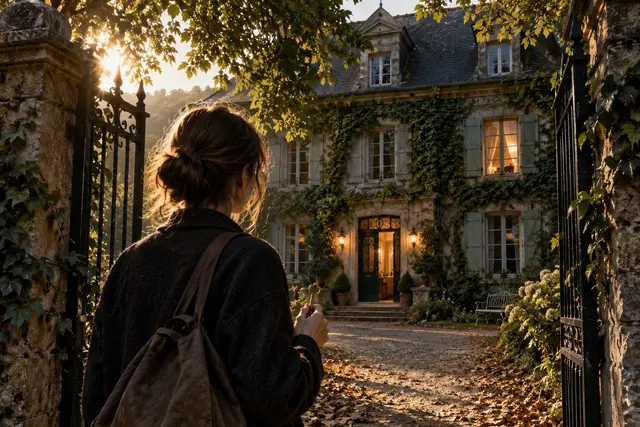
La Maison des Tilleuls was a two-hour drive away, in a valley where the telephone stopped receiving at times. It wasn’t really a hotel. A large building, five windows upstairs, an alley covered with leaves despite the beginning of summer. At the gate, a plaque indicated only the name of the house.
The woman on the phone was waiting for him at the entrance. She introduced herself: Jeanne Varenne. She was in her fifties, a sweater on the elbow and the face of someone who also listens when we are silent.
— Your father came on Wednesday.
— For how long?
— “A little more than a year.
Maëlle felt a familiar anger forming. A parallel life. One more thing that had not been told to her because she lived far away, because she had a lot of work, because it had been decided that saving her looked like informing her less.
Jeanne gave him a register. On the line of the day, there were only three boxes: name, time of entry, no one to warn.
— I don't intend to stay.
— You can only look.
— What did he come here to do?
Jeanne looked at the key in her hand.
— He would spend an hour in a day he couldn’t leave.
Maëlle thought of a commercial formula for people in mourning. She had read enough letters to recognize the phrases that enveloped an invoice.
Then, on the first floor, someone laughed.
It was his father’s laugh before he got sick.
2. Lunch that hadn’t cooled down.
Room four had no lock on the side of the hallway. Maëlle had a key. Jeanne explained to him that she had to place it against the door plate, and then decide to enter. The metal did not open a mechanism.
— What does he open?
— A place.
Maëlle stepped back. She did not like puzzles or the people who used them to give depth to their power. Jeanne did not seem offended.
— "You can go. The bill is already settled. I won’t sell you anything today.
This ordinary precision, in a situation that was no longer so, allowed him to remain.
She placed the key on the number four.
The room contained no bed or wardrobe. It was the kitchen of his childhood, on a Sunday in July. The striped tablecloth, the window half-opened, the bottle of lemonade whose label took off in a basin. His father cut bread. His mother was looking for a clean knife. Romane, about ten years old, grazed cheese over a dish.
Maëlle had left this kitchen at the age of eighteen. His mother died five years later. The house was sold. Nothing she looked at existed in this form.
— “You’re finally here,” said his father.
She pulled back so fast that she hit the doorbell.
The corridor reappeared. Jeanne held her by the arm, then immediately released her grip.
— Don’t go in if you feel like you have to.
— Do you have any recordings?
— - Nope.
— People who play?
Jeanne shook her head.
Maëlle returned to the room to unmask a process. His father was always in front of the breadboard. He didn’t seem to have seen her come out. He asked her to take the plates from the buffet.
She opened the left door. A pile of tea towels blocked his way.
— “To the right,” said his mother. You know that.
She knew. She had forgotten him.
Her hands trembled as she placed the plates. No one is surprised. Lunch moved forward with the tranquility of a day that does not know what the next ones will take.
She wanted to ask her father why he had hidden this place. But his face was the one before the gray hair, before the operations, before the fatigue installed in each movement. His question had no place on this Sunday.
He handed her a slice of bread.
— You have a strange head, my friend.
Maëlle began to cry. His mother put a hand on his shoulder. The heat was as precise as the grain of the wood under his fingers.
Outside, a bell rang.
The kitchen fades at once, like an overexposed photograph. Jeanne stood in the frame.
— It’s time to come back.
Maëlle wanted to keep the slice of bread. When she crossed the threshold, her hand was empty.
3. The rules of an impossible place
In the living room on the ground floor, Jeanne served him tea that was normally cooled. Maëlle looked at him for a long time before drinking.
The house kept days, Jeanne explained. Not all of them. Only those that a person had left here by accepting that they take a shareable form. Room four contained a Sunday from his father. What she had just seen was neither a passage to the past nor a way to bring back the dead.
— You say that as if the difference is obvious.
— She is not at the beginning.
We could intervene in a day. To speak differently, to sit in another place, to take someone in his arms. But the people present only knew what they had known then. The next day the outside world did not change. The objects did not come out.
— Roman is small. I am my age. Why is no one surprised?
— The day gives you a place. It doesn’t ask you to be likely. You can even meet the child you were. She doesn't know who you've become.
— “Then that’s not exactly what happened.
— As soon as you enter, no. The starting point is preserved. What you do next belongs to the visit. The next time, we find the same beginning.
Maëlle thought of her father in front of the breadboard, at the slice she had taken twice. A part of her would have preferred to learn that Jeanne was using projectors.
— What about the answers?
— They come from the conserved day. These are not messages sent today by the dead.
Maëlle lowered her eyes. Jeanne had answered a question she had not yet dared to ask.
A visit was to be short. At first, the visitor remembered his outside life. Then this life became distant. We stopped looking for the door because we gradually forgot why we had entered.
— "How long?"
— Cela It varies. We ring after an hour. And someone stays close to the threshold.
— You said thirty nights on the bill.
— The title of our accounting has not changed. We sleep here, in the real rooms. Visits are made during the day.
Maëlle stood up to examine the window. She almost expected to find the street of her childhood outside. There was only the garden and an old man watering a massif.
— Did my father know he was sick?
— When he started coming, yes.
— He came to see my mother.
Jeanne did not confirm.
— You’ll have to look at what happens, not just what you want to find.
This time, the phrase irritated Maëlle.
— You love to let people search.
— I prefer that they do not take my explanation instead of what they come to find.
A noise of footsteps interrupted the exchange. A woman went down the stairs, a bag of canvas against her. She seemed to be Maëlle’s age. Passing by the drawing-room, she asked Jeanne what day it was.
— - Tuesday. Seventeen.
— June?
Jeanne nodded.
The woman closed her eyes and went out into the garden.
— Does she come often? asked Maëlle.
— "Too often."
— You could refuse.
For the first time, Jeanne looked away.
— "Yes," she said. I could.
4. A 10-year-old sister
Maëlle booked an ordinary room for the night. She sent Romane a message saying that she was checking an expense from their father and would return the next day. The answer came as soon as the network returned.
“More papers?”
She did not answer.
At dinner, the woman with the canvas bag sat in front of her. Her name was Inès and she came to see her son again one morning when he had prepared breakfast. It says this without precaution, as the purpose of a journey is explained.
— He was eight years old. He put salt in the coffee.
Maëlle waited. Inès smiles.
— "No, he is not dead. That’s usually the question I don’t dare ask.
His son was twenty-two years old. They had been arguing for a long time, on several subjects which she summed up by saying that he had changed. In the room, he had not changed. He called her Mom, brought a cup and laughed before she drank.
— At least I know how to talk to him.
Maëlle thought that the house was becoming more disturbing at that moment than by showing him a dead man.
The next day she entered again on the Sunday of July. She had asked Jeanne to ring after forty minutes. She wore her watch turned over, to check that an object from today could still remind her of her time.
His mother asked him to wash a salad. His father always cut the bread. Romane grated the cheese with an upset application.
Maëlle leaned over to her sister.
— What's wrong?
— - Nothing.
— "You can tell me.
Romane looked up. There was something in this look that Maëlle knew too well: the distrust of the one to whom we promise a listening because we have not yet understood what it will cost.
— Are you leaving again?
This Sunday preceded Maëlle’s departure for her first holiday without her parents. She was seventeen years old. Two friends had to take her by car after lunch.
— Not now, she said.
— You said you would come.
— "Where?"
Romane closed immediately.
Maëlle had forgotten. A show? A competition? She searched in her adult memory, but the memories of that time were mostly about her own departures. The events of others formed the background.
Her watch indicated an impossible hour: the hands had the arrangement of a small pink watch that she had at seventeen.
She pulled back to the door.
In the corridor, his metal bracelet had regained its shape. Jeanne was waiting for him, with the bell in her hand.
— “Objects don’t protect you,” she said. It is the person who is waiting for you outside that matters.
5. Someone else's Sunday
La Maison des Tilleuls had a library. There was no explanation of its rooms, but novels, atlases and a series of records devoted to visits. Jeanne agreed to show Maëlle the lines concerning her father. He had authorized this consultation.
Every Wednesday, he entered room four. Every Wednesday he came out before the bell. In the last column, he wrote a few words. At the beginning: “Not yet.” Later: “Almost.” Then, twice: “She doesn’t want to.”
Maëlle felt pain rising in her chest.
— My mother?
— I was not in the room.
— You must know something.
Jeanne laid her hand flat on the register.
— “I know he was trying less to get an answer than to bear hearing it.
Maëlle thought of all the conversations that her father had ended with a joke. His way of saying that there was no problem as soon as a problem could force him to sit still.
She called Romane from the end of the garden.
— “Do you remember a Sunday before my vacation with Simon and Ludo?” Mom made stuffed tomatoes.
His sister answered after a silence.
— There were several.
— You wanted me to come somewhere.
— My concert.
The word brought back a gym, folding chairs, a flute stored in a brown case.
— “I was there?”
— - Nope.
— - Dad?
Romane had a little dry laugh.
— He had to take me. He agreed to drive your friends to the lake because their car was broken. My mom worked in the afternoon. The neighbor accompanied me.
Maëlle looked at the facade.
In his memory, this Sunday belonged to the family happiness of before. She had found her mother, the bread, the light. For Romane, the same day had a different form.
— You never reproached me.
— - Yes. You told me it was just a concert.
She closed her eyes.
— I'm so sorry.
— Why are you asking me that now?
Maëlle could have spoken of a found notebook, a photograph, a need to restore order. She knew all the acceptable formulations.
— There was a place where Dad came. I'd like to show you.
Roman did not respond immediately. In silence, Maëlle heard a door shut, and then the sound of a tap.
— “If it’s still a way of finding out that he had a good reason, I don’t want to.
— “I think it’s precisely the opposite.
6. One more hour
Inès did not come for lunch. Jeanne prepared a plate which she placed near the oven. She looked at the clock three times, then went up the stairs.
Maëlle heard it ringing.
A few minutes later, she rang again.
The house seemed to him suddenly full of ordinary noises: the refrigerator, a bird against a gutter, the floor that cracked under Jeanne’s footsteps. No one explained why Inès did not come down.
Maëlle joined the first floor. The door to room two was open. Inside, she saw a kitchen different from her own, with a round table and drawings glued to a piece of furniture.
Inès was standing in front of the sink. A little boy was cutting bread with a round-toed knife.
— “We must come back,” said Jeanne.
— "I have come back from the baker's," replied Inès.
She had an impatient but amiable tone, the one reserved for a neighbor who asks a question of which she should know the answer.
Jeanne remained on the threshold. She pronounced the name of Inès, reminded him of the month, the house, his bag. Inès didn’t seem to understand why this woman interrupted him at home.
Maëlle looked at the boy. He was wearing a shirt stained with chocolate. Everything in him seemed to invite him to believe that the problem was in the hallway, not in the kitchen.
— Can you take it by the hand?
— If she follows me.
— What if she doesn’t follow you?
Jeanne did not answer.
The old man seen in the garden came behind them. His name was Louis. Without entering, he put a pair of muddy boots on the threshold and asked:
— Who promised to help me plant tomatoes?
Inès turned his head.
— "Not now.
— You told me this morning. You even told me that I watered them too much.
She smiled in spite of herself. This morning still existed somewhere in his mind, close enough to make way for the little boy.
Louis spoke of the garden. of their quarrel over the guardians. From a bag of seeds she had dropped. He did not try to make the present beautiful. He made it precise.
Inès took a step towards the door.
The boy called him. She stopped.
— The coffee will cool down.
Maëlle thought she was going to go back to him. But Louis simply held out his hand, without grasping it.
Inès took it.
In the hallway, she folded in half as if she were missing air. Jeanne supported her. The kitchen disappeared behind an ordinary door.
Later, sitting in the living room, Inès asked how long she had stayed.
— "A little more than two hours," said Jeanne.
— I would have sworn 20 minutes.
She looked at his phone. His son had sent him a message the day before. She had not opened it.
7. The woman who kept the keys
Maëlle waited for Jeanne to put away the cups.
— You knew it could happen.
— - Yeah.
— Do you let her come back alone?
— Louis was there.
— ’ Today.
Jeanne sat down. For the first time, she seemed her age, neither older nor mysteriously preserved by her acquaintances.
The house belonged to his family. She had grown up with impossible rooms and adults who talked about how they worked like a capricious boiler. Do not stay too long. Do not close all doors. Always someone out there.
— I thought following those rules was enough.
— You did not respect them.
— I wanted to let him finish.
Maëlle looked at the plate that remained near the oven. The sauce had dried on the edge.
— - Finish what? She'll eat the same breakfast tomorrow.
Jeanne picked up a spoon, wiped it, and then rested it without storing it.
— "I know.
— "Then why?"
Instead of answering, Jeanne opened the drawer where the doubles of the keys hung. The last coat was empty.
— Five, she said. I had to ask Louis to keep mine.
In room five, his mother was still alive. They were throwing away a table after a birthday. The conversation was not about anything important: plates lent, a neighbor who had salted the soup too much, the rain announced. Jeanne had spent years looking for the phrase that would allow her to come out calm.
— I found her sometimes. Then she stopped being enough.
— Are you going there again?
— - Nope. Louis kept the key.
Maëlle looked at Louis. He crossed the lawn with the boots that had brought Inès back. One of them had left a trail of mud on the stairs; no one thought of wiping it off.
Jeanne agreed to close the rooms for the day. She called the expected visitors. It would refund unused stays and remove 30-night packages. Each visit should now be accompanied by a person chosen in advance, who would know the risks and stay outside.
— "That won't solve everything," said Maëlle.
— - Nope.
The answer was small, but finally straightforward.
That night, Inès dined with them. She had read her son’s message: he asked her for an address to send him the things she had left at home.
— “That’s not a good message,” she said.
Louis gave him the bread.
— This is a message from today.
She rereads it before responding.
8. The place near the window
Romane arrived the next day with a bag for just one night. She had brought walking shoes, as if planning a real move could protect her from what was going to be shown to her.
Maëlle told everything without trying to make the story believable.
His sister listened to him, then asked Jeanne if their father was sitting somewhere in the house. Jeanne answered no. A preserved day could give it a sensitive presence; it could not bring it back to their time.
— “Then I will not be able to make him understand what happened afterwards.
— You can try. But he will not be able to wear it like the man he has become.
Romane nodded. She didn’t seem reassured; she seemed informed, which was different.
The two sisters decided to take turns. Maëlle first stayed in the corridor. The door made it possible to see part of the kitchen, but the voices became less clear for the one who did not cross the threshold.
Roman remained motionless for a long time.
Their mother passed behind the table, a pot in her hands. Maëlle saw her sister carry her fingers to her mouth. She understood that she had told him about the father, the concert, the rules, without really preparing the meeting with the mother.
Then Romane sat down by the window, next to the little girl she had been.
She hardly looked at her father.
At the exit, she cried without noise. Maëlle handed him a handkerchief, which she refused with a gesture.
— There’s something you haven’t seen.
— What is it?
— I had a stomach ache. I didn't want to play anymore. I asked him to stay with me until the beginning.
Maëlle now remembered their father promising that he would do it fast. He had to drop the big ones at the lake, come back, take Romane. A trip of a few minutes became a detour, a puncture, then a too late arrival.
She had always held back the accident. His sister had withheld the departure.
— “Dad came back here to do otherwise,” said Maëlle.
— "Perhaps.
— "To stay.
Romane wiped her cheeks.
— I don’t want it to be his story yet. Even now. Even with good intention.
Maëlle felt the reflex to defend her father before he thought. He had loved her. He had regretted. He had been sick. All these things were true, and none required Romane to offer him the soothing version that was expected.
— “Okay,” she said.
Romane looked at her as if the word was harder to believe than the impossible piece.
9. What an excuse doesn’t buy back
They came together for the last visit. Jeanne had set the bell for half an hour; Louis would also wait in the corridor. Maëlle had written Romane’s number on her palm, not as a magical protection, but as a way of recognizing what she chose not to lose.
Lunch resumed.
Their mother was looking for the clean knife. Their father cut the bread. The little Romane grated the cheese while looking at the clock. Maëlle watched the scene without trying to correct it immediately.
Then their father announced that he was going to take the friends to the lake.
— “Stay,” said Maëlle.
He said he would have 20 minutes.
— She needs you now.
He looked at his youngest daughter. In his face passed a tiny annoyance, that of a man who thought himself available because he planned to return.
— The neighbor can take him if I delay.
Adult Roman laid her hands on the table.
— It wasn’t just a matter of the car.
He asked her what she meant.
She could talk. She could explain the concert, the other promises, the habit of feeling reasonable only when she asked for nothing. But Maëlle saw her understand the limit of the room: she did not want only an answer from that father. She wanted the whole years that followed to be different.
No room contained them.
Romane turned to the little girl.
— You have the right to be afraid before you play.
The girl stopped grating.
— “I will be wrong.
— "Perhaps. You can play anyway.
— Will you come?
Adult Roman looked at Maëlle.
The question went through both of them. He did not ask for a miracle or an explanation of time. She asked for a presence that that day had left empty.
They sat on either side of the child.
The father left. The mother placed the tomatoes on the table. For a few minutes, the two sisters talked about music with the little girl. The time was not repaired. Something in their way of looking at it changed.
When the bell rang, Romane stood up first.
Their mother asked her if she wanted to take a portion.
— “No, thank you,” she said.
The simplicity of the refusal made Maëlle cry.
At the threshold, she turned to her father, returned to get her keys. She could have asked him again why he had never told the house. She chose another phrase:
— We'll both go home.
He smiled without understanding what it meant.
The door closed before she needed to blame him for it.
10. A ticket for Saturday
In his last notes, their father had left an envelope for his daughters. Jeanne gave it to them when they asked to end the stay. There was no revelation about the origin of the house, no secret will, no object impossible to bring back.
Only a letter written by his hand became trembling.
He said he chose Sunday because he remembered it as a happy day. On his first visit, he had found his wife, his children and a missing kitchen. Then he noticed Romane in front of his flute. He started to stay instead of leaving.
In the room, it changed lunch. Outside, it didn’t change what he had done.
He had noted "Almost" the day that little Romane had agreed to play her piece before leaving. He thought he was approaching the Sunday he should have given him. The following week, she refused. Then the next one.
“She didn’t want to play. I thought if she played in front of me, if she smiled at the end, I would know that I had finally been her father the right way. I asked him to do it again. I told her she was brave. I was staying, but I still wasn’t listening.”
Maëlle looked up at her sister. The two words in the register had changed their meaning. She had imagined a pardon refused, their mother closing a door. It was a child who was still being asked to do something to make an adult feel better.
Romane gently took the letter from him and continued to read it alone.
He wanted to talk to them. He had postponed the conversation because he feared that a late apology might sound like a pressing plea for forgiveness related to his illness. Repelling again, he ended up not having time.
“I gave you the opportunity to go. You don’t have to use it. And you don’t have to understand me.”
Romane read the letter twice. Then she folds it.
— I would have preferred him to call.
— “Me too,” said Maëlle.
Roman remained for a moment looking at the envelope.
— Do you know what I didn’t like yesterday?
Maëlle shook her head.
— When you asked him to stay. You spoke for me even before I opened my mouth.
She replied that she had only tried to help him. The sentence reached her lips; she could not find a way to pronounce it without hearing their father.
— I should have let you do it.
— You could ask me.
Maëlle nodded. It didn’t seem like much, after all they’d gone through. She would have liked their last visit to be a flawless memory, on which they could finally agree. Romane folded the envelope in half to store it in her bag. She didn’t seem to know she had taken something away from him.
When he got up, his sister touched his shoulder.
— I’m glad you called me.
Maëlle took his hand for a second, then got up to go and get their coats. Romane's had slipped out of the file. She shook him, hesitated to ask him if she was cold, and simply handed it to him.
Before their departure, Jeanne proposed to leave Sunday in the house, to make it inaccessible or to withdraw their authorization to enter. They asked for time to decide. The possibility of a memory was not to become a new family decision taken in an emergency.
The key would remain temporarily at Jeanne's house. None of them wanted to have it in their pocket for the next few weeks.
Inès says goodbye to them on the steps. She also left, accompanied by Louis to the station. His son responded to his message. They wouldn’t see each other right away, but he had given a day for a call.
— “I don’t know what I’m going to tell her,” she confessed.
— "You can begin by listening to him," replied Romane.
The return route ran along a river. In the first place where the phone received again, the notifications came in a mess. Maëlle left the device face down against the seat.
Romane asked if she was free the following Saturday.
— Why not?
— I play with a little together. To the neighborhood room.
Maëlle felt the automatic response coming back: she had to look at her schedule. There would certainly be a file, a complicated train, a good reason to confirm later.
— - What time?
— - Nineteen hours.
She asked her sister to pick up her phone and buy her a train ticket. The right route, this time: the one that would arrive before.
On Saturday, Maëlle was seated in the third row at 18:40. The room felt the heating and the wood of the instruments. Romane entered, looked for a face, found it.
She was wrong on a note in the middle of the second piece.
Maëlle was there to hear it.
End