1. The message between two compliments
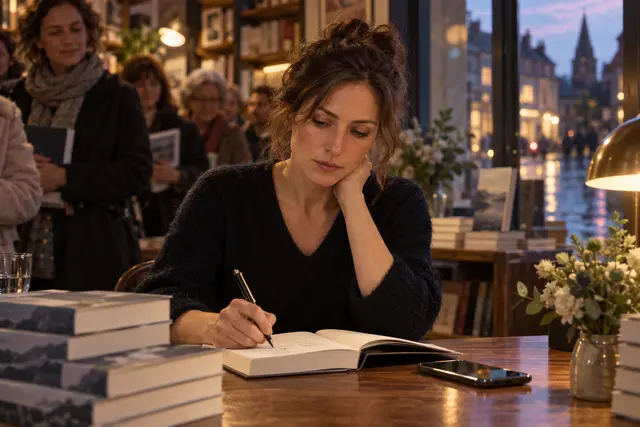
Sonia’s message came as Mélanie signed her seventeenth copy of the evening. She saw it appear above the name of a reader who wanted a dedication for her sister. Six words: The daughter of chapter eleven calls. Mélanie turned her phone over and wrote a sentence about the links that stand up to time. His pen drew an accent where it wasn’t needed.
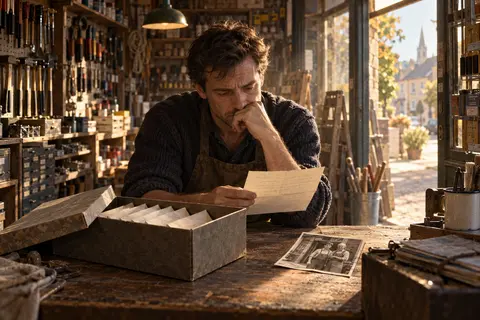
She had published her first novel at the age of thirty-nine, after twelve years of attempts of which she gladly recounted the difficulties. The refusals, the hours taken on sleep, the Saturdays when she had declined invitations. She told less of the people who had given her enough to fill those hours. They appeared in the thanks under initials or in an affectionate formula. She thought it was enough to keep them safe.
The novel was set in a fictional town. A teenage girl, Noémie, was waiting for the letters of a father who had been gone for a long time. In chapter 11, the reader discovered that she was writing them herself. The green ink, the voluntary faults, the stamp taken off an old envelope: the critics had praised the precision of this scene. Mélanie had replied that the imagination worked with small details.
Sonia had told him the letters when they were fifteen years old. She had asked never to repeat it. They were sitting in a reserve behind her grandmother’s grocery store, among the boxes of water and bags of potatoes. Mélanie remembered the cold of the tiles under their legs. She didn’t use that detail in the book. She considered this omission a delicacy.
After the meeting, Marianne, her editor, told him that a second impression was being considered. The first draw sold well. There was a price on his list. The library of Valrue, his childhood city, was preparing for his arrival the following Saturday. There would be teachers, old acquaintances, maybe the local press. Mélanie smiled at the right moment and looked for her coat.
In the street, she recalled Sonia. It sounded a long time. When her friend picked up, Mélanie heard behind her the regular sound of a machine, then a door that closed.
— “Have you read it?” she asked, before she could hold the question.
— My daughter read it before me.
Mélanie stopped under an extinguished sign.
— Sonia is a novel.
There was a silence, long enough for her to hear her own sentence ending in hurting.
— “I know,” Sonia replied. I'm not a novel.
2. Everything that had changed its name
Lina was sixteen years old. Mélanie had sent him the book with a dedication: To the one who will invent the next. She even thought Sonia would be happy to see her writer friend cheering on her daughter. She now remembered the lack of response after sending. She had attributed it to a busy life, which had allowed her not to insist.
Lina had recognized the grocery store, the dog called Igloo, the little scar on the heroine’s thumb. Mélanie had changed the name of the city and that of the father, but kept the dog because no other name seemed so right. In reality, Igloo had been dead for twenty years. She believed that the dead could no longer point to anyone.
In high school, a friend recognized the same things. She knew Sonia’s grandmother, who had held the grocery store until late in her life. The passage on the letters had begun to circulate in a group of messages. Lina asked her mother if it was true. Sonia answered him. The difficulty of this answer did not appear in any of the criticisms received by Mélanie.
— “Are they laughing at her?” asked the writer.
— There are some who laughed. There are some who have been kind in this way that forces us to thank. Do you want to know which is worse?
Mélanie was looking for something useful. She could write to Lina, talk in high school, publicly explain that Noémie was invented. Sonia stopped him on the third proposal.
— "And what do I do?" I tell my daughter that I lied by telling her the truth?
— I can tell you that a lot of scenes are imagined.
— Are you going to put labels on the pieces of my life?
The question left Mélanie without a sentence. She heard the machine behind the door again. Sonia was working in a retouching workshop. She had left the room for a few minutes for this call, probably leaving a half-finished hem. The writer imagined the scene with an ease that made her suddenly ashamed.
They agreed to meet on Thursday, two days before Valrue’s meeting. Sonia chooses a café near the train station, far from the old grocery store. She asked that Mélanie come alone.
At the hotel, Marianne sent him a photograph of the pile of signed books. It was a beautiful evening, she wrote. Mélanie looked at the lined covers, the names printed in large characters. There was only one. She had always found this obvious. For the first time, this evidence seemed incomplete.
3. Draft approved
Back home, Mélanie looked for their old exchanges. She knew that she had sent Sonia a first chapter two years earlier. She needed to find her answer, as we are looking for an invoice that could prove that we have already paid. Her husband, Jules, looked at her from the office door.
— Are you coming to eat? he asked.
— "Wait. I sent him the beginning.
She finally found the message: It’s beautiful, keep going. You found exactly the light behind the store. She went down with the computer, which she put between the plates.
Jules read the message and then opened the attachment.
— Where are the letters?
— "Not yet. It was the first version.
He scrolled a few pages before returning the screen. The gratin was cooling. Mélanie looked for another exchange, an allusion that would prove that Sonia knew; there were only news of the children and holiday photographs.
— I wanted her to read the finished book.
Jules served him a part.
— Did you ask her if she wanted to?
She pushed back the computer to take her plate. Two years earlier, she had already hesitated to send Chapter 11. Sonia could have asked him to take it away. She promised to talk about it later, when the text would be good enough to be understood.
The next day, she reread Chapter 11. The sentences seemed to be intact. It was almost the worst. They still had the rhythm she had worked on, the end she was proud of. Nothing in their quality bore a trace of the harm they could do. She had hoped to discover a bad passage that was easy to condemn, and found herself in front of the best place in her book.
She called Marianne. The editor listened to him to the end, then asked what details allowed identification. Mélanie enumerates them. Marianne proposed to discuss possible changes for a new impression. She also reminded that the copies already sold would not disappear. Mélanie knew this fact; hearing it finally gave her her material weight.
On the shelf, she had stored the twelve copies received for her. She took one. The cover weighed almost nothing. The book had already left its scope.
4. Coffee away from the grocery store
Sonia came before her. She wore a dark jacket, a worn-out bag, and glasses that Mélanie didn’t know about. They had seen each other the previous year during a quick passage to Valrue. They exchanged news, memories, photographs of their children. Mélanie had confused the length of their history with the precision of their current knowledge.
She wanted to kiss Sonia. Her friend stepped back slightly, just enough to make the gesture impossible without a scene. They sat down. The waiter took their order with a professional gaiety that seemed to come from another floor of the world.
Mélanie had prepared some sentences. Sonia asked him to wait. She first wanted to know when the idea of the letters came into the book. At the third draft, Mélanie replied. The character lacked something that made his expectation active. Sonia closed her eyes.
— Do you hear what you mean about me?
— I am talking about the character.
— “It’s practical. You can change people in the middle of the sentence.
Mélanie moved her cup. A damp circle remained on the table; she placed the saucer on it, without being able to look at Sonia.
Sonia explained that the hardest part wasn’t just Lina’s discovery. Since the publication, a former neighbor had told him about her father with a new and unbearable tenderness. One client had asked if she was still writing letters to men who didn’t respond, thinking she was joking. She had to decide every time what she corrected, denied or let pass. Mélanie gave him a job she didn’t ask for.
— “In the book, you make it almost beautiful,” said Sonia. When I was fifteen, I didn’t need it to be beautiful. I needed you to be quiet.
The writer felt the tears rise and held them back. She didn’t want to force her friend to console her. She explained what she had proposed to Marianne. Sonia listened without saying that it fixed anything.
— I’m not asking you to burn your books. I don't even know what I can ask. I want you to stop saying that everything is out of your imagination.
Mélanie promised not to say it again. Sonia then took out an envelope from her bag.
— "There is something else. Before Saturday, you have to read this.
She put it between the cups. Mélanie recognized the green ink before recognizing its writing.
5. The first letter
She had forgotten. Or she had stored this memory in an area too narrow for it to bother others. The first letter was not written by Sonia. It was she, Mélanie, who had offered to answer in the place of the father.
They were fifteen years old. Sonia was waiting for a mail after getting an address through a family acquaintance. Weeks had passed. At school, others talked about holidays with their parents. Sonia claimed that she might join her father during the summer. Mélanie wanted to make her laugh, to relieve her, to show that she could find a solution to this void. She had taken a leaf and imitated an adult voice.
At first, they both laughed. Then Sonia asked if she could keep the letter. She started writing others. Mélanie had witnessed this change without knowing what to do. She had convinced herself that she had only proposed one game, and that the rest belonged to her friend.
On the preserved sheet, there was a sentence that she had almost reproduced in the novel: I would even recognize you in a crowd. The last time she read that promise was in the middle of an excerpt published by a magazine. She appreciated that we chose precisely this line.
— Did you keep it all this time? she asked.
— Not on my pillow. In a box. You can keep one thing without entrusting your whole life to it.
Mélanie rereads the date. She wanted to say that her book did not pretend to tell the facts faithfully. She now knew what that response would avoid. She had taken Sonia’s pain and removed from the story her own gesture, one that made the scene less pure, less admirably lonely, less comfortable for the author.
In the novel, a friend understood Noémie’s secret and stayed with her without judging. This friend had some Mélanie traits. She had retained her best role and abandoned the rest to fiction.
— “I’m not saying you created my father’s absence,” Sonia said. I said you were there. Not just as a generous witness.
Mélanie nodded. On the leaf, its old capital M always looked like two mountains. She remembered that they had laughed at this writing that day, before Sonia asked to keep the paper.
When they came out, the rain stopped. Sonia took the envelope. Mélanie had the reflex to ask if she could photograph her to check her memories. She stopped before she spoke. Her friend put the letter back in her bag and left with what belonged to her.
6. The place you are given
At the library, a poster announced: Mélanie Darel, the imagination as close as possible to the real. The manager, Laurence, had chosen her before knowing their conversation. Mélanie called him on Friday morning to ask for a change to the program. She would not read chapter 11. She wanted to talk about the writing choices and what they entail, without telling the lives of the people who inspired the novel.
Laurence asked if there was a problem she needed to know. Mélanie replied that she had used confidence without measuring or asking what her use would do to someone. She did not give the name Sonia. The librarian remained silent for a moment, then proposed to maintain a shorter meeting, centered on the work of the book and the questions of the public. They would agree in advance not to look for real models behind the characters.
Marianne preferred to report. She feared an improvised statement that would worsen identification and turn a private person into a local news item. Mélanie understood this fear. She did not want a spectacular confession where Sonia would still serve as the setting for her own courage. They prepared a few exact sentences, limited to her responsibility as author. No additional clues. No mention of their meeting at the café. No mention of the letter found.
His mother called in the afternoon. She had heard that there would be a change and wanted to know if Mélanie was sick. Upon learning of the conflict, she sighed.
— “Sonia has always been sensitive about this story.
Mélanie felt the ease of this outing. She could have borrowed it, accepted that an old fragility explains everything and found herself on the reasonable side of the conversation. She looked at the books on her desk.
— It’s not a weakness that allowed me to tell it.
His mother took a slight turn. She wanted to support her. Mélanie replied that she knew this, but that the support could consist in not providing an excuse. They left with a new embarrassment. Not all the consequences concerned Sonia; some transformed the places where Mélanie used to be innocent.
In the evening, she wrote to her friend to clarify what she would do on Saturday and what she would not say. She did not send the text for validation, as if Sonia now had to reread her speeches. She gave him only the information, without asking for an answer.
Sonia replied an hour later: I will not come. Mélanie looked at these four words for a long time. She secretly imagined seeing him in the back of the room. He still had to give up an audience for his apology.
7. The chapter you don’t read
On Saturday, the library was full without being crowded. Mélanie recognized a former teacher, two neighbors of her mother and the baker where they bought teenage sweets. She searched for Sonia’s face, then forced herself to look at the people present. They had not come to judge a scene whose limits they still did not know. She shouldn’t invite them.
Laurence began by questioning the time of writing. Mélanie answered honestly, without drawing up the catalogue of her sacrifices. They talked about abandoned versions, the main character, the work of the sentences. Then came the question of the sources of the novel. The writer placed her hands on her knees to stop touching the glass of water.
— I’ve said so many times that I’ve invented everything. That is not true. Like many authors, I work with memories and what I’ve heard. But this general phrase can become a way of not responding to a specific choice. I used a confidence that was not entrusted to me for publication. I won’t say any more here, because it would do the same thing again.
The silence was less dramatic than she had imagined. Someone coughed. A chair squeaked. Laurence asked her what she wanted to change. Mélanie spoke of the revision of the text, of the details allowing for recognition and of the need to distinguish what one has experienced oneself from what one has received in the intimacy of a friendship. She did not present these intentions as a refund.
A man raised his hand.
— "But who is it?" We must know...
— "I will not answer that question," said Mélanie.
Laurence immediately intervened to recall the setting of the meeting. Another person asked if you could still write anything in fear of hurting. Mélanie felt the temptation of a brilliant answer. She could have talked about art, freedom, the function of literature. She replied more simply that she did not think she had to silence everything, but that she had long confused the fear of losing a good scene with an artistic requirement.
After the meeting, readers came to see her. Some praised her for her courage, which seemed almost as uncomfortable as the criticism she expected. She thanked without prolonging. A woman asked him if the novel was still valid. She said she hoped it still contained something to read, knowing that this question was not erasing the other.
She left with fewer signatures than expected and more fatigue. Outside, the city continued normally. She felt a strange relief: no public revelation had granted her the right to consider the matter closed.
8. Sentences that cost
The review began the following week. Marianne got the new impression waiting for work on the text. They drew up a list of identifying elements, passages from confidences and those that Mélanie had actually invented. The work was accurate, often ungrateful. Changing a dog’s name wasn’t enough when an entire scene kept the contours of a life.
Mélanie first proposed to move the episode from the letters, and then to make it less recognizable. Each solution preserved the passage she loved. Marianne let her defend three versions before asking if she was still looking for a camouflage. The writer closed the file. She spent a whole day without coming back, furious at a question she knew the answer to.
She finally chooses to remove this sequence and reconstruct its consequences differently. Noémie still had an absent father; the absence did not belong to one person. But the invention of the letters, the ink, the stamps, the discovery by the friend and the associated details disappeared from the new version. This changed several chapters. The novel lost an articulation that she had long believed indispensable. He found another one, less spectacular, around a decision that Noémie made herself rather than a secret revealed by someone else.
The second version would not erase the first. Mélanie reminded him in her message to Sonia, describing the changes without sending her a manuscript to correct. She proposed a conversation, if and when her friend wanted it. Sonia replied that she needed distance. She didn't say how long.
The organizers of the prize asked which version would be presented. After discussion with Marianne, Mélanie withdrew her candidacy that year: she no longer wanted to publicly defend a text she was in the process of modifying in this way. She was disappointed with the violence she was ashamed of. Jules told him that doing something necessary did not prevent him from regretting what it cost.
At home, their daughter Zoe asked why the book had changed. Mélanie explained that she had told something that a person had entrusted to her alone. Zoe thought about it, then asked if she had used the stories she was telling her when she got home from school.
Mélanie answered no. Then she realized that she had to give something other than a reassuring answer. She told him that if she ever wished to do so, they would talk about it before, and that a refusal would not become a proof of lack of love. His daughter shook her head and resumed her snack. That confidence still existed. It just became less automatic.
9. What Sonia had written
Two months passed. The new impression came out with a mention of revision. The first copies continued to circulate; some bookstores still had stock, readers lent them, extracts remained in accounts. Mélanie stopped checking every day what was said about the withdrawn passage. Surveillance did not have the power to remind her.
One Sunday, Sonia finally accepted a call. It did not begin with the book. She talked about the workshop, about Lina looking for an internship, about a leak in the kitchen. Mélanie listened without seeking in these details the sign of forgiveness. She would have liked to have regained their former facility, but understood that impatience could still become a request addressed to the one who had already borne the consequences.
Sonia had read the revised passages that the editor had proposed to send her, without obligation of return. She wanted to know what was no longer in the new version. She simply confirmed that she had noticed the changes. Then she talked about Lina. Their conversation about the absent father had continued after the first anger. Her daughter had not become happier because of the book; she now knew part of the story, in the words Sonia had finally chosen herself.
— “She asked me why I kept the letters,” she said. I explained to her that I could have been that girl without being that girl all my life.
Mélanie looked out the window of her office. In his novel, Noémie remained in the most poignant place. Sonia had spent twenty-four years getting out of it, working, loving, being wrong otherwise. She had brought her back to fifteen with a strength that the elegance of prose made almost invisible.
— “I’m sorry,” she said.
— I know you are.
She added nothing. Mélanie had to learn that this sentence could be received without immediately opening another one.
Before hanging up, Sonia told him that she had written a few pages for Lina. Not a book, not a public response. Memories she wanted to transmit, with blanks she didn’t have to fill. Mélanie asked if she could read them one day. She almost immediately regretted the speed of the question.
— "Perhaps not," Sonia replied.
— “Okay.
This was their last important word in the call. After hanging up, Mélanie didn’t turn it into measurable progress. They had spoken. The future of their friendship had not been announced. Some things could remain open without her adding an end to it to reassure herself.
10. The Second Book
In early winter, Mélanie returned to Valrue to see her mother. The old grocery store had become a phone repair store. She stopped in front of the window, looking for the location of the reserve behind the aligned screens.
Sonia crossed the street with Lina. They each carried a bag and seemed to argue over the direction to take. Mélanie raised a hand. Sonia answered him, then caught up with her daughter, who had already turned to the corner. Nothing in their gestures looked like a scene written for her.
At her mother's house, Mélanie found a box of notebooks. In the first, heroines announced their courage before doing anything. In the second, she had copied phrases heard at the Sunday meal. The third contained an argument with Sonia. Mélanie already gave herself the role of the one who had understood everything and generously forgave herself for not being understood in return.
She took this notebook with her. On the train, she read it to the end. At fifteen, she wasn’t just lying to make us love her. She sometimes wanted to have the last word after the others had left the room.
Upon his return, an email awaited him. The press secretary offered a long interview to a magazine. A journalist had attended Valrue's meeting. She wanted to return to the revision of the novel, on what an author owed to those he was inspired by. The message was warm. There was a possible angle attached to her: “She dared to rewrite her success.”
Mélanie smiles as she reads it. The smile sat on her face for a moment before she knew what to do with it.
She opened a document. She could talk about work, the difficulty of removing a scene, the price she had given up. No name, no new details. She was used to it now. The first sentences came quickly.
At the end of a page, she recognized her own voice in the library: grave, precise, capable of not completely granting forgiveness to leave the public the pleasure of offering it to her.
She called Marianne.
— Have you read the proposal?
— - Yeah. You don't have to answer.
— She's good.
— For the press, of course.
Mélanie looked at the first paragraph she had just written. She described the twelve copies on her shelf, their sudden weight, her hand on the cover. Sonia was not there. You can find it behind every sentence.
— Would that help the new edition?
Marianne did not offer him the answer that would have facilitated the refusal.
— "Probably. I can't promise you otherwise so you'll feel better.
They talked about sales. They had slowed down. The withdrawal of the prize had removed several possible encounters. The review had required work and cost money. Mélanie knew all this; this time the numbers stayed with each other instead of becoming proofs of her sacrifice.
She said she would respond the next day.
In the evening, Jules found her in front of his computer. He read the title of the document: "What Writing Taught Me".
— Is it for the magazine?
She nodded.
— Do you want to do it?
— - Yeah.
He waited.
— "That's what bothers me," she added.
He did not make the conclusion in his place that she was beginning to seek. He said dinner was ready. She saved the page, then went down.
The next day, she declined the interview. She proposed to answer in writing the only questions concerning the modifications of the edition, without any account of the friendship or their confrontation. The journalist was looking for this story. The proposal went no further.
No one applauds. Marianne replied that she had transmitted. Sonia didn't know. Mélanie spent part of the morning imagining the portrait that might have appeared, the photograph in her office, the sentence extracted in large characters. At last she closed the page where she had begun to prepare herself for an admirable place.
She didn’t have a second novel yet. For several days, this absence irritated her more than she would have confessed. She could write a page about silence; she was less likely to stand in front of a blank page without asking someone else to fill it out for her.
One Thursday, she resumed an old abandoned beginning: a man discovered that a piano ordered under his name had been delivered to him. She didn’t know what she had planned after the third page. She tried two sequels, found them bad, and then wrote a third. At six o'clock, the character had still not found the owner of the piano. Mélanie went down to dinner without having solved the problem.
On the stairs, Zoe stopped him. She wanted to tell him something, but first asked him if she was going to put it in a book.
The question did not look like a warning. It had become necessary.
— "No," said Mélanie.
Zoe looked at the notebook she still held in her hand. Mélanie placed him on the step, closed, and sat next to her.
His daughter started laughing. She talked a long time. At one point, Mélanie thought that one of her expressions was wonderful and felt her hand looking for the notebook.
She left it on her knee.
Later, when she came up, she picked up the pages for the magazine. She didn't erase them. She placed them in the file of abandoned projects and changed their title so that she could recognize what she had tried to do.
“The 11th chapter again.”
End