1. The Window
The first time the window lit up, Nora believed a reflection. It was seven o'clock. On the other side of the lake, the Hôtel des Roches had no electricity for thirty years.
She placed her cup against the window. A yellow light occupied the third floor, exactly above the balcony where her mother had photographed her as a child. All around, the facade remained black. No car on the way, no movement behind the other windows. Just that stubborn rectangle in the evening blue.
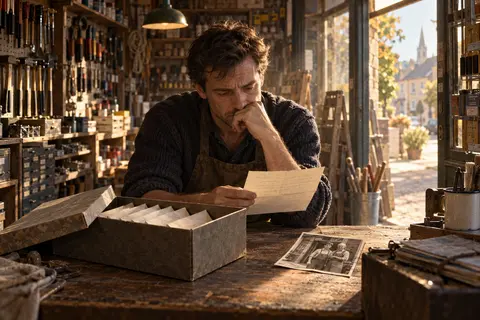
On the table, an envelope had been waiting for him since morning. His name was written in his father’s hand. It would have been less disturbing if he had not died eleven days earlier.
Inside, a single sentence: “If the light comes back, look for what we left in room six.”
All day, Nora had wanted to recognize one last game of her father. He invented treasure hunts for her birthdays; she had kept until twenty years old the habit of looking under her plate before eating the cake. This time, the envelope had arrived by mail, attached to the notary's papers. And someone had just lit the light on the other side of the lake.
She called the notary. He had already closed his office, but answered with the embarrassed patience of people who were grieving without knowing how to talk to him. Yes, his father had entrusted him with this letter. Three months ago. No, it should not be sent on a particular date. He had just asked to be handed over after his funeral.
— Did he tell you about the hotel?
The silence lasted just enough to become an answer.
— “Your father asked me to keep a second document. Underply. I can't tell you the content by phone.
— You are forty minutes from my house.
— Come in tomorrow morning.
On the other side, the light went out. Nora consulted her watch: 19:12. Five minutes exactly. She noted the two hours on the back of the envelope, put on her shoes and took the flashlight that her father kept in the drawer of the tea towels.
When she returned to the village, she found the house smaller than in her memories. Tonight, as she closed the door, she had the opposite impression for the first time. Something continued to grow in his absence.
2. The Photograph Returned
Before she came out, she came back for a raincoat. The landline phone rang as she closed the buttons. She had planned to terminate that line. She walked away without thinking.
— “Did you get the papers?” asked a woman’s voice.
— What papers?
A traffic noise passed behind the handset. The woman asked if she was talking to Louis' daughter. Nora answered yes. Her correspondent paused for a moment, then said she would call back. The line was cut before Nora could ask him his name.
She looked at the notebook near the phone. His father still wrote the numbers in his hand. The last pages had been torn clean, with a rule. On the next sheet, a pressure from the pen had left a trace of an amount. Nora tilted the paper under the lamp. She distinguished a seven, two zeros, and then nothing. She didn’t know if it was money, a date, or the end of a number.
The notary had told him of a simple succession: the house, some savings, no known debt. His father had been a modest man, thrifty enough to wash the freezer bags. However, she remembered that he had paid for his studies without ever accepting that she would repay him. Whenever she asked how he had done it, he replied that a father knew how to cope.
On the fireplace, a photograph of the hotel was turned towards the wall. She found it that way in the morning and didn’t touch it. Now she returns it. His mother was standing in the balcony, Nora against the hip. The little girl was wearing a red vest. At the edge of the frame appeared another hand, cut on the wrist by the framing.
Nora removed the back carton. The complete photograph was a few centimetres under the mat. To the left of his mother was a young woman who vaguely resembled him, or perhaps it was only the same way of leaning towards the child. She held an envelope against her skirt. With her other hand, she guided Nora’s fingers around a piece of chalk, near the balcony wall.
On the back, three words: “Before the pay.”
Nora rested the frame without closing it. She was wrong to take the letter for a game. Her father had devoted enough care to hiding certain things so that she stopped imagining that he would simply give them back to her.
3. Room six
The path of the shore ran along the old fishermen's huts. A gate closed the access to the hotel. She wore a new chain and a sign announcing a residential project, with a drawing of white terraces instead of the black building. At the bottom of the sign, the name of the promoter was also that of the president of the commune: Varenne.
Nora knew of another passage. As a child, she had spent two summers here, when her mother repaired the curtains and tablecloths of the restaurant. Behind the laundry, a service staircase went down almost to the water. The little door, once always open, had lost its handle. It was enough to push up to the lock.
The dust looked like ashes. In the hall, a mirror returned the light of its torch in fragments, between the sheets of paper that covered it. A brief noise came from the ceiling. One step, maybe. Nora stopped breathing, then heard a trickle of water dripping into a bucket.
Room six was on the third floor. The numbering followed the old building and not the landings, a detail that had always amused her. She went up counting the steps. At the twenty-seventh, his lamp illuminated a trace of sole, clear in the dust.
The door of the six was half-open. Inside, the furniture had disappeared, but someone had placed a battery lamp on the windowsill. A digital timer indicated another nineteen hours seven. Nora felt her fear change. The impossible had just become a human decision again, and she didn’t know if it was reassuring.
— - You took a long time.
A man stood by the door. She raised the torch to her face and recognized Adrien Roussel, the son of the former receptionist. He was three years younger than her. In the past, they collected the abandoned keys behind the counter.
— Are you the one who lit up?
He nodded and pulled out of his pocket a sheet folded in four.
— Your father asked me to do it. The first Sunday after his funeral. He knew you'd be back.
— He could have talked to me.
— "Yes," said Adrian. He could have.
This simple answer hurt him more than an excuse.
Adrien was now running an electricity company. He had received the external key with the letter. The timer was only a precaution: he did not want to wait alone in the hotel. He asked what Nora was supposed to find. She showed him the message.
They examined the cupboard, the baseboards, the underside of the radiator. On the wall near the balcony, a lighter rectangle kept the shape of a photograph unhooked. Nora suddenly remembered the sound her mother made when she knocked against the wall: two deaf blows, one hollow blow. She had explained to him that the old houses had small hiding places for mice.
The third lath of the panel moved under his fingers. Behind, wrapped in a waxed canvas, rested a metal box.
4. What is missing from the register
They opened the box in Nora's kitchen. It contained a notebook, six photographic negatives and an audio cassette. On the notebook, his mother had written: “Night of October 14. Don’t give it to Varenne.”
Nora was nine that night. She remembered a storm, a car, and her mother’s wet hair. After that, they had moved. His father had said that work was lacking in the village. His mother had died ten years later, of an illness unrelated to this departure. Nora had always classified these events in two separate drawers of her memory.
The notebook was a record of staff schedules. Some names were followed by a sum, others by a cross. In the middle, a page had been ripped off. The next one began with these words: “Lucie left at twenty-three and ten with the extras. I saw her go through the office.”
— "Lucie," said Adrien. Aunt.
Nora looked up.
— It was said that she stole the box.
— "They say it again.
Lucie worked as a waitress. She had left the village a few days after the famous storm, without trying to defend herself publicly. Adrien was fifteen years old when he learned that she was living in Lyon. His mother almost never talked about it. In a small community, he explained, an accusation can become an address: that’s where you’re put forever.
His father's tape recorder was sleeping in the attic. They changed the batteries. First, the cassette produced only one breath. Then her mother's voice came out of the speaker, so close that Nora stepped back.
“My name is Marianne. I make this recording because I can’t get him to write what he saw.”
A chair squeaked. His father’s voice followed, low and slow. He explained that he had seen Henri Varenne, the father of the current promoter, take out a bag from the hotel safe before the storm. The pay envelopes remained on the desk. Lucie had taken them away to distribute them to the employees, as agreed. The flight was declared the next day. However, the complaint included these salaries in the sum lost. The promised bonuses and the last month of the seasonal workers had then been withheld, on the grounds that the caisse was empty.
The tape stopped in the middle of a sentence. Adrien returned the tape. The other side was empty.
— Why didn’t they say anything? he asked.
Nora looked at the window. On the lake, the reflections of the village trembled in long lines.
— I’ll ask that question tomorrow.
5. The noise behind the voice
Adrien was about to leave when the tape snapped. He forgot to stop the tape recorder. The ribbon was still spinning on its empty side.
Nora pressed the stop key, then hesitated. She put the tape back a few seconds. The snap came back, followed by a wrinkle. Adrien leaned towards the camera. Someone had flipped the tape, re-recorded it, and then waited before speaking.
— Get up a little, he said.
Louis’s voice came out of the breath: “Not that word, Marianne.”
His wife answered closer to the microphone, “That’s the one you wrote.”
A shock covered the rest. Nora recognized the sound of the tape recorder being moved on a table. After that, there was only the band that was turning. She waited until the final click, with her finger on the volume button.
They decided not to further interpret the tape before it was digitized. Adrien photographed the pages of the notebook. Nora made coffee. When she came back, he looked at the disassembled photograph on the fireplace.
— “It’s her,” he said. Lucie.
— With the envelope?
— - Yeah. My mother took one on the same day.
Nora asked if he could show her. He said he had to ask his mother first. His prudence irritated him. She searched her own father’s things, opened his house to him, shared a voice she hadn’t heard for twenty years. He still had something on his side.
— “Can you call him now?” asked Nora.
Adrien carefully closed the frame.
— - It's late.
— She must be awake.
— Nora, I’ll ask him. Tomorrow. She doesn’t even know what we found tonight.
Nora put the cups a little too hard. Coffee spilled over the saucer. She took a tea towel, wiped slowly, and then apologized. He was right, and she didn’t like the speed with which anger sought out people who were easier to reach.
Adrien walked away. An hour later, a message arrived. His mother agreed to have him photograph the album, as long as he saw Nora before any publication. In the image attached, the two women stood in front of the hotel, with the little girl in the middle. Louis, Nora’s father, was in the background. He came out of the office holding a dark bag.
It enlarges the image until the faces break down into squares. The bag did not establish anything. Men carried bags every day. But she understood why Adrien had not commented on the photograph.
He was waiting for her to see it herself.
6. The second fold
The notary placed an envelope in front of her without trying to take a solemn tone. He liked it. She could no longer bear the dull voices, the phrases that began with “in these circumstances.”
The document was a signed statement from his father. He admitted to having withdrawn his testimony after threats about his employment and their official housing. Varenne owned both. Marianne wanted to leave immediately, then make public the evidence. He promised to follow her and at the last moment hid the box rather than hand it over to her.
“She thought I had destroyed her. I let her believe it. I am not asking my daughter to forgive me. I ask him not to confuse my silence with the truth.”
The final page contained a list of documents and the name of a former accountant, Esther Favre. She still lived about twenty kilometres away.
— “Why now?” asked Nora.
— He saw the demolition permit in the newspaper. He knew the hiding place was going to disappear. He wanted to come and talk to you, and then his health got worse.
— He was thirty years old.
The notary did not answer. He gave her a certified copy of the statement and kept the original. On his advice, Nora photographed the notebook and had the tape digitized without changing the recording. Anger made him want to go straight to the communal office. She decided to start with the facts that could still be verified.
Esther Favre received them that very afternoon. She didn’t have to look at the negatives for long. She recognized the cash books that Marianne had photographed, page after page, on the lingerie table. Esther had reported differences in amounts. She was told that she confused the seasons.
— I wasn’t brave, she said.
Adrien replied that they had not come to give out medals. The old woman smiled sadly, then showed them a file kept in a shoe cabinet. The doubles of his mail were still there.
7. The exact sum
Esther asked them to stay for the soup. She had prepared a pot for three days and seemed relieved to be able to share a part of it. Adrien went to buy bread. Nora stayed with her in front of the open files.
— "Do you recognize that bag?" she asked, pointing to the album on her phone.
Esther put her glasses back on. She replied that Louis often took the takings to the bank. It was a task entrusted to reliable employees. The word hung between them with an unpleasant weight.
— “My father says he saw Varenne take the money.
— Both things can be true.
The accountant took out a folded statement in an envelope. A sum was included under the title “exceptional advance”. The beneficiary was Louis. Nora read the numbers twice. Seven thousand francs. Exactly the kind of amount she thought she saw on the phone block.
— A loan?
— That’s what the accounting book says. I have never found a refund in the years I have held.
— “That doesn’t prove that he didn’t pay back afterwards.
— No, said Esther. That doesn't prove it.
This restraint prevented Nora from defending herself against her. The old woman accused him of nothing. She only refused to put the numbers in a more comfortable story than the documents.
The advance was made the day after the testimony was withdrawn. Nora felt the heat of the stove becoming unbearable. Until then, she had imagined her father locked in a terrible choice: protect his family or talk. She could have pity on a frightened man. She knew less what to do with a man who had received money.
— Do you think we bought it?
Esther put her glasses on the lift. Without them, his eyes seemed less assured.
— I thought about it when I saw the date. Yeah.
Nora waited until she added something.
— And you asked him?
— He no longer came to the office. After that, you were gone.
— You had our address.
The accountant looked at the pan on the stove. A little soup had dried up against the handle.
— "Yes," she said. I had it.
Nora felt the paper crumple under her thumb. She put it back flat. She wanted to ask Esther why she had not written, phoned, insisted; each question brought her back to the man whose name appeared in front of the seven thousand francs.
Adrian returned with the bread. He understood something in his face and asked for nothing. They ate in a kitchen with an eight-minute clock. Esther explained that she had been leaving her this way for twenty years and was still late. This absurd little confession gave Nora the opportunity to breathe.
That evening, she searched through her father’s bank statements. She found modest, regular transfers to the same account. The first dated from the year her mother had died. Over the previous twelve months, some transfers had been rejected because the account details were no longer valid. The last pages torn from the address book might have been attempts to find someone.
She called the number displayed during the mysterious conversation. A woman answered. Nora recognized the voice immediately.
— - Lucie?
The woman did not confirm it immediately.
— “So he let you search,” she said at last.
8. The woman who asked for nothing
Lucie had been receiving money from Louis for years. The first mandates were marked “hotel regularization”; she had believed in the late payment of the premiums withheld. His lawyer had had these sums settled for a long time. She had asked for an explanation, then discovered that Louis was sending his own savings. She told him to stop. He had continued until the change of bank that had interrupted the transfers.
— "He thought he was buying your pardon?" asked Nora.
— Maybe he was thinking about paying for something that matters. The rest he did not know how to do.
Nora spoke of the seven thousand francs. Lucie knew the amount. Marianne had told him after leaving the village. Louis had accepted an advance to rent another dwelling. The manager then cleared his debt. It was not the money of the robbery delivered by hand, nor was it sufficient proof to recount a precise transaction. It was a favor that everyone knew the price of without having written it.
— Did my mother know that?
— She ended up knowing.
A kettle noise came up at the other end of the line. Lucie asked him to wait. Nora heard him lay two cups. She was relieved to discover that this woman had a life around this conversation, someone with whom to drink something warm, gestures that did not depend on their memories.
When she returned, Nora asked why she had called the house.
— Your father wrote to me in the spring. He wanted to know if I wanted to review the documents. I told him that he had to show them to you. He wrote to me that you would receive the papers. So I wanted to know if he kept his word.
— Did he tell you about the lamp?
Lucie had a brief laugh without joy.
— - Nope. Always his staging. To say three sentences, he needed an entire house.
Nora felt a laugh in her turn, so inappropriate that she choked him. Lucie heard it and did not take offense. For a moment, they were no longer the daughter of the silent witness and the woman accused. They knew the same man, his detours, his inability to start with the subject.
— “There is something else,” said Lucie. Your mother kept a double of the photographs. The box was not the last piece of evidence. She sent them to me.
— Why not use it?
— I used it. To get payment for what I was owed, with my lawyer. The newspaper never talked about it. A discreet way out arranged a lot of people. Me too, at that time. I needed a salary, an apartment, to live somewhere else. I didn’t have to be brave for the whole village.
Nora looked at the pieces spread out in front of her. She had taken their discovery for the beginning of the truth. It was only the beginning of what we had chosen to tell him.
— So what do I do with all this?
— "First read to the end," replied Lucie. Did he leave you his statement?
Nora took the notary's statement. She rereads the first line.
— He explains why he was silent.
— "Then no.
Lucie asked for her email address. Ten minutes later, Nora opened a three-page scan. The first was a letter from Lucie's former lawyer. The second detailed the salaries and premiums finally settled. On the third, Nora recognized her father's writing before even reading its contents.
He didn’t just take a testimony.
“I saw Lucie Roussel take the bag from the trunk, in addition to the envelopes that had been entrusted to her.”
Below, he had described his skirt, the time, the door used. The details were accurate enough to have been retained by an entire village.
Nora placed the sheet on the table. She had printed the document almost mechanically, as if the ink could make it less likely than the screen. His mother had repeated in the microphone, "That's the one you wrote." She didn't ask him to write what he had seen for the first time. She asked him to replace the lie with the truth.
The phone was always against his ear.
— Why didn't you tell me right away?
— I thought it was in the papers.
Nora looked at Louis' last statement. He had listed his fear, threats, housing. He had found a very correct sentence about forgiveness that he did not ask for. But not a line on the woman he had appointed.
Even though he was dead, he had chosen the version she had to love.
Adrien arrived while she hung up. She handed him the page without speaking. He read her standing up, took off her jacket, and then put it back on. Nora followed his gestures knowing already that he would not stay for dinner.
— Did you know that? he asked.
— - Five minutes ago.
He nodded. He believed her; that was not enough to stay.
After his departure, Nora checked his father's two writings. The first had driven Lucie away. The second explained to his daughter how much he had suffered.
She could no longer look at the envelope as before.
9. What can remain in the family
The next day, a message awaited Nora on her phone. President Varenne wanted to meet her about the hotel. She chose the café of the place. She did not call Adrian to ask him to come. She sent him the time and place, then added that she would tell him the conversation if he wanted to.
Varenne arrived without a coat despite the rain. He had a red face, flat hair and a soft back under his arm. He ordered a coffee before he sat down.
— You have entered a private property.
— "With someone who had a key given to my father." If you want to file a complaint, do so.
She repeated that phrase when she came. After she said it, she didn't know what to do with her hands. She slipped them under the table. Varenne opened her file.
— I am not trying to get you into trouble.
He was talking more slowly now. He had found documents, he said. Copies previously sent to the insurer. He wanted to avoid discovering certain things in the newspapers.
Nora lives at the top of the deposition. She did not stretch out her hand.
— “Have you already?” asked Varenne.
— - Yeah.
It disconcerted him more than he thought. He folded the leaf and drank his coffee too fast.
— My father is dead, so is yours. They will not be able to answer. Lucie was paid. What are you going to stir, exactly?
— An accusation that is repeated again.
— With the signature of Louis below.
This time she put her hands on the table.
— - Yeah.
Varenne waited. He had probably prepared several sentences to arrive at this signature. Nora had just deprived him of the path. He leaned back on his cup, rotated the small package of sugar between his fingers.
— “You will not be able to publish only what concerns my family.
— "I know.
— Everyone loved your father here.
She would have preferred a threat. She could have used it to get angry. This phrase made her see the neighbors at the funeral, the hand of an old colleague on her shoulder, the dish left at the door because she forgot to eat.
— “Me too,” she said.
The president closed his case. When he came out, he left the coffee at his expense.
Nora sat down for a few minutes. Through the window, she saw him greet a woman who was pushing a pram. He held the door of a shop. She wondered how often her father had been helpful while Lucie was telling others why she had to leave the village.
His phone vibrated. Adrien asked if the meeting was over.
She replied, “Yes. He wanted me to protect Dad.”
Adrien read the message. The three little dots appeared, disappeared. Nora waited without writing anything else.
“What about you?”
She looked at the file she had brought. Everything she wanted to save was in a handful of memories, and none of it could serve to exonerate her father.
“Me too. That’s why I have to pass on everything.”
This time, Adrien answered almost immediately. He would spend the next day collecting the copies for Lucie. He did not offer dinner. Nora was grateful that he did not pretend that the conversation was already over.
10. The whole photograph
A journalist met them separately. She asked for the original documents, dates, and permission to contact Lucie. When she returned to Nora's house, she had drawn colored lines on a copy of the posthumous statement.
— Here, he admits to having given up on telling the truth. He doesn't say he provided another version instead. Do you see the problem?
Nora had been seeing him for several days. She laid the deposition next to her, accusing Lucie, and then listened to the recording. The reporter did not comment on Marianne's voice. She asked to receive the entire tape, including the second face and the silences.
In the article published a month later, the name of Louis appeared with that of Henri Varenne. The journalist distinguished what the exhibits established, the accounts of the witnesses and what could no longer be clarified. The son Varenne challenged the interpretation of the accounts. Lucie explained why she had accepted, at the time, the payment of her salaries without conducting a public battle any more.
Nora is unable to read the article of a trade.
Her aunt called before noon. She had put the newspaper in front of her, she said, and did not understand that Nora had done this to her own father. Nora asked if she had read the passage about Lucie. Her aunt replied that she was talking about family.
They hung up without wishing themselves a good day.
In the evening, Adrien passed with a copy of the newspaper for his mother. He stood at the door, embarrassed to find her with red eyes. Nora asked him to come in. They drank a glass of water in the kitchen because she forgot to buy coffee.
— “I don’t know what to keep from him,” she said.
Adrien looked at the towel she was twisting in her hands.
— You don’t have to decide today.
She wanted him to tell her that she had done well. She understood from his fatigue that he had spent the day reassuring his mother and that he had not come to absolve anyone else. She put the towel down.
They talked about the construction site, which had fallen behind due to technical reasons. Adrien explained that he had to take the lamp back before the access was condemned. This time, he asked for permission in writing. Nora asked to accompany him.
They returned to room six on a Wednesday afternoon. The balcony was marked with a construction ribbon. On the wall, the displaced latte always let see the empty cavity. Nora passed her fingers over the wood, then stepped back.
— Did he come back here? she asked.
— Your father? To show me where to install the lamp, yes. In March.
— Did he stay with you all the time?
Adrien hesitated.
— - Nope. I went back down to get my stuff in the car. He joined me a quarter of an hour later.
Nora looked at the cavity. Louis had had time to pick up the box, put it in his bag and come and bring it to him. He preferred to let her look. She saw herself again in front of her window, upset to receive a sign of a dead man. Without Lucie, she would have stayed there: her father had been afraid, then found courage in the end.
Adrian unplugged the timer. The screen went out.
— "Why nine o'clock seven?" asked Nora.
— “That was the time he saw you coming home when you came in on weekends. He said you always put your things in the kitchen and looked at the lake.
She turned her eyes away. Until the end, her father had known where she would be, what she would look at, what she would find touching. The precision of this love hurt him almost more than the lie.
On the balcony, she looked for the chalk marks of the photograph: they had long since disappeared. Only the two initials which she had copied afterwards, N and L, remained, engraved in the wood of the frame, under a small house. She thought the L was pointing to Louis.
Back home, Nora printed the photograph sent by Adrien, that of her mother's album. She placed it in a larger frame. Lucie was no longer cut at the edge. She held a child’s hand to teach her how to draw, while Louis, at the back, came out of the office with a bag. There was no way to know what was in it. Nora no longer tried to guess.
She sent a copy of the image to Lucie. The answer came the next day, with a photograph taken in front of a grocery store in Lyon. Lucie laughed between two women, her arms laden with bags. In her message, she explained that she recognized the dress of the hotel and that she hated it: the fabric scratched at the waist. She couldn’t remember the little house.
Nora placed the two images next to each other. One belonged to the story his father had left him. The other continued without him.
He had the envelope for the first day. She hesitated for a long time to throw it away, then to put it away with the letters she loved. She finally slipped it into the archive file, next to the false statement.
Before closing, she reread the sentence that had led her to the hotel.
“Look for what we left in room six.”
He had not written: seek the truth.
End