1. Eighteen Keys
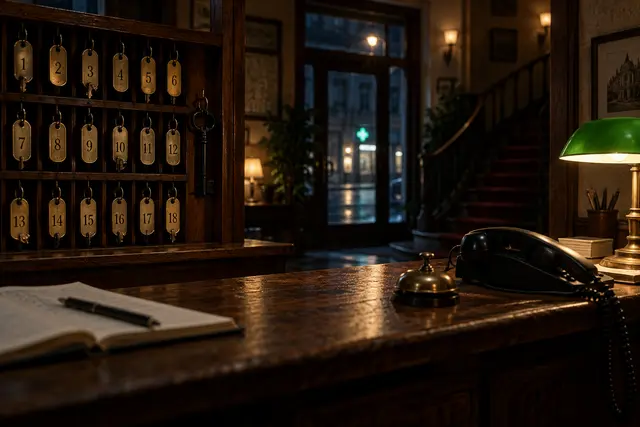
On the first night, Ana counted the keys three times. Eighteen doubles, under eighteen copper labels. The customers carried the originals; these keys had to stay behind the counter. On a hook apart hung that of the garden, big and black. The owner required an inventory at each rotation. He had also left a list of instructions: close the garden at 22 o’clock, check the boiler, do not let the cat enter the kitchen.
The last line was written in pencil: “If the nineteen calls after midnight, do not answer.”
Ana showed the sheet to Malik, the day receptionist. He sighed.
— A joke from the old guard. He was bored.
— - She's walking?
— You will tell me tomorrow.
He handed her his badge. She stared him in the wrong direction at his vest, put the pin back on, and pricked his thumb. Malik found a bandage in the drawer. Under the plastic, his name seemed tiny: ANA. She had come here precisely so that nothing else would be asked of her.
The Hôtel des Tilleuls mainly welcomed representatives and families visiting the nearby hospital. He had nothing of an isolated castle. A pharmacy was facing the entrance and the last bus passed under the windows at 23:40. This banality pleased Ana. After two years working in an emergency department, she wanted nights when the worst news would be a cold radiator.
At twenty-three fifty-eight she made tea. At midnight two, the phone rang.
The screen said: 19.
She stood still, with the kettle in her hand. The ringing stopped at the fourth call. A second later, the printer at the counter woke up and pulled out a blank sheet of paper. Ana turned her back. On the back, in small grey letters, was a phrase: “Let it ring to the end.”
She checked the printer tray, the call log and the office door. Everything was normal. At six o'clock, when she told Malik of the incident, he did not smile.
— “It’s not connected to the network,” he said, pointing to the printer. We've been waiting for the technician since Tuesday.
2. The breakfast customer
Ana did not leave immediately. At seven o’clock, a customer came down with a badly buttoned shirt and asked if anyone had found his scarf. She showed him the basket behind the counter. The man searched for a few seconds, then pulled out a long strip of gray wool.
— “She was in the corridor,” he said. I thought the lady would bring it back.
— What lady?
— That of the reception. Tonight. She opened the door to the garden.
Ana looked at Malik. He had just arrived. She asked at what time. The client consulted his phone, found a call made to his wife and replied: midnight six. He was out smoking. An employee showed him where the ashtray was, then waited for him to close.
— She looked like you, he added. I thought you were sisters.
He paid for a coffee and sat by the window. Ana would have wanted to question her again, but the question of age, dress or voice would have made visible a fear that she was not ready to share. She only asked if the employee was wearing a badge.
— “I haven’t read. He was upside down. She knew I was in the 12th.
Ana looked down at her own badge. He was in the right direction.
The garden was closed at 10 p.m. Ana was sure of that. She had to force on the lock whose inflated wood hindered the race. The key was now hanging on the board, exactly in its place.
Malik offered to look at the cameras. The system recorded only the main entrance and the counter, not the bedrooms or the garden. At midnight six, the client was seen coming down. He stopped at the foot of the stairs and spoke to someone out of the field. Ana was sitting at the reception, visible in profile. She stared at the phone.
— “He speaks to himself,” said Malik.
— He is waiting for an answer.
On the screen, the customer smiled and tilted his head slightly. Then he disappeared into the garden. Ana rembobina. As the man smiled, she herself turned her face towards the stairs. She had no memory of that gesture.
They kept the extract. Neither of them uttered the word joke. Ana returned home in broad daylight and left the radio on while she was sleeping, not knowing yet that another woman had been in the same habit for a very long time.
3. The corridor
Ana returned the next day with the firm intention of not being impressed. She had slept five hours. In the light of his kitchen, the story seemed ridiculous to him. A phone could be malfunctioning. Someone had slipped a sheet into a printer. Two coincidences were not a mystery.
At ten o’clock, a client asked for extra coverage. Ana went up to the second floor. She passed before the sixteen, the seventeen, and the eighteen. The corridor ended on a window opening above the garden.
The window was gone.
In its place was a narrow door, painted the same yellowed white as the others. A copper figure shone at the height of his face: 19.
Ana stepped back a step. She looked behind her, counted the doors, walked back, and found the 16-year-old’s client waiting in the doorway. She handed him the cover without being able to speak.
— Did you hear that too? the woman asked.
— What is it?
— Someone who moves a chair. Above. But we are on the top floor, aren’t we?
Ana said she was going to check the lingerie. She didn’t go back to the back of the corridor. At the bottom, she consulted the evacuation plan: behind the eighteen, the window was clearly drawn. She took the shot with her phone, then went up to photograph the door.
There was no more door. Only a cold window on which his lamp was reflected.
At midnight two, the phone rang. Ana looked at him without moving. Four rings, then a fifth, longer. The screen went out. The printer remained silent.
Under the counter, something struck three times.
4. The Cold Key
The beatings under the counter did not repeat. Ana got up, pulled back to the door and waited. The lobby was so quiet that she could hear the vibration of the refrigerator in the small living room. She called Malik's number. He did not answer. She hesitated to join the rescue, then wondered how to explain that a piece of furniture had just knocked on her own door.
She took the safety lamp and lit the space under the reception. A box of envelopes, two rolls of paper, an unplugged electric radiator. Nothing can make that noise. At the bottom, against the baseboard, a key was placed on a piece of blue fabric.
She didn't touch her. She photographed it, then went to get a clip in the maintenance drawer. The key was longer than those of the renovated rooms. His ring had a little tag with no number. On one side, someone had engraved a vertical bar; on the other, a nearly closed loop.
Together, the two brands could form nineteen. Separated, they meant nothing.
Ana locked the key in a bag for found objects. She wrote the time, the place, her signature. This familiar gesture calmed her down. In the hospital, note exactly what we observed sometimes avoid giving in to what we imagined.
At five o'clock, the bag was empty.
She checked the closure, intact. The key had not slipped behind the drawer. No one came to the counter. On the label, the ink of her signature still looked fresh, although she would have used a ballpoint pen.
A detail holds it. His name was well written by his hand, but the date had changed. Instead of the date of the day was his first hospital contract, eight years earlier. She recognized that day immediately. She had waited for her mother in the rain after work, because she wanted to show her badge before going home.
The memory came full: the white car, the smell of heating, a box of pastries slipped on the seat. Then a less precise sensation, that of knowing oneself looked by someone who was waiting for her to go to the end of the memory.
Ana put the bag face up against the desk. She spoke out loud, for the mere sound of her own voice.
— I'm at the reception. It's five-three. It's raining outside.
In the ceiling, a chair gently scrapes the floor.
5. The watchmen's notebook
The owner returned in the late morning. He listened to Ana as one listens to an unexpected bill, pinching his lips. He proposed to have the standard checked. When she spoke of the door, he advised her to rest for a few days.
— “You’ve been looking for someone for the night for how long?” she asked.
He got up before answering.
Malik waited until he left to take out an old notebook from the drawer of found objects. The cover was marked with the word “Transmission.” The first pages contained ordinary remarks: bulb to replace, leak in the three, taxi reserved for five hours. Then, between two dates six months apart, a different writing had noted, “Don’t give him a name.”
Further on, “Don’t say there’s no one.”
And again: “If you see an extra key, don’t look for the door.”
— Why didn't you tell me?
Malik put a hand on his face.
— Because I have never seen anything. The others were leaving. I thought they were telling the same story. I didn’t want to believe it.
Ana flipped through to the last page filled in. The former watchman, that of the alleged joke, had written there an address and a name: Madeleine. She lived five blocks from the hotel.
Madeleine opened with the security chain still engaged. She was nearly eighty years old, with very clear eyes and a radio so loud that Ana had to repeat the name of the hotel.
— "Did you answer?" asked the old woman.
— - Nope.
The chain slipped. Madeleine let her in.
6. What we leave out
The Nineteenth Chamber had existed before. A small room under the attic for seasonal employees. After a fire, the access was removed and the last landing was redone. Madeleine had worked there as a maid. She remembered a night of snow, long before the work, when a traveler arrived with a suitcase too light.
The hotel was full. The manager let her wait in the lobby and then closed her office. Madeleine had asked if we could prepare the little room from above. He replied that it did not exist for customers.
— Is she gone?
Madeleine looked at her radio.
— I don't know. In the morning, his coat was still there. No one wanted to call anyone. I was told to put it on found objects.
— And since then, she has called?
— I didn’t say it was her.
The silence that followed seemed to absorb the sound of the radio.
Madeleine explained that she had replied only once. She had been asked, “Who is missing?” She had pronounced the name of her sister, who had been dead for ten years. For the next few weeks, she had heard the sister call her in all the rooms where she was alone. His voice always asked him to open a door.
— “What waits up there borrows what you give it. A name, an absence, a concern. Don't give him anything.
Ana didn’t know if she was listening to a memory or a fear that had been nurtured for decades. She asked why Madeleine kept the sound so loud.
— My sister had a very small voice.
Ana looked at the door chain, then at the three locks added to the doorframe.
— Does the radio prevent him from entering?
Madeleine shook her head.
— The radio prevented me from answering. That's all I found.
7. A story with holes
Ana asked if the name of the traveler had been found. Madeleine replied that the register of that time had disappeared during the work. She remembered a brown coat and a light suitcase, but could not guarantee the woman’s age or the color of her hair.
— Did you see her leave the hall?
— - Nope.
— She was able to get out while you were working.
— - Yeah.
Ana waited for the rest. Madeleine rubbed her thumb on the armrest.
— “Is that what you think?” asked Ana. That she's gone?
— Some days.
— What about the others?
Madeleine looked up at the radio. The host announced a record; during the short break before the music, they heard a tap at the neighbor’s.
— The others, I see his coat again. I folded it myself.
She came out of a box several letters from former watchmen. Some had heard a dead person, others a living person. One said he recognized his own voice behind a door while still holding the handset. Everyone had the same question, formulated differently: who were we waiting for? Who did we want to bring in? Who was missing on the call?
Ana read the letter of a man named Laurent. It was nine years old. He replied that no one was missing. For three days, the customers had called him by another name. The payroll software displayed a name that was not his. In one staff photograph, his face had remained clean, but no one could tell who he was.
— What has he become?
— "He wrote me another time," said Madeleine. I didn’t keep the envelope.
She said it too quickly. Ana noticed it, but did not insist. In the hallway of the apartment, a parquet cracked. Madeleine raised the sound of the radio a notch without looking towards the door.
— Have you thought about leaving this apartment?
— - Yeah. Three times.
Ana understood that this was not the answer to her question. Or that it was precisely the answer she would have preferred not to receive.
8. The name on the list
She went to the hotel before her last night to pick up her belongings. Malik had printed the schedule for the last six months. Nine people had occupied the night shift. Some only stayed for a week. The owner cited the lack of reliability of employees, transport, family constraints.
At the bottom of a sheet, a name had been crossed out: Laurent Morel.
— “When was that one?” asked Ana.
— I don't know him. Probably a software error. He returns to the models.
Ana showed the photograph of the letter. Malik read the date, then the schedule. He laid down the leaves and remained silent long enough for her to stop waiting for a joke.
They called the maintenance department of the standard. The technician explained that the number nineteen was still in the old configuration, but that no physical station was connected to it according to the last plan. He could turn off the extension remotely. Malik asked him.
At 6:10 p.m., the counter screen displayed “position removed.”
Ana felt a disproportionate relief. She had forgotten that an anomaly could sometimes be solved by a banal procedure. Malik offered him something to drink before leaving. She agreed, and for twenty minutes they talked about the price of rent, fatigue, and how her son pronounced the word helicopter.
When she came back to pick up her bag, the phone was off. The handset rested straight on the notebook, as if someone had put it down to take a note.
A breath came out.
Ana did not approach the ear. She put the handset back on her stand with a towel, without knowing why she avoided touching it. In the notebook, on the blank page she had opened when she arrived, a sentence occupied the entire width.
“You deleted the number. Not the room.”
She called the owner in front of Malik and told him she was leaving. That’s when he promised to come back at one o’clock, and she made this little arrangement with herself: a few more hours, for the customers, then it would be over.
9. The next generation
The owner was driving to the hotel. Malik had returned to take care of his son. Ana could leave, of course, but eight rooms were occupied. She knew too well the weight of a building left without anyone to decide what to do when an alarm sounded.
She agreed to stay until 01:00. She kept the office door open and all the hall lights on. The notebook lay beside the telephone. At 23:00, she counted the keys: eighteen.
At twenty-three fifty-nine, an additional key.
She hung on the hook of the garden, in front of the big black key. She was wearing a blue ribbon. Ana recognized this ribbon before she even admitted that she recognized it: she attached a similar one to the handlebars of her bicycle when she was a child. The marks engraved on both sides were those of the missing key of the bag.
The phone rang at midnight two. The screen did not show nineteen. He was showing his mother's number.
Ana felt her legs slipping away. His mother had died three years earlier. The number was still recorded in his personal phone, but not in the standard of the hotel. The ringing continues. On the fifth call, she stopped.
A voice came from the stairs.
— Ana, I forgot my keys.
It was exactly his voice. Neither a distant imitation nor a distorted memory. The same gentle fatigue at the end of the sentence, the same breath before his first name.
Ana placed both hands on the counter. She looked at the front door, the headlights of a car passing in the street, the breakfast poster. She named these things in her head to stay by their side.
— Aren’t you going to leave me out?
A walk snapped.
The notebook was open under his hand. “Don’t say there’s no one.” She looked for the next line, but her shadow covered the words. Another march snapped. She did not dare to bend over to move the lamp.
She left the service phone on her base and called Malik with her cell phone. He answered the third call.
— “Speak to me,” she said. Don't stop.
He told him of his sleeping son, of the pasta he had overcooked, of a cartoon whose characters he did not understand. Ana repeated some sentences. The voice of the stairs changed. It became Malik’s, and then his.
— Hang up, she said. It's not him.
Ana looked at the screen of her phone. She heard a child coughing in the distance, a chair squeaking, the ordinary life of an apartment. She clung to these imperfections until she could loosen the fingers of the counter.
10. On either side of the door
In Malik's apartment, his son had just woken up. Ana heard her bare feet on the floor, then a question Malik made her repeat.
— Why is Ana in the hallway?
The receptionist no longer answered. There was a deaf shock, the sound of the phone being caught, and then his breath close to the microphone.
— He looked at the Judas.
Ana searched for what she had said since the beginning of the call. His name? The address? Did she ask to come in? By dint of holding back her words, she didn’t even know which ones she had spoken.
— Keep him away from the door.
— She has your vest.
Malik's tone made her stand up. He was not trying to reassure her. He saw someone.
— I'm at the hotel. Can you hear me?
— - Yeah.
— My vest is on me.
At the other end, a bell rings. Ana heard it in the phone, then again out of the handset, with a tiny shift. She took several seconds to understand: the second sound came from the stairs of the hotel. Someone up there was reproducing what she heard at Malik's.
She pulled the phone out of her ear. His colleague’s breathing continued on the floors.
— Ana?
The two voices spoke together.
She checked the speaker: it was off. She awkwardly touched several icons, moved the phone further away. The voice continued to the top of the stairs.
— “Go to a room that closes,” she said. With your son. Call for help from another device if you can. Say there's someone in front of your house.
— What about you?
The question held her back more than all the voices. She looked at the window of the pharmacy. The on-call pharmacist left a small lamp on. Twenty meters, maybe twenty-five, between two places where someone was still working.
— I'll go out.
— “Then go out now.
Ana had spent an hour waiting for permission. She took her bag. The handset of the standard rose from its base and fell back. She didn't stop. On the stairs, her mother said her name with a perfectly recognizable anger, that rare anger that had always preceded tears.
Ana reached the glass door.
The lock was pulled.
She had not closed it. She took the key to the entrance in the pocket of her vest, missed the lock, started again. His hand trembled so much that the metal rang against the plate. At the other end of the line, Malik was talking to his son. He asked her to put on her shoes. Not the laces, the others.
The key finally turned.
An engine stopped at the edge of the sidewalk. The owner got out of his car, still in communication, and signaled to Ana to open it. She stepped back just enough to let him pass. He had a real wet coat, mud on a shoe and this way of looking at her watch that she already hated.
— What are you doing with your bag?
She put the key to the entrance in his hand.
— There are eight rooms occupied. The doubles table is behind you. I'm leaving.
He wanted to take her arm. She got out, went down the two steps and passed through without checking if a car was coming. The pharmacist saw her knocking on the shutter. He opened the little side door.
— “Stay here for a minute, please,” she said.
He pushed back a crate to give him a chair. Ana finally heard Malik say that someone was picking up his other phone. She stayed online while he gave her address. He used neither the word ghost nor Ana's name. He said that a woman insisted at his door, that he was alone with his child and that he did not want to open it.
The pharmacist put a glass of water in front of her. Ana took it in both hands. On the other side of the street, the owner was standing behind the hotel window. He seemed to be talking to someone next to him.
She couldn't see anyone.
11. Four minutes
When the agents arrived at Malik's house, the landing was empty. A neighbor heard the bell. She didn’t open either. The receptionist spent the rest of the night at his sister's with his son. Ana joined them in the morning.
They drink coffee in a hot kitchen. The boy ate cereal from the box, exceptionally allowed to watch cartoons before school. Malik had taken off his shoes; a red mark barred his forehead, where he had leaned against the door of the room while waiting for the agents.
— “How long have you seen her?” asked Ana.
— Three seconds. Maybe less.
— Did she really look like me?
He put down his cup.
— She looked like you enough for me to get my hands on the lock.
Ana thought of the garden client. She wanted to believe that a frightened person could confuse two others. Now she was looking at a friend who had almost opened her door because of her.
— Why didn't you open it?
— Your badge. She had turned it upside down.
He doesn’t smile when he says it. This derisive detail was all that had been found between his son and the woman of the landing.
They resigned the same day. The owner spoke of fatigue, of shared panic, of an employee whose medical history worried him. Ana let him finish, then asked for a copy of the reception recordings. She wanted to pass them on with her testimony. At that word, he became much less talkative.
He sent the pictures two days later.
The camera did not take the entire street. We could see the counter, the first two steps and, in the glass door, a portion of the sidewalk. Ana looked at the sequence with Malik at her sister's table. The sound was missing, as in the other excerpts.
At five-six o'clock, Ana was behind the counter, phone to ear.
At five-seven o'clock, she got up and took her bag.
At five-eight o'clock she opened the door.
They both lean towards the screen.
The owner's car was not there.
Ana went out alone. The door slowly returned to its frame. Through the glass, she was seen crossing, then disappearing towards the pharmacy.
— "The time of the camera is wrong," said Malik.
He advanced the video. Four minutes later, the car parked. The owner went downstairs, looked for his keys and entered the hotel. He passed behind the counter, put down his phone, took off his coat.
No one had waited for him. No one gave him the key.
Ana asked to come back at the time of her departure. She remembered everything: the buttons on the coat, her sleeve clenched in one hand, the mud on a shoe. She could still feel the fingers on her arm.
In the picture, she held out her hand to someone.
But the owner had not arrived.
Malik stopped reading. He offered to call the police with this new element. She nodded. They sent the entire file, without cutting it, with the times of their calls. Ana also asked the pharmacist if he had a camera. He told her that she was only filming inside.
He had, however, retained a very precise memory of that night.
— “Your colleague has come to get you,” he said.
— What colleague?
— The one that hit after you. You ended up falling asleep in the chair. I told him to come back in the day.
Ana looked at Malik. He heard it, too, through the loudspeaker.
— Did she give you her name?
The pharmacist thinks.
— - Nope. She told me you exchanged your badges.
12. The first name
The hotel closed for three weeks. Craftsmen entered with rolls of carpet; the rooms were repainted. An announcement offered the night shift with a salary a little higher than the previous one.
Ana did not answer. She now worked at the municipal library, reception and storage. She liked the end of the day when several colleagues went together, after checking the windows. None of them thought it was strange that she was waiting to get out.
With Malik, she had established a precaution that they did not tell anyone. When one called the other, they found themselves, if possible, in a crowded place. They were no longer satisfied with a voice. It wasn’t a rule that could protect them from everything; it was a way to keep seeing each other.
They met Madeleine on a Sunday. Ana told him the four minutes and the pharmacy. The old woman stood looking at her hands for a long time.
— Laurent also said that he had managed to leave.
She got up, opened the mailbox and found the one she had claimed she no longer had. She put it in front of them. The writing was tight, almost illegible in the bottom of the page.
Laurent had been arrested when he entered his home. His wife had called the police: a stranger had his keys and refused to leave the vestibule. Her husband, she said, had already returned. He was waiting for her in the kitchen.
Madeleine did not ask them to believe her. She offered them no solution. She gave them the letters, because Ana still had someone to read them with her.
In the autumn, the owner finally sent the balance of the salary. In the envelope was his badge, accompanied by a word: "Recovered behind the counter." The pin had the same twist. A tiny brown spot remained near the clasp, where it had stung the first night.
She put it on the kitchen table.
Then she went to get her old jacket.
She had kept her work clothes at the bottom of a bag, without washing them, without being able to bring herself to throw them away. The badge was still attached, name side against the fabric.
Ana pulled it off. She placed the two small rectangles side by side.
The one in the envelope was carrying the blood stain. The other was clean.
She tried to remember the moment she had turned it over. On the first evening, Malik had given her a dressing. On the third, a hand had held her back before letting her leave. Between the two, she remembered saying her name so many times. To customers. Into her phone. To reassure herself, at five oh three, behind the counter.
His cell phone vibrated.
Malik asked her if she was coming to dinner on Friday. His son had invited a comrade; his sister would be there too. Ana began to answer, erased, resumed. She was going to write that they had to see each other immediately when a call interrupted the message.
The hotel number.
She looked at the screen for a long time. Then she dropped.
A woman cried without noise, breathing in small jolts. Ana recognized how she held her breath so that no one in the ER could hear her crying in the locker room.
— Who are you? she asked.
— "You know that.
Ana only looked at the two badges.
— "What do you want?"
At the other end, a chair scraped the floor.
— “Go back,” said his voice. You took my life.
End