1. A broken line
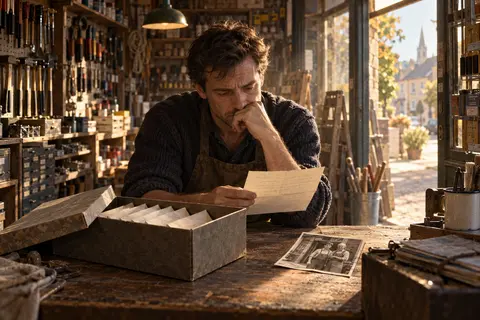
The first thing Sana did when she saw my card was put her mug on it.
— How much did you pay for that?
I released the paper before the tea went through the fold.
— This is not a collection card. It is a statement.
— How much did you pay for this statement?
I didn't answer. The company had given me a numbered copy, two boxes of equipment and a contract advantageous enough for me to stop asking the questions of which I already knew the answers. After eight months of drawing parking lots for people who never looked at my plans, I was finally leaving on a river.
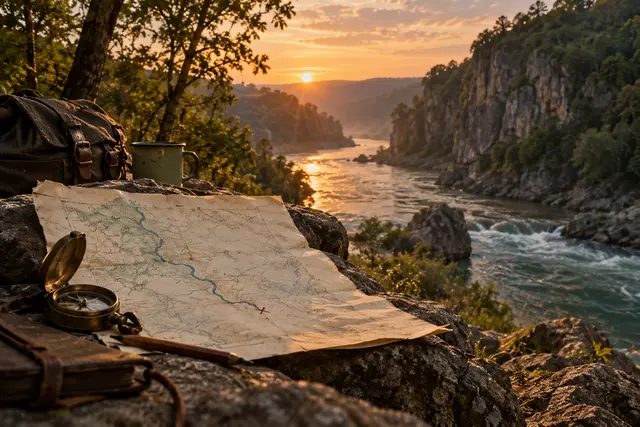
The Orane came down from the northern plateaux before crossing Veyra, our port of departure. On the map, on the contrary, it went up between my fingers, a large blue line that I had to follow towards an old landing. Then, about thirty kilometers from our destination, it stopped.
No tears. No stain. A line that ended in the middle of the paper.
— “The previous expedition did not complete the survey,” I explained.
Sana lifted the cup.
— She may have finished it very well.
She was about forty years old, with narrow shoulders and the quiet authority of the people who had already been entrusted with her life. His boat, the Merle, could carry our small team and our crates to the gorges. She knew the Oran. It was precisely for this reason that I would have preferred her to judge my document differently.
Elias arrived with new boots and a bag that seemed too light. He represented the company. My role was to measure; his, to obtain before Friday a report to defend the reopening of a river link to the Highlands.
— "We are waiting at the landing of the Three Willows," he said. First time buyers want dates.
The fourth person of the journey came out of the hold holding a belt. Inès, mechanic of the Merle, examined it in the light and then stored it with the spare parts.
— Buyers can wait one day if the engine asks for two.
Elias smiles as one smiles at a trade joke.
I was always looking at the end of the blue line. A tiny cross had been traced there, almost erased by successive copies. In the margin, three letters seemed to form a name.
M. A. R.
I noticed that we should ask for the original when we get back.
It was my first mistake: to imagine that important questions could wait for the return.
2. The River at Hand
We left Veyra after the market. On the docks, fruit crates were piled under tarps. The sun was shining on the damaged skin. I carried the sweet smell of this commodity to the first bends of the river.
Elias first spoke of commercial outlets, uninhabited villages, and reduced journeys. He was not unpleasant. He even knew how to listen, provided that what he was told could one day appear in a presentation.
Sana was driving upright, one foot against the bench. She chose a shore, abandoned it, slowed down in front of a place where I could see nothing. When I asked her how she was spotting the passage, she showed me three wrinkles on the water.
— The current is talking about the bottom.
I waited for the following. There was none.
I lowered my measuring device, checked the first points and postponed them. After an hour, my card began to look like a job. The distances corresponded. The villages too. An abandoned mill occupied exactly the expected position.
This precision reassured me too quickly.
At noon we had lunch on a gravel bank. Inès put his hands in the water to remove the black from the engine. A small piece of bark passed between his fingers.
— "It's going up," she said.
I looked at the sky, perfectly clear.
— “It rained on the plateaus,” Sana explained.
She had received the relay bulletin before the departure. Nothing that forbids continuing on that day, provided you sleep before the tightening and re-evaluate the situation the next day. She showed us the program written on her notebook. It included hours of passage, drop-off points and a large box entitled renunciation.
Elias read this box in silence.
— “She’s still there,” Sana said.
In the evening camp, near an old guard house, I found a red mark on a trunk. Same sign as the little cross on my card, but sharp enough to reveal two uneven branches.
— “A measuring point?” I asked.
Sana looked at her.
— A road.
— On a tree?
— Not all of them are on the water.
While we were making the canvases, Elias went away to call Veyra. I heard him pronounce the words passage confirmed.
I had not confirmed any passage.
When he came back, he said he was talking about the first section. It was possible. I decided to believe it, because the trip was more enjoyable as well.
3. The box of too much
The next day, a smell of wet wood preceded us in the gorges. The water had gained a strip of land during the night. Sana spent a long time looking at a clear block near the shore before allowing us to go up.
— "To the basin of the Aulnes." Then we decide.
In the cases, my instruments were surrounded by gray foam. I was looking for a battery when I noticed that one of the company’s trunks had a different number on its lid and on its inventory.
He was heavier than the others.
Elias helped me shoot him, too fast.
— Equipment for the arrival.
— What equipment?
He unfastens the ties.
Inside, there was an enameled plaque, two flags, a roll of ribbon and a pile of small signs indicating FUTURE FLUVIALE LIAISON. The name of the company occupied almost the entire width.
— “They will only be used if the record is conclusive,” he said.
I found under the plate copies of invitations. A ceremony was scheduled for Friday at the Three Willows. Shopkeepers, a district delegation, a photographer.
We had three days left.
I felt anger with a slight delay. It came first in the form of a shame: the only ones not to have been invited to the opening of the road were those who had to verify its existence.
Sana didn't raise her voice.
— This box remains closed. It will not decide our navigation.
Elias wanted to explain that a ceremony could be postponed. Inès asked him why the invitations did not carry this reserve.
He did not answer.
In the basin of the Alders, we found a pontoon torn off, held by a root. The Merle ran along the shore at low speed. Sana pointed to the cliff in front. A recent scar shared the vegetation. The earth was broken off during the rains.
— “We stop.
The word fell without violence. This did not make it easier to accept.
I saw on my map a wide channel, ancient depths, a very continuous line. In front of us, the current was pushing branches towards a gorge where there was not to be such a narrow gorge.
I compared the two once again.
The real river made no effort to resemble the drawing.
4. The Price of a Shortcut
We moored the Merle in a sheltered recess. Sana and I went up to a high point, following the path of the old guards. We stayed away from the unstable edge. From there, the change became visible.
There was a crash in the bed. The water tightened around this obstacle, then disappeared behind a mass of stones and branches. Even after the drop, it would take an adequate inspection, time, information that we did not have.
— “When was your card?” asked Sana.
— , The bottom of the record, thirty-two years. The company said it had confronted him with recent sightings.
— ? Which ones?
I felt my face warm.
— I didn’t have the raw data.
She nodded. Not to absolve me. To record the information.
When we got back down, we heard the engine.
Inès was standing in the boat, furious. Elias had asked to move the Merle a few meters in order to recover a stuck rope. He insisted on going further, seeing the entrance to the channel from the water. She had refused.
The trip lasted only a few seconds. A piece of wood had hit the propulsion. The water began to vibrate in a way that I felt even in my knees.
Inès shut down the engine.
— Now we have one more problem.
Elias opened his mouth. Sana interrupted him.
— You can explain later.
The next day took the whole of the morning. Inès checked the damage from the shore, with equipment designed to immobilize and inspect the boat. She had enough to repair part of the whole, but not the wrong part. We would not resume the current as if nothing had happened.
Sana called the relay. The reception passed badly against the wall; she won the promontory provided on her notebook. When she returned, she had spoken at a post downstream. A team could try to join us after the decline. Not the same day.
We had food, a possible camp on the terrace and what to report our position. There was no reason to throw us into an absurd adventure to make an appointment.
Then a noise reached us from the other side.
Three metal shots, spaced.
Sana raised her head.
Someone had just asked us to look elsewhere.
5. Those who were not on the map
It took the binoculars of Inès to distinguish the silhouettes. Two adults and a child were waiting on a terrace, above the tightening. A shelter of canvas had been erected against the trees. They did not wave their arms randomly. One of the adults showed the top of the shore.
Sana recognized the signal.
— They show us the passage through the plateau.
— Are they blocked?
— I don't know yet.
It does not turn a guess into certainty. I was beginning to understand how much less it cost him than it did me.
The river separated us. We could neither cross the engine nor scream loud enough. Sana used our radio on the service channel originally announced. After several attempts, a voice answered him, chopped but intelligible.
His name was Tarek. He worked for the hamlets of the plateau. With his sister and son, he had left an old depot when the low path had been cut. They were safe, but their boat was below, behind the obstacle. They could walk to the high walkway.
That bridge wasn't on my card.
— "It did not exist at the time of the survey," said Sana.
Tarek could lead us to the Three Willows from the opposite shore. The journey would take a good day with the stops, more if a passage was cut. It was not necessary to wait until the next rains reached the plateau.
We could stay by the boat and wait for the team. We could also reach the high road together, if his condition was confirmed, and then ask for a recovery from the villages. Sana put the options, the resources, the unknowns.
For the first time, Elias did not speak of Friday.
He asked:
— Who checks the bridge?
Tarek knew her; he would approach her without committing himself and describe what he saw. We would wait for his radio return. Sana knew how to reach our end by the wooded terrace. No crossing would be decided remotely.
While waiting, I drew the three silhouettes on my notebook. The radio spat again: Tarek spelled out the name of a woman who could house us if we did not reach the Three Willows before nightfall. I noted it in the margin, next to a point of which I did not yet know the position.
He had to repeat it. I covered the end of his answer by asking him for contact information.
6. What we have left
Tarek’s message arrived in the afternoon. The accesses were clear. He would wait on the opposite shore with his family. Sana organized the start for the next morning, after a last point with the relay.
We had to walk light.
Elias placed the box of the panels in front of our bags, then looked at it as if he were discovering its weight. He took out the invitations, made a packet of them, and slipped them into a pocket. The rest remained on board.
My instruments were asking for a more painful choice. An expensive, fragile and voluminous device would not serve me on the trails. I could keep him safe in the Merle with the watertight crates. To check our course, a simpler equipment and my notebook would be enough.
I spent far too long in hesitation.
— "It is not an examination of courage," said Inès. You gain nothing by wearing what you can’t use.
She took away her essential tools, a damaged room to show to the village mechanic and his radio. Then she added a small tea bag. I looked at her.
— I know how to use it.
We left the relay our itinerary, our scheduled departure time and the contact points. The boat would not be abandoned without news. Sana returned to check the moorings and the position of the crates twice. His hand remained on the hull for a moment.
Sana counted the crates one last time, then asked me for my pencil. On the page where I had written the distances, she drew up an inventory of what remained on board.
— Is he insured? he asked.
— The boat, yes.
She entered the number of the engine, which she knew by heart.
— What about the weeks you won’t be able to work?
— - We'll see.
I wanted to promise him that the company would pay. I knew the timing of my own bills. She handed me the notebook back before I found anything else to say; under the engine she had added two cups and a kettle.
— “You can take that one,” she said, holding out the smallest cup to me. It fits in your bag.
In the morning, the Merle seemed smaller from the way. We went up between trees whose roots formed irregular steps. Elias slipped almost immediately. Inès asked him to slow down before he changed his new boots due to calling a second team.
The path took us away from the sound of the river, and then gave it back to us all at once.
The bridge appeared between the trunks.
She had nothing of the heroic rope that my imagination had prepared. It was a maintained structure, with boards replaced, thick cables and control marks. Its balance and the vacuum underneath were enough for me.
On the other side, Tarek’s child greeted us.
He held a plastic box against his chest.
7. The crossing without photography
Sana and Tarek took the time to examine the accesses. They exchanged information that I only partially understood. A portion of the way after the bridge had received stones; one should go on foot, without trying to carry the crates of the boat.
Then we went through their directions.
I thought I was reasonably indifferent to emptiness. Halfway through, my body expressed a different opinion. My hands were wet. Each step seemed to add weight to the next.
I fixed the back of Inès.
— “Don’t look at me like that,” she said without turning around. I’m going to believe that I left something open.
I'm laughing. The laughter came out of the way, but it allowed me to catch my breath.
On the other side, Tarek gave me a firm handshake. His sister, Alma, carried a repaired canvas bag in several places. His son, Sami, was still protecting his box.
— Insects? he asked.
— charnière Hinges.
He showed me two metal parts and some screws.
— For the school cupboard. My father says that we always find people to inaugurate things. To change a hinge, it is more complicated.
Elias had heard.
No one commented.
We then followed a path that reached the plateau by long detours. In some places, a red mark, identical to that of the camp, appeared on a stone. I photographed it for my reading.
Sana asked me to wait before publishing the positions.
— “Some passages pass through lands where you are welcomed because you are known. A line on a card does not replace an agreement.
I put the device away. I had planned to draw a road, not ask who it belonged to. The work was beginning to change in nature.
At noon we arrived in front of a collapsed portion of the trail. The path still existed on the opposite slope, cut off from us by a few meters of torn earth.
Tarek put down his bag.
— - We're not going through here.
Elias looked at his watch and then took it off. He slipped it into his pocket without saying anything.
For the first time since Veyra, I found a useful gesture.
8. The detour
The detour went through an old career. Tarek knew this variant, but it hadn’t been around since the previous season. We had to go to the first marker and check before continuing.
Maps like continuous roads. Travel is made up of much smaller decisions.
We walked to a fence. Alma recognized the sign engraved on her pole: the land belonged to a family with whom she traded grain. She called before she opened. An elderly woman came from an invisible house under the trees.
She looked at us, counted the bags and asked if we had eaten.
We had eaten. She let us in anyway.
At home, the radio went by. Sana transmitted our position to the relay. The level of the river had stopped rising, but the current remained too strong for the recovery of the Merle. A team would inspect the access the next day. We could win the Three Willows by the quarry, whose path had been cleared the same morning by neighbors.
The information went around the room without causing a scream. It turned into water filled in the gourds, into a piece of cheese added to the bread.
Elias asked the woman’s name to thank her in her report.
— “You can start here,” she replied.
He thanked her.
We did not leave that evening. The announced downpour came faster than us. Yara, as Alma had presented it to us, opened a shed where we spread our things between sacks of grain. Sana prevented the relay of this additional step. Elias read the invitations in the light of his lamp, then put them back in his pocket. To arrive on Thursday, we would have to leave for the day.
The next day we left with Yara's nephew, who was to show Tarek a recent change in the passage. Another line in my notebook, another name. My beautiful self-contained statement now depended on six people that my contract did not mention.
At the quarry, a shower caught up with us. We took shelter in an open building, far from the unstable walls. The water crackled on the sheet metal. Sami checked that the hinges were dry.
I finally took out the old map to compare our detour. Tarek asked for it.
He followed the river with his finger until it was interrupted.
— Where did you find that?
— In the archives of the company.
He brought the paper closer to the light.
— This is Maren’s job.
— - M. A. R., I murmured.
— She signed like that when she was out of space.
I had imagined a missing explorer, a hasty departure, perhaps even a catastrophe.
Tarek carefully folded the map.
— She lives next to the school. She doesn’t like visitors much after dinner.
9. The Woman in the Red Pencil
We reached the Three Willows on Thursday afternoon. The landing place existed. It was small, high on the shore, suitable for local routes. Behind, a path served houses, a workshop and a school whose window closed badly.
Two people were waiting for us under an awning. They had received the news transmitted by radio. We were brought water and then asked what had to happen from the port to repair the Merle.
The ceremony of the next day was still on a poster.
Elias picked it up himself.
Maren received us before dinner.
She was a little woman with white hair, with glasses tied by a cord. She had followed the news of our journey. When I placed the card on her table, she showed no surprise.
— Do they still use the first sheet?
I thought I could hear you wrong.
She opened a piece of furniture and took out a shirt. Inside were the originals of his statement, the copies of letters, the drawings of the tray. A smaller test remained under her elbow when she handed us the other documents.
The second sheet started exactly where mine stopped.
It was not a continuation of the river.
It was a route combining two navigable sections and a land crossing between the two. On the first sheet, at the place of the cross, a complete mention indicated: breakage of load, see sheet two.
The reproduction provided by the company had lost this margin.
— “Why didn’t the liaison open?” I asked.
Maren consulted a file before answering. She didn’t trust his memory any more than she did the rest.
— It worked a few seasons for small loads. The industrial project was too expensive. They wanted only one boat from the start to the finish. I drew them what existed.
Elias sat down.
— “The file I was given was about an unfinished record.
Maren pushed the letters towards him.
— - It was complete. His conclusion was not appropriate.
There was no treasure buried in the white area. There was no miraculous passage that I was going to discover. Only information kept for thirty-two years by someone who had the wrong idea to answer exactly the question.
I put my hand on the fold of the copy.
Our whole expedition was in a margin that no one had thought necessary to reproduce.
10. A different arrival
On Friday morning, the guests came despite the cancellation. Some had gone too far to leave without explanation. The photographer too.
Elias asked for a table under the awning. He laid in front of him the two leaves of Maren, my provisional statement and the invitations he had saved from his box.
I expected a clever speech on a promising first step.
He says:
— “We have not shown that a direct connection is possible. On the contrary, we have reasons not to announce it.
He explained the collapse, the limits of the documents, the damaged equipment. He did not say that we had triumphed over the elements. He said that the insistence of the calendar had contributed to a bad decision near the boat.
Sana looked at him without smiling.
One of the shopkeepers asked who would pay for his trip. Another wanted to know if the company had already promised volumes to buyers. The questions were concrete and unpleasant. Elias noted them. For some, he had no answer.
Then Maren got up.
— There is a road, she said. But it has several pieces and several owners. If you want to talk about this one, the people involved are here.
Tarek placed on the table a local journey book. Alma talked about the loads that could actually be carried. Sana specified what still needed to be inspected. I showed my records, then the parts that I was not able to certify.
The photographer took a picture of our hands around the leaves.
I thought of the enamel plate left in the hold of the Merle. She would have made a much simpler photograph.
In the afternoon, the news arrived: a team had reached the boat through safe access. The repair would require a piece from Veyra, but the hull had not suffered. Sana closed her eyes for a second. I understood that she had been waiting for this phrase since we left the terrace.
She left the next day with the people in charge of the intervention. Inès accompanied her. We parted in front of the school, whose cabinet now had two new hinges.
Sami showed me the doors.
— That, at least, is open.
11. What we put in the white
I was not paid immediately. The company asked why my report did not correspond to the original purpose of the mission. I attached the contract, the available statements and the documents of Maren. Then I waited, with a less romantic anxiety than that of the gorges: my rent.
Elias confirmed in writing the conditions under which the mission had been prepared. He also requested that the Merle be repaired. It took several exchanges. Nothing was settled by a single courageous phrase in front of the traders.
When the money finally arrived, I settled my debts before buying anything.
I returned to the Three Willows two months later, this time by the southern road and then by the paths that the inhabitants had agreed to include in a common document. I was not alone in signing the card. The names of Maren, Sana and the people who maintained the passages accompanied mine.
Some information voluntarily remained out of the public version. The navigation instructions referred to the local operators and the conditions of the time. The limits were no longer little shameful notes: they occupied the necessary place.
The company was studying a multi-stage liaison. It could end or be abandoned. We had promised neither fortune to the villages nor personal victory to the man who had held the pencil.
Maren ran the test with a rule.
— You forgot something.
My stomach tightened.
She pointed to a house near the quarry.
— - His name. It's Yara. Not the old lady of the detour.
I corrected it. I noticed his name during the walk. I just didn’t postpone it.
Maren continued reading. Arriving at the cartridge where I had written down the names of the authors, she laid down her rule.
— You give me a lot of room.
— You had done the work.
She looked at the furniture where she kept her files. I thought she was still going to look for a measure, a badly copied name. She returned with the little ordeal she had kept under her elbow on our first visit.
The river stopped there in the same place as on my copy. The margin was gone.
Under the drawing, in red pencil, four words preceded a signature: good for reproduction, Maren.
I laid my hands flat on the table.
— Are you the one who accepted this?
— For a brochure. They only wanted to show the navigable parts. Sheet two was to be attached to the technical file.
— What about the dismissal?
— Too small, they said. No need for a brochure.
She spoke without looking at the paper. She was clearly familiar with the location of her signature.
— “You told us that your conclusion was not appropriate.
— "It was not so.
— You have signed anyway.
She brought the ruler back to the edge of the table, carefully parallel to the wood.
— The last bill had been waiting five months.
I thought of my rent, of my reread messages before I sent them, of the peculiar sweetness of the first morning when the money had finally arrived. That didn’t make me want to forgive her. This prevented me from answering him as quickly as I would have liked.
— “When did you realize they were using the test without the second sheet?”
— When you put it here.
— You could have shown it to us that night.
She nodded. I remembered my enthusiasm in front of the originals, my relief at being able to oppose real work to the negligence of the company. She had let me do it.
In the yard, children were playing a ball at a dog. I heard them laugh as I looked for a question less unfair than the one that came to me: how long did she still want to let me thank her?
— What will you write? she asked.
I resumed my report. He said that accurate information had been suppressed by the company. It was true. That was no longer enough.
— You have drawn the passage. And approved this reproduction. These are your two signatures.
She read the paragraph I added. She made me replace “map intended for navigation” with “proof intended for a brochure”. I checked the letterhead: she was right. I corrected him, despite the petty urge to deny him this last detail.
His name remained among the authors of the new map. At his request, the small test joined the documents submitted with the supplementary report.
At the port of Veyra, I found the Merle. Inès worked in the back. Sana was drinking tea on the dock. I unrolled the new card in front of them, then showed them the signed copy of the proof. Sana didn’t make the comment I was expecting. She read, looked at the date, and asked if the other people mentioned in my report would also receive the correction.
— - Yeah.
She then followed the route of the journey with her finger. At the land passage, she stopped to move her cup, dangerously close to the paper.
— How much did that cost you?
I thought she was talking about the impression.
Then I looked at the two leaves, the names that had to be added, the signature that had been so pleasant not to see.
— More than expected.
Sana handed me an empty cup. I folded the card before having tea.
End