1. The turn of too much
The ice rink had been empty since Sunday, but someone was still finishing a lap.
Maud heard it as soon as she pushed the door reserved for the staff: three rapid slips, a longer friction, then the sound of a blade pressing back. She had an appointment with the guard to prepare the work. The lockers were open, the end-of-season posters were off. On the ice, no silhouette.
She walked up to the fence. The noise passed in front of her and continued her curve. He had just come from below.
— "The pipes are working," said a voice behind his back.
Eloi was wearing his coat despite the June heat. He had kept this rink for thirty-one years and had to hand over his keys the same evening. Maud, in charge of refurbishing the equipment, knew the facilities well enough to know that a pipe was not running through an oval while accelerating in the bends.
The guard changed a cassette in a device placed near the control room. Ancient music fills the building, with fluctuations in speed and very brief cuts. The invisible skater disappeared under a poorly recorded battery.
— “The sound system will be replaced,” Maud announced.
Eloi looked at her as if she had been talking about tearing down a load-bearing wall.
She presented him with the schedule: inventory, shutdown, complete cast iron, inspection of the slab, works. No public meeting will resume until September. The installation had been kept cold all year until then, even during closures; from now on, this aberrant expense would be corrected.
Eloi only asked to be present for the judgment. He had already transmitted all his remarks, he said, in a notebook that no one had read to the end. Maud promised to consult him. She wanted peaceful cooperation, not a battle with a man who had spent half his life here.
The skater made three slips under a quieter passage of the music. Then the long friction. Then the return of support.
Maud looked at the tracks near the goal. A pale line was drawn beneath the surface, contrary to the old marks. She interrupted exactly at their height.
— Did you hear? she asked.
Eloi laid his hand on the fence. He tapped the wood twice, then a third time after a different interval.
Under the ice, someone tried to answer.
2. The bad music
Djibril arrived at nine o'clock with the measuring boxes and the transport cart. He had been working with Maud for two years. He was the only one of their small team who liked to skate, which had automatically designated him for all the jokes on the construction site. He entered, whistling, and stopped at the first note of the tape.
— Is that a punishment in the contract?
Eloi does not smile. He asked her not to always whistle the same sentence.
The room smelled of warm plastic. Dozens of cassettes occupied two drawers. None were labeled by artist. The cases wore durations, strokes and sometimes the words “too regular”. Maud finally found the keeper's notebook. The first pages listed blisters, interventions, moisture anomalies. Further on, the sentences became incomprehensible.
Don’t let the series end.
Don’t look for where it comes from with your foot.
The answer is not a person.
She raised her head. Eloi stared at the speakers rather than the ice.
— What happened here?
The old man said that the buildings aged badly and that everyone ended up developing their habits. He always wanted to attend the stop. Maud replied that she could not work with hints. If there was a danger in the equipment, she needed facts.
He opened his mouth. Djibril called him from the dressing room: some of the lights had gone out. Maud went to examine the painting with him. During this check, the tape arrived at the end of the tape.
The silence was instantaneous, massive. It didn’t look like the absence of music. It looked like someone had just closed a lid on the whole building.
Djibril took three steps to get to the door. Its soles slammed on the slab. He stopped. Three more steps echoed under them, a little slower.
He looked at Maud and raised his right foot. The noise started again, exactly the same this time.
Eloi ran into the locker room. He threw his coat on the floor and struck the door with his palm, with no apparent rhythm. The underground steps hesitated. At the control room, it took long seconds to flip the cassette.
When the music came back, Djibril had left his foot in the air. His leg trembled. He couldn’t put it where he wanted it.
3. The fourth step
Maud pulled a chair towards him. Djibril tried to sit, but his knee unfolded and forced him to move forward. He took three steps, then a fourth too long, as if he were stepping over an invisible obstacle. His right foot immediately turned back. The sequence begins again.
— “I don’t do that,” he said.
He spoke distinctly, without weakness of face or apparent confusion. Maud called for help, describing the sudden disturbance, their address, and access to the building. She didn’t talk about a skater under the ice. She needed a team to come, not a discussion of what she thought she was hearing.
Eloi wanted to lift Djibril under his arms. Maud helped him. The legs continued their movement in the void, then slowed down when they reached the old rubber mat at the entrance. The young man fell on his knees. His breath made three small repetitions before an inordinate inspiration.
Under the floor, the same breath imitated them.
Maud grabs the cart. Together, they installed Djibril on it, feet off the ground. The wheels rolled to the outer threshold. As soon as they left the slab of the rink for the ramp separated by a joint, the involuntary movement stopped.
Djibril remained folded in two, exhausted. Maud crouched near him. He could move his fingers and legs again. She asked him not to try to get up to show that he was okay. The ambulance was on its way.
Inside, the steps continued without him. Three short, one long. They walked through the locker room with perfect regularity.
Eloi had blemished.
— He was lucky, he said.
Maud pushed him against the doorpost, less violently than she would have liked.
— "You knew.
The guard did not deny it. He only says that in the past, the slab had remained naked until the threshold. He had laid the carpets after an initial incident, and had the ramp replaced so that it would no longer touch the building. He spoke of small works as much larger things are admitted.
Djibril raised his head.
— You protected the exit. Not those who come in.
This time Eloi found it impossible to answer. Ancient music always came from the management. Between two pieces, the fourth step sounded further and further.
4. The face under the lines
The paramedics found Djibril sitting outside, conscious, but unable to explain what had triggered the movements. They took him for an examination. Maud indicated that she would remain available and asked her manager to close the access to the site. She described an unexplained incident, serious enough to warrant an immediate suspension.
His manager agreed. No one else had to come in before an evaluation. This elementary decision gave him some solidity. The outside world still existed; the rink had not swallowed the ordinary rules with the young man.
Eloi did not want to leave the threshold. He had kept the player running, but the tape was nearing its end. Maud forbids him to go back alone. They passed through the rubber corridor to the control room, the floor of which rested on a wooden platform. The supports isolated the room from the slab. This precision, which she would normally have neglected, now seemed essential to her.
Before joining them, Eloi had taken the abandoned coat back into the locker room and put it back on his shoulders. Maud asked who was replacing him during his vacation. He had trained his colleagues to use the recordings and not to be left alone near the runway after the closure. He cited a problem with acoustics and ordinary work precautions. No one had all of his observations.
— "You gave them your habits," said Maud. You kept the reasons.
He said he was afraid he would be fired before he believed him. Then, the years without visible incident had ended up serving as evidence. Each successful day made it more difficult to admit the next day.
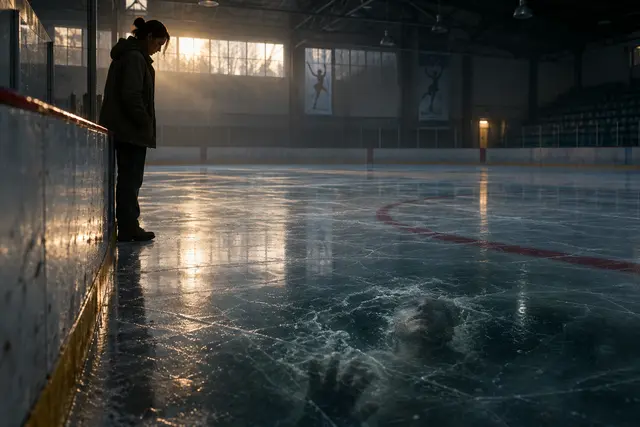
From the window, they could see the whole track. A face appeared under the red line of the center.
He was not a prisoner in a thickness of ice. It stood lower, in a depth that the building should not have had. A cheek, an open eye, and then a mouth were drawn through the bubbles. The eyes did not seem to turn towards them; he waited for the rest of the face to join him.
— How long has it been? asked Maud.
Eloi finally answered. Twenty-nine years earlier, during a closing night, he had heard a knock. He thought that an animal was stuck in a technical passage. He answered with his key. The next day, a shape appeared under the ice. Not an animal. Not a face yet. Something that seemed to want to learn how we moved above.
He had reported noises. The pipelines had been inspected, real defects had been found and these had been corrected. The other phenomena were silent in front of the technicians. Éloi had then discovered that the music disrupted the answers, especially when the recording jumped or changed speed.
— So you let people come back.
The guard lowered his eyes.
— “When there were people, all the noises would mix. I thought I understood.
Under the red line, the mouth opened. She utters no words. She inspired according to the three times of Djibril.
5. A collection of gestures
The face disappeared when Maud lit a second ramp of light. He didn’t run away from the light: the different reflections had simply made him less visible. In the window of the control room, his image remained suspended above the track like that of a swimmer under a transparent ceiling.
Eloi showed him the tapes. He had made the recordings over the years, superimposed incompatible music, added silences of different lengths. He wasn’t trying to entertain it. He tried to prevent her from agreeing on a movement that she could reproduce.
Maud pulled the notebook towards her. Some pages were stained with water, others were almost new.
— Did you write down the dates?
Eloi showed a column. Under the last lines, he had written only “nothing”.
— And when there was something?
He took a cassette, flipped it between his fingers, and then rested it.
The guard recounted an episode that he had not written in his notebook. A young skater had turned alone after training. Three slips, one friction, one return of support. She repeated her face until she could no longer stop him. Eloi had pulled her behind the fence, onto the carpets. She attributed her panic to a cramp. He realized that we weren’t just copying a sound.
— Didn't you tell him?
— “She did not come back. I thought it was better.
The tour heard by Maud when he arrived was therefore several years old. The ice had retained a way of moving, available long after the body had left.
A dry shock made them jump. In the dressing room, the chair Maud had pulled for Djibril slipped a few centimetres. Three strokes, then a fourth longer. It stopped against the wall. The building was beginning to execute what it had learned.
Maud felt anger giving way to a colder fear. Carpets and music were not a cure. They had only allowed to postpone the moment when the accumulated gestures would become quite numerous.
She looked at the schedule close to the reader. Stop, complete cast iron, inspection. What was supposed to be a formality was perhaps the only chance to clear that memory.
Eloi shook her head before she spoke.
— “The last time I tried it, it got closer to the surface.
6. The detached piece
He had tried a cast 20 years earlier. After a few hours, a hand shape followed the painted lines. He had panicked and restored the cold. The hand had sunk again. Since then, he has always maintained a layer of ice, even in times when the ice rink should have remained empty.
— "Twenty years," repeated Maud.
She looked at the hand under the red line. Eloi looked in her face for a reason to let the machines turn; she turned her eyes away to the edge of the track.
Near the maintenance door, a plate had risen at the edge of the runway. Eloi had reported it earlier this week and left it behind a small cone. They saw it from the protected passage. In its thickness, something black moved when the guard laid his hand on the barrier.
— Remove your hand.
The form stopped.
They didn’t need to get on the ice. With the maintenance tool left on the cart, Eloi slipped the fragment already detached into a tray, then Maud pulled it on the carpet. A dark spot remained there, similar to an eye whose outline had not yet been drawn.
They left the box on the platform. In the relative heat of the control, the fragment began to lose its angles. The stain warped, gathered against an edge, and then disassembled into filaments. Maud watched her become inconsistent. She wanted to see destruction, rather than something they could no longer distinguish in the water.
Eloi held his breath. The stain dispersed into a clear puddle. Two dark filaments still adhered to the bottom; he pointed to them without touching the container. Maud covered it with the lid placed under the cart.
Maud noted the time, photographed the container and called his manager. She did not ask that his interpretation be believed from the outset. She asked to maintain the access ban and to have a remote shutdown prepared, under the control of the competent team. The official, who had already heard Djibril from the ambulance, promised to come with the maintenance manager.
Eloi always looked at the water.
— I thought I was preventing him from going out.
The reader produced a snap. The tape was finished.
Under the track, all the tracks learned began to move together. There were steps, blades, a breath, the scraping of the chair. Then a new noise: that of a keyring of keys tapping three times against a railing.
Eloi immediately put his hand in his pocket.
7. The one she already knew
The first shake pulled the guard forward. Maud held him by the coat. He stepped back, but his arm struck the window post with a precision that was nothing like a defense move. Three keystrokes. A silence. Three more shots.
The floor of the house was isolated. Maud searched for the point of contact and found it in his own hand: a section of the mantle hung on the metal barrier that joined the slab. Eloi had let him fall down there as he sat by the window. She pulled the fabric. The disjointed lining had taken hold under a fixing leg.
— - Take it off!
The guard tried to clear his shoulders. His fingers continued their loop, unable to open the buttons. Maud took the scissors from the supply drawer and cut the liner to release the retained pan. Eloi’s arm stopped so suddenly that the keys fell against the glass.
The piece of lining remained attached to the metal. Through the glass, Maud could see Eloi’s fingers finally opening, one by one. She pulled her own coat away from the fence and back to the reader.
She turned the tape with trembling hands. The device swallowed a loop of tape and jammed. Eloi looked at the drawers without moving. Changing the record would not repair a stopped engine.
Maud seized the little enclosure that Djibril had left with his belongings. His phone contained music, but almost all the tracks had a regular rhythm. She passed from one extract to another, interrupted words, changed the volume, added her own voice. The result was unbearable. Under the ice, however, the gestures ceased to overlap.
They had a respite, not a stable solution. Maud could not hold his finger indefinitely over a screen.
Eloi sat down. He had spent years watching the reader and calling it a trade. For the first time, he seemed to consider the possibility that his work had been used to feed what it contained.
In the middle of the track, the shape came up. It was no longer a face. Several incomplete bodies were trying to occupy the same place, each advancing in a different sequence. The arms did not yet know which shoulders to belong to.
8. The exit he had prepared
Maud’s manager, Béatrice, arrived with Laurent, the maintenance manager, at 1:00 p.m. They stayed out. Maud spoke to them by telephone from the control room and described the route to the exit. She demanded that neither of them come to pick them up on the slab.
Laurent knew the equipment. He could arrange the cold cut from the outside technical room, but first wanted to empty the building and check the situation in Djibril. The latter was still under observation; the movements had not resumed. He asked if Maud and the guard had come out.
— “Almost,” she replied.
The word was premature. The carpet corridor ran along the fence to the locker room, then reached the staff door. Eloi had maintained it for years. Now, three rubber plates had moved under the jolts of the chair, leaving a portion of the slab exposed.
From the outside, Béatrice saw the chair through the chain of doors. She saw her doing her four jolts without anyone approaching her. His voice changed on the phone. She no longer asked if Maud was certain of his observations. She asked him what he needed to get out. Maud felt his eyes filled with tears. Being believed did not remove any danger, but spared him the effort to carry this solitude as well. She described the carriage, the passage and the need to maintain the sounds during the crossing. Laurent repeated the information, without adding a word too much.
The guard offered to return them. Maud looked at him until he withdrew the idea himself. Their old habits always brought them back to a person sent to danger to repair what protected others.
Laurent brought from the van a mobile platform with a large plateau. He pushed it from the ramp to the interruption of the path, without crossing the threshold himself. Maud and Eloi joined its end using the carpets that remained in place. They then had to settle there to be brought outside, without letting a foot or a garment touch the barrier.
During this trip, Maud continued to change the sounds on his phone. The keys lost their meaning under his fingers. A song came back twice; the ice immediately answered with the same beginning of the sentence, without words, in the form of shocks.
Eloi went up to the plateau. Maud followed him with the enclosure and the tray of the molten fragment, which she had brought back to the carpets. The guard looked for his keychain, forgotten in the control room, and then raised his eyes to the window.
— You need the keys to...
He stopped. Laurent had the means to access the facilities. There was no reason to go back and look for that familiar little noise.
The platform passed the first irregularity of the soil. Eloi almost laid his hand on the railing. Maud grabbed his wrist. They looked at each other without speaking. This time, he held his two hands tight against him.
The outside door appeared to them much farther than to go.
9. A Night Without a Guardian
When the wheels crossed the ramp joint, Maud stopped choosing the pieces. She cut off the sound, despite Eloi’s gaze. Inside, a hand knocked three times against the window of the control room. Then the same noise occurred in the dressing room. He stopped before the threshold.
The thing had learned the keeper, the skater, Djibril. She had not learned to go through a breakup without any support. They saw it for this outing. Maud refused to make it a certainty about all that could still happen.
The building was banned. Laurent and his team isolated the equipment according to their procedures, from outside technical access. No one went down to inspect the slab. Already installed cameras made it possible to follow the track without reintroducing steps or presence in the room.
The first few hours were the hardest for Eloi. With every sound he heard from the microphones, he wanted to intervene. The cast iron, slow, made the forms sharper. The show looked exactly like the one that had made him restore the cold twenty years earlier.
This time, Maud stayed with him in the surveillance vehicle. She didn’t ask him to trust her. She showed him the tray containing the molten fragment, now placed outside. Nothing was reconstituted there. It was a limited, but real observation. They chose to continue knowing what they didn’t know.
At midnight, the red lines seemed to float on faces. The gestures accelerated. The chair went through the dressing room alone, stopped against the wall and started again from there, without being able to regain its initial position. The sequences conflicted with the building, which no longer offered the same support.
Around four o'clock, a whole shape appeared in the center. She stood up like a person coming up under a surface that was too low. His head had no back. His arms were composed of superimposed movements, transparent between two times. She tried the fourth step of Djibril.
The ice gave way under its own weight. Not in a crash, but with a soft subsidence and a long crack. The form tried to repeat its sequence. A foot stood where there was no support. The rest retreated around this mistake, and then fell back into the water.
Eloi moved his hand towards the screen.
Maud didn't hold him back. His fingers touched cold glass. For once, nothing answered.
10. The conserved room
The inspection began several days after the last piece of ice disappeared. There was no passage under the track or cavity capable of accommodating the shapes seen on the screen. The slab had old defects; the work would be more important than expected. On the videos, the dressing room chair continued to scour its four jolts alone. No one disputes the images. No one proposed to show them to the companies that came to draw up their estimates.
Maud kept the originals. She also placed the tray of the molten fragment in a crate, with its lid and a label indicating the place and time of collection. The water was clear. Two fine black particles rested at the bottom. She couldn't have distinguished them from seal dust.
The container was stored with the elements removed from the site, in an annex of the municipal depot. We kept the pieces whose fate we still had to decide. The room's thermostat was set low; it wasn't a lab room. Maud wrote on the card not to open or empty the tray without warning it. She asked for an analysis, without knowing what research to name. The demand circulated between several departments, then returned with a question about its funding.
She relaunched it.
Djibril remained in detention for several weeks. When he came to pick up his tools, Maud had already taken them out into the yard. He opened the box, moved two screwdrivers and closed it.
— “They were in that order before,” he said.
— I did not touch it.
— "I know.
He did not ask her to understand why she had just put them away differently. They went to have a coffee on the other side of the street. Djibril chose a place where you could not see the ice rink. When Maud asked if he wanted to go back with her to the next job, he replied that he preferred another team for a while.
She says okay. He seemed relieved that she did not ask him to reassure her about this refusal.
The ice rink did not reopen in September. We gave up on ice. The installations were dismantled, the damaged bleachers removed. The building would perhaps serve as a hall after renovation; no one found it urgent to organize an inauguration.
Eloi handed over his keys. They were picked up in the control room once the room was accessible. He asked to see the keychain again, and then refused to take it when Beatrice handed it to him. They listened to him recounting the incidents he had hidden. He made a mistake on a date, found a name, interrupted himself in front of a line of his own notebook. His silence had lasted long enough that some witnesses could no longer be found.
After the interview, he asked Maud if she thought we could learn to sleep without hearing the building.
She replied that she did not know.
In December, she met him at a bus stop. He had a shopping bag and his old coat repaired. The lining featured a large piece of lighter fabric. Maud noticed her when he raised his arm to greet her. He didn’t seem to understand why she was looking at him.
They talked about Djibril. Eloi also recounted that he helped a neighbor sort through photographs. It occupied him in the afternoons. The bus arrived before he could decide if this information was interesting. He went up, chose a place near the door, and waved at him through the window.
Maud left with the cautious impression that something was finally moving away.
The cold wave began two weeks later.
The depot called him on a Thursday morning. A pipe had frozen in the annex. The heating circuit had been shut down for several days; no one had received the alert, sent back to an address that was no longer consulted. They had to move objects fearing frost. On one of the boxes, they had found his name.
— “There is water in it,” said the storekeeper. Well, there was. You want us to get him warm?
Maud sat up in his chair.
— "Don't open it.
— I didn't open it. The lid is cracked.
— How did he split?
— The frost, I guess.
She heard a scrape at the end of the line. Three small trips, then a longer one.
— What did you just move?
— - Nothing. Hold on.
He walked away from the phone. Maud called him by his first name, too loud. He came back.
— It's in the box.
She asked him to leave the room, without grabbing or moving anything, and to close the access. She stayed with him in line until he was in the yard. Then she called Beatrice. This time, she did not look for a reasonable expression to describe what she feared.
When they arrived, the storekeeper was waiting for them in front of the gate. He wasn't hurt. He had placed his phone on a wall, as if he no longer wanted to carry it against him.
From the exterior door of the annex, they could see the open box on a low shelf. The boat passed between two wooden wedges. The cold had clouded its walls; nothing could be seen inside.
He moved.
The right edge hit the hold three times in a row. Then the vessel rose slightly, moved forward and fell back. The box limited the next movement. The same noise started again.
Beatrice pushed everyone back. She asked that we condemn both accesses. Maud pointed out to him the joint separating the threshold from the rest of the court. They stayed on that side. She did not know how long this precaution would buy them; she still knew that it had to be taken.
In his bag, the phone vibrated. A message from the analysis department. He was asked if the sample kept since June was still of interest.
She did not answer.
A drier snap came from the bin. The lid lifted to the place where it was cracked. The frozen surface appeared, thin, grayish, barely larger than two hands.
Far below, a silhouette passed.
She made three rapid slips, a longer friction, and then resumed support.
The tower could not fit in the container.
But he still wanted to.
End