The shape of our hands
The first time the corolla reproduced the shape of our claw, Ivo said that we had found an animal capable of mocking engineers.
In the observation chamber, behind three transparent walls, the small white mass extended its branches around the metal fingers. She had no face or recognisable. An hour earlier, she looked like a badly rolled ball. Now she drew three almost equal branches, each resting against one of the instrument's jaws.
— “She’s looking for heat,” I replied. The clamp is hotter than the rest.
— “You always ruin the first few meetings, Sana.
I smiled without leaving the screen. There were four of us on the moon Tessere, several years away from Earth. Under six hundred meters of ice, a black ocean surrounded reliefs that our maps were barely beginning to distinguish. The Nacre station had been built above a well passing through this ice. All we knew about local life was in three months of observations, a few samplings, and a humiliating amount of assumptions.
We called these white organisms corollas because we had to find a name. It didn’t make them flowers. We would talk about branches, skin, mouth sometimes, and then we would correct the reports to remove from the creatures the pieces of our own world that we had lent them too quickly.
Ivo was flying the small submersible. Bo maintained the instruments. Ruth commanded the mission and reminded us that returning home was also a scientific result. In thirty-six hours, we had to leave Nacre to join the orbital vehicle. A deformation of the ice shelf threatened the installation; it had been progressing for several days and the measures no longer allowed an extended stay.
The corolla suddenly folded its third branch.
— “That’s it,” Ivo said. She spotted the manufacturing defect.
A light had just been extinguished on the clamp. The small heating element of the third finger had broken down. It took less than two minutes for the body to abandon this area.
I noticed the delay. Ivo went to check his diving device. At that time, I still thought that the most important day of my life would be when we would take a living specimen.
On the table, the transport box was waiting, straps open. I checked the joints that morning.
The Double of Threshold
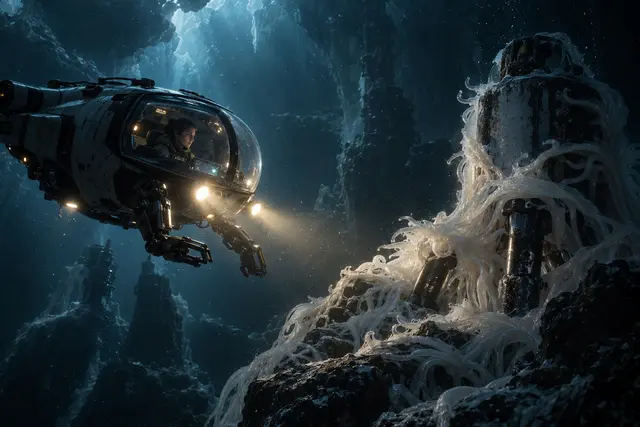
Bo called us before Ivo left. On its screen, the Seuil probe stood at the edge of a cornice. A white network covered his three metres and for twelve days prevented the release of the lift lock. Twenty meters away, another barrel rested on three supports.
— “There were two in the boxes?” Ivo asked.
Bo changed the angle. The second object had a hollow top, a foot much too long. I moved my face closer to the screen.
Threshold was automatically lowered six months before our arrival. His heating kept his moving parts in order; for nine months the corollas had been thriving around him. We had planned to recover it before the evacuation. Ruth allowed Ivo to look, without snatching anything. He would remain in the submersible and return if the outer arms were not enough.
— “Even if you’ve almost succeeded,” she said.
He raised a hand in agreement. By the way, he took the last clean cup on my desk.
The light of his apparatus passed through a snow of particles. I was following the dive from the lab, with Ruth at the navigation console and Bo behind our shoulders. As Ivo went down, the cup was cooling down next to me.
The double of Threshold appeared in the projector. Its walls were mineral, almost translucent in places, and dozens of corollas occupied the hollows. Some came out half way, stretched out a branch, and then folded back.
— It looks like they live in it.
I thought the same thing. I already wanted to choose this image for my first article.
Ivo moved his thermometer over the shelter. Nothing moved. When he directed the projector, whose envelope was warmer, the pale branches turned together. He stepped back to widen the field; Threshold and his copy entered the screen.
— “Wait there. I'd like to see the base.
He stabilized the submersible. Under him, a white veil rose, then the edge of the cornice disappeared in a thick dust. I heard a shock before the image flipped.
The link sizzled. I still had my finger on the screen, where I had asked him to wait.
— - Ivo?
— I'm here. The case holds.
A light came back, wrong. Between two black blocks, part of the outer arm had taken an impossible angle.
— I'm stuck.
What was closing
Ruth asked him what pressure he had, what reserves he had, and whether he was bleeding. He answered in order, then tried the engines.
— “Wait until we see the support,” she said.
A skate was resting under the collapsed ledge. He should have been able to drop it, but white cloth covered the junction to the hull. With each movement, the folds tightened. Ivo stopped touching the controls.
Bo was already preparing the rescue craft and its cutting tool. I looked at my corolla in her room; it had spread out towards the two still warm fingers of the clamp.
— You can move the heat.
Ruth was waiting for me to clarify. I showed him the images of the projector and the delay noted in the morning. Bo had a heating cassette that he could attach to the remote-controlled vehicle. By temporarily reducing the external discharges of the submersible, we would try to attract the tissue to it.
— "You're still making the cut," Ruth said to Bo.
Then she opened the connection.
— - Ivo, we try while the vehicle comes down. You stop us if you want.
He did not reply immediately. On the screen, his shoulder was moving against the sloping seat.
— “Okay. But you keep the other tool.
Bo tapped twice on the cutting handle, near the microphone.
The tape went down. Meanwhile, Ivo limited the heat evacuation to the side caught in the folds. The temperature of his cabin began to rise. I watched both this figure and the corolla of the laboratory; she followed the warmed area of her room, with returns that I could not predict.
Outside, the branches near the cassette were oriented, but the large tablecloth did not yield. His ties joined other shelters, then the base of Seuil. Our probe was heating up more than bait.
— “Should we turn it off?” asked Bo.
I approached the survey. Without Threshold, the hottest point would remain the submersible.
— “Not at once. You have to take them to the crack below.
— "Sana," said Ivo, "how long?"
I started measuring distances as if I was alone in the lab. I was looking for an answer that he could use.
— We will go down in stages. If it comes more towards you, we stop and Bo cuts.
Ruth confirmed. Ivo unbuttoned the collar of his suit.
Three impulses, then two
A naturally warmer water circulation ran along the basaltic fissure below. The first images already showed white structures at this location, before the installation of Seuil. Bo opened the recent survey: on the curve, three small rises followed one another, then two others after a pause.
— Is it the flow that varies?
— "Perhaps. I'll keep this.
He marked the sequence and returned to the rescue vehicle. The cassette penetrated the crack as we decreased the heating of the Threshold. A tablecloth slipped on the hull; Ivo swore, then signaled that it was moving away from the junction.
The lock appeared.
Bo approached his mechanical arm. Immediately, the fabric folds down. In the laboratory, our corolla also contracted. I checked my settings, then the two pressure curves: the same pulse passed through them. The seawater circuit that fed the chamber had transmitted the outside jolt.
— The engines, Bo. Stop for a moment.
— - I'll drift.
— “Can you sit down?” asked Ruth.
He found support at a distance from the landslide. When the thrusters stopped, the particles stopped swirling. Gradually, the tablecloth relaxed.
I could hear Ivo’s breath, stronger now that he no longer spoke. Bo moved the arm forward in fractions, letting the water subside between the movements. This time the opening was visible.
— “I can drop it,” Ivo said.
Ruth consulted the constraint indicator.
— - Go on.
The skate broke off. The hull went up a few centimeters and crushed the edge of a shelter. Some corollas left in the beam, while others remained caught under the pieces. Bo clung to the tow. I wanted to ask him to shift his cable, but the submersible had finally pivoted; I shut up.
Ivo restores the cooling. The tablecloth shivered towards him, then fell back. Slowly, the hull crosses the cornice.
Ruth put her hand on my shoulder. I had no idea how long I was holding my breath.
The ascent lasted a long time. Ivo only joked at the entrance to the well, asking for coffee. Bo replied that he would be charged with the intervention.
When the airlock opened, Ivo took three steps, then sat down on the ground. I leaned close to him. His fingers were shaking against his knees.
— I made you wait.
— I said yes, Sana.
He looked at my hand, which still clenched the edge of my blouse.
— Come sit down instead. You're making my legs hurt.
I sat down. Bo brought two cups, not to mention a bill, and then stayed with us until Ruth called to prepare for the evacuation.
What we would not carry
The evacuation was not postponed. The ice continued to deform and the submersible was to remain out of service. We no longer had the means to maintain an artificial heat source on site for months. Ruth asked us to prepare a closure that does not add a second accident to the first.
Threshold would stay in the ocean. Its frame had been incorporated into the living relief; to tear it out would require new means and a study that we did not possess. We had diminished his power. It was now necessary to check that the tissue was reorganizing towards the natural circulation, without pretending to guarantee the survival of all the corollas.
For several hours, Bo held the cassette near the underpass, then reduced its intake. White units gained the old structures. Some stayed near Seuil.
The corolla in my room was for the orbital vehicle. An autonomous device had to maintain its conditions until the return laboratories. Years of preparation were concentrated in this small box. I was involved in its design. I knew exactly what we were losing by giving up on winning.
I looked at the cut filaments during the sampling. We had planned to transport an independent being. Perhaps we had separated a fragment of an organization whose growth required exchanges absent from the box. The limits of our knowledge were no longer abstract: they moved against a wall that was too clean.
I proposed to return the sample in the immediate vicinity of its point of origin, with the containment precautions we had planned for returns of unpreserved samples. No material from the laboratory would be released with it. The orbital teams received the procedure and the data justifying the decision.
Ruth asked me if I gave up because I was scared after the rescue.
— I am afraid, I answer. But that's not the only thing.
After reviewing the data and agreeing with the orbital team, Ruth authorized the return. Ivo stayed close to the console while Bo prepared the device.
— “You can always publish the images,” he said.
— It's not the same.
— - Nope.
He was kind enough not to add that it was enough to console me.
The garden without a gardener
The remote-controlled vehicle carried the box. I watched the corolla move during the descent.
The return took place near the flat where we had taken it, away from the freshly fallen debris. The compartment opened. For a long time, nothing happened. Then the organism extended a branch towards a warmer current and slipped out of the frame.
In spite of myself, I was expecting a meeting, a way to recognize others. There was nothing that our images allow us to name so. The corolla remained next to a larger shape, folded back, opened again.
We removed the heating cassette when the majority of the visible tissue was redirected to the natural passage. A few pockets around the Threshold remained closed. They would stay in our reports. We had destroyed some structures during the rescue and transformed the site in the first month. No last move would make the ocean intact.
Bo installed two passive instruments with low dissipation, far from the densest areas, to continue the observations after our departure.
On the last close-up images, I distinguished several layers in an old white shelter. Each layer followed a slightly different outline. Some copied rocks, others the mineral remains of collapsed forms. Threshold was just one more model.
— “They didn’t build our house,” I said. They used a warm place.
Ivo nodded. He had laid a blanket on his shoulders, although the station was properly heated.
On the edge of the image, a pale pocket closed. I asked Bo to keep this sequence with the others, including the seconds when nothing seemed to be happening.
An unknown form
We left Nacre before the limit set by Ruth. The station was put to rest. From the ascent vehicle, the surface of Tessère looked like a white continent whose edges someone would have crumpled. None of the black sea shelters were visible. Ivo closed his eyes as soon as the well disappeared under us.
In the orbital vehicle, he underwent examinations, slept for a long time and woke up in a bad mood against a meal that was too soft. Bo brought him some coffee. He knocked it over on his cover and began to swear with so much conviction that I had to come out for a laugh.
The next day, he asked me for the pictures of the cornice.
— Not the rescue setup. Before.
We looked at them together. At the sixth minute, a pale dust left the edge of the relief. At the time, I took it for a movement of the corollas. Ivo enlarges the corner of the image. He could have gone back there; I could have asked him to. None of us knew if this departure of matter was already heralding the collapse. We kept the whole sequence, with our voices, for those who would examine the accident.
— "Keep also what I have said about manufacturing defects," he added.
— n It is not necessary for the report.
— “I want them to hear what state of mind I have come down into.
During the following months, the instruments left under the ice sent us their observations. Pockets were emptying around the threshold. Some persisted, inert or too slow for our measurements. Below, the arches continued to grow along the crack. I was recording the changes without being able to say whether we were looking at an environment that was recovering or just the surviving part of what we had disturbed.
We had to leave the system six months after the evacuation. The transport boxes were stowed. The one I designed for our corolla now contained out-of-service sensors, sealed mineral samples, and a bag of straps. I walked past every day. He was exactly the right size to remind me of what was missing.
Three days before the departure, Bo came to pick me up.
— “The teeth on your curve,” he said.
I knew which ones. In the ocean, before the intervention, he had shown me the impulses of the lower source: three weak rises, one pause, two others. We had left them aside. The average flow rate was more important than these irregularities when Ivo had to be pulled out of his aircraft.
Bo had aligned the recent surveys with those of the arrival of Seuil.
— It is not a regular oscillation. Look at the spacing.
The five impulses formed a group. The interval between the last two was a little longer than the others. This happened again, with a slow drift. After each group, the lower sensor recorded a change in flow rate.
— Convection can produce cycles, I say.
— - Yeah.
He opened a second graph. This one came from the internal memory of Seuil, not from the sea: it was the sequence of control of the heating at the first start. Three impulses, one pause, two impulses. The last one was delayed by a voltage check. A banal event. Bo knew this because he had closed the automatic alert nine months before our evacuation.
He had superimposed the two tracks without changing their time scale.
I was looking for a copy error first. It was almost pleasant: a problem where we knew the words.
We spent the day comparing sources. The last readings came from autonomous sensors installed after the heating of Seuil was stopped. They did not use its controller or diagnostic files. Their clocks had their own deviations. Repetition persisted when we worked on the raw recordings.
It was not a proof of intent. The living network had been able to maintain a rhythm imposed by the machine, as it had retained its contours. But none of our models predicted that such a brief irregularity would survive months after its shutdown.
Ruth sat behind us. She did not ask for a title for the discovery. She asked what we could check before we left.
Bo opened the very first measurements, those recorded during the automatic descent of Seuil. The probe had not yet touched the flat. Its main heating had remained cut off; only its measuring circuits dissipated a little energy. Under it, the lower source already had a series of fluctuations.
It wasn't our sequence.
Seven small ridges, then a long variation. The pattern returned to the windows where the motion of the probe did not blur the signal. Later, after its commissioning, it became less sharp. During the three months we had lived at Nacre, I had called it background noise.
Bo placed the three readings side by side: the previous pattern, the first start of our machine, then the current activity of the crack.
I remembered the white layers under the shelter, each espousing an older form. We were able to read the recent silhouette because it was ours. Everything else had become relief.
— They were already keeping something, I said.
No one answered.
Ivo had come in without me hearing him. He leaned on the back of the empty seat, and then asked if the first suite could come from another of our probes.
We took back the inventory. No human apparatus had been sent under this ice before Threshold. The other instruments of the mission had remained in orbit or on the surface. The records did not tell us what produced this first pattern. They only forbade us to date it when we arrived.
I felt a joy that I would have liked to be reasonable. Previous visitors, a living memory, an activity of the environment whose unity we did not even know: each of these ideas required different proofs. I did not want to lose any of it by choosing too quickly the one that would make the most beautiful story.
Ruth had the data transmitted with our checks and objections. The departure was maintained. We no longer had a habitable station under our feet, nor a submersible able to bring us back.
That night, I went back to the screens. The recent arches bordered the crack. I couldn’t see anything new in the picture, but I didn’t feel like I was looking at the same place.
Ivo found me there before the relief.
— “You wanted them to recognize us,” he said.
— I wanted to know when the meeting started.
On the graph, our sequence reappeared. Three impulses, one pause, then two. The little imperfection of the last one was still there. I thought of the engine that Ivo had silenced, of the clamp with which a finger had cooled, of everything that we had emitted before seeking an answer.
I opened the file for the first few months. The main file still had my title: “Before Contact”.
I stayed for a long time with my hand on the keyboard.
Then I replaced those three words with two more.
“Before listening.”
End