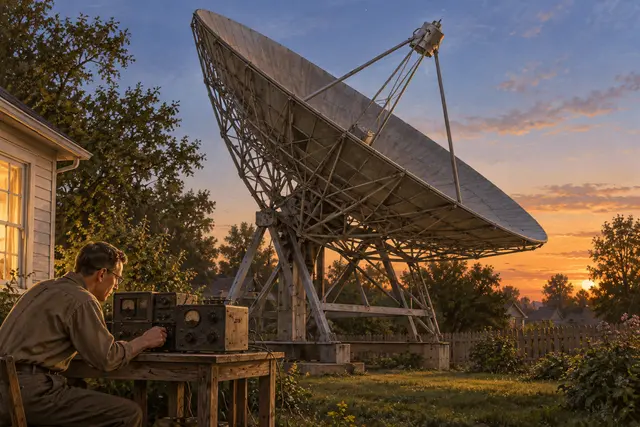
In his garden in Wheaton, Illinois, Grote Reber installs an object difficult to confuse with outdoor furniture: a parabolic antenna of about nine meters. This radio engineer dedicates evenings and weekends to its construction. In 1937, he owned an instrument designed to observe the sky differently from its visible light.
Reber continues Karl Jansky's discoveries about radio broadcasts from the Milky Way. His first tests at short wavelengths did not give the expected result. It modifies its equipment and finally detects emissions at a wavelength of 1.87 meters. Changing the setting opens a sky that his first choice had hidden from him.
He continued his surveys and published radio maps of the sky in the 1940s. The craft antenna was therefore not looking for a distant earth station or an identified extraterrestrial message. It had a natural radiance. While a garden hosted this imposing experience, a new way of mapping the Universe was taking shape.
What we know
Natural emissions, not messages from detected civilizations.
To go to the source
References consulted on September 21, 2026. Linked pages may be in another language.
Signaler une erreur ou apporter une précision