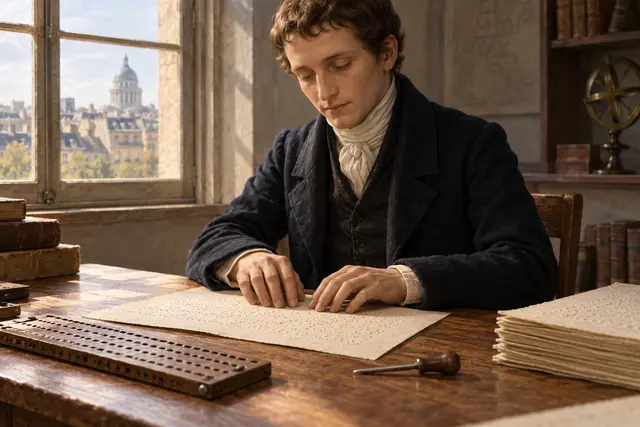
A printed letter can be recognized with the eyes; reproducing it in relief is not enough to make it easy to read. A student at the Institut Royale des Jeunes Blindes in Paris, Louis Braille discovered another track in 1821: the stitched writing proposed by Charles Barbier. He is trying to perfect it.
The system he published, then reworked, ultimately rested on six organized positions in a cell. According to the points present, the sign changes. Sixty-three non-empty combinations become available. There are also special signs to announce numbers or capital letters: six positions do not condemn the reader to having only six letters.
The 1837 version abandoned the features of his first essays. Its use can extend to music and mathematics. What seems a reduction is thus an enlargement: by simplifying the shape that the finger encounters, Braille builds a tool for reading and writing. This invention extends previous research, to which it brings a new organization.
What we know
Six combinable positions, not just six signs.
To go to the source
- Association Valentin Haüy — L’écriture braille (new tab)↗
- Association Valentin Haüy — Notre histoire (new tab)↗
References consulted on September 21, 2026. Linked pages may be in another language.
Signaler une erreur ou apporter une précision