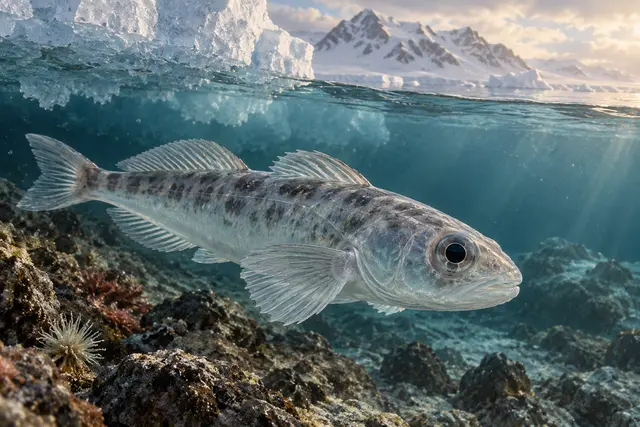
A fish can lose hemoglobin without losing the ability to live. Icefish of the family Channichthyidae are an amazing example. This protein, which gives human blood its red color and carries its oxygen, is missing in them. Their bodies must therefore otherwise perform an indispensable function for their cells.
Part of the answer lies in their environment. Cold water may contain more dissolved oxygen than hot water. In these fish, oxygen circulates in solution in plasma. Physiological adaptations accompany this particularity: removing such an important transporter does not simply mean changing the color of a liquid in the body.
The British Antarctic Survey places this singularity in the evolutionary history of fish in southern waters, also studied thanks to their genomes. It does not mean that these animals breathe without oxygen, nor that all Antarctic fish have this blood. A particular branch has followed a biological path that our own circulation seems, at first glance, to forbid existence.
What we know
A family peculiarity, not that of all Antarctic fish.
To go to the source
- British Antarctic Survey — Fish survival in the extreme cold (new tab)↗
- British Antarctic Survey — Fish (new tab)↗
References consulted on September 21, 2026. Linked pages may be in another language.
Signaler une erreur ou apporter une précision