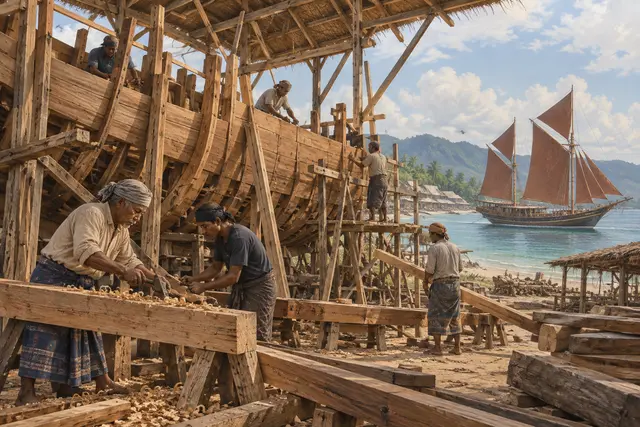
In front of a large Indonesian wooden sailboat, one might think that pinisi simply refers to the shape of its hull. The heritage record says something else: the term literally refers to the rigging and sails of Sulawesi’s schooner. Its public use has become the emblem of a much broader shipbuilding tradition.
In the construction sites of Bulukumba, manufacturing combines complementary functions. The master builder works with a team of workers, for a sponsor, in a workshop called bantilang. The steps require precision and cooperation, while understanding ritual dimensions. What appears to be a single object thus condenses an organization of work and several specialized knowledges.
The 2017 registration concerns this art of construction, transmitted within families and beyond. In Tana Beru, researchers from Hasanuddin University again observed these activities in 2025. Talking about a living tradition does not require us to imagine identical boats for centuries: artisans continue to work in a contemporary economic context.
What we know
The rigging does not define a single hull.
To go to the source
- UNESCO — Inventaire indonésien du pinisi (new tab)↗
- UNESCO — Présentation du patrimoine pinisi (new tab)↗
- Université Hasanuddin — Observations à Tana Beru, 2025 (new tab)↗
References consulted on September 21, 2026. Linked pages may be in another language.
Signaler une erreur ou apporter une précision