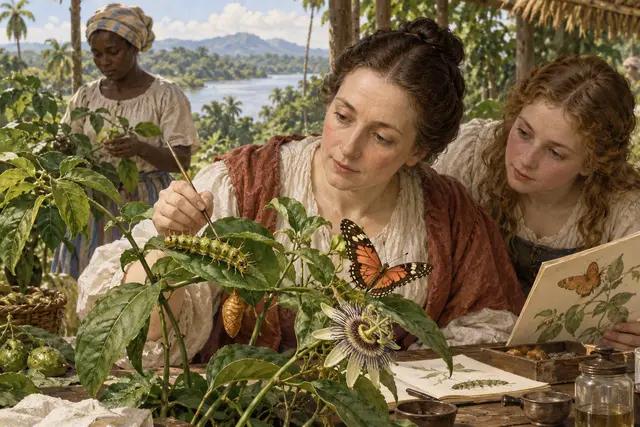
A caterpillar on a leaf, a chrysalis and a butterfly may seem to form a pretty arrangement. In the images of Maria Sibylla Merian, their meeting responds to a search: to understand the stages of a life and their relationship with plants. The illustration does not just present an isolated animal.
In 1699, Merian moved to Suriname with his daughter Dorothea. They studied caterpillars and their transformations, then returned to Europe in 1701. The book published in 1705 associates insects with their nourishing plants. The boards make visible relationships that separate specimens in a collection could make forget.
This work also relies on the knowledge and help of local people, notably enslaved in the Dutch colony. The results are not those of an observer entirely alone. Behind the beauty of an image are breedings, ongoing observations, and shared knowledge in deeply unequal power relationships.
What we know
Local knowledge and the colonial context are part of this research.
To go to the source
- Natural History Museum — Maria Sibylla Merian (new tab)↗
- Royal Collection Trust — Suriname (new tab)↗
References consulted on September 21, 2026. Linked pages may be in another language.
Signaler une erreur ou apporter une précision