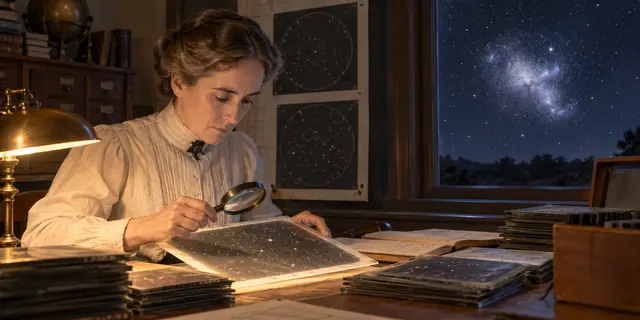
Stars become brighter, then weaker, at a steady pace. Henrietta Swan Leavitt studies these variations on photographic plates. In the Small Magellanic Cloud, it highlights a relationship between the cycle length of certain stars and their luminosity.
This rapprochement is precious: stars located in the same set are at distances sufficiently comparable to make the link appear. Once the relationship is calibrated, the cepheids become benchmarks for measuring astronomical distances.
Leavitt did not send a probe to these stars. She compared traces of light. This patient work helped transform a sky filled with dots into a space whose depth could be estimated.
What we know
The period-luminosity relation must be calibrated; it does not provide alone, without other measurements, all the cosmic distances.
To go to the source
References consulted on September 20, 2026. Linked pages may be in another language.
Signaler une erreur ou apporter une précision