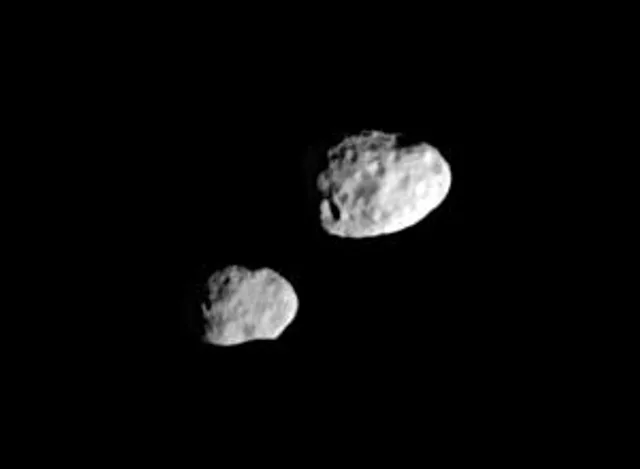
Two small moons revolve around Saturn on trajectories so close that it has long been difficult to distinguish them. Janus and Epimetheus don’t just share the neighborhood: every four years or so, they exchange their inner and outer positions.
The moon on the inner orbit moves a little faster. She gradually catches up with the other. When their rapprochement becomes sufficient, their gravitational interaction modifies the two trajectories: the one that was inside passes outside, and vice versa.
The exchange is not a collision or a crossing of each other. The bodies remain separate. The initial difference between the distances of the two orbits is about fifty kilometers, a tiny gap on the scale of their path around Saturn.
The 1966 observations had initially suggested a single object. Voyager 1 confirmed in 1980 that it was necessary to recognize two moons to understand their movement.
What we know
Exchange of orbits under gravitational interaction; the moons do not cross and do not collide.
To go to the source
References accessed October 11, 2026. Linked pages may be in another language.
Signaler une erreur ou apporter une précision