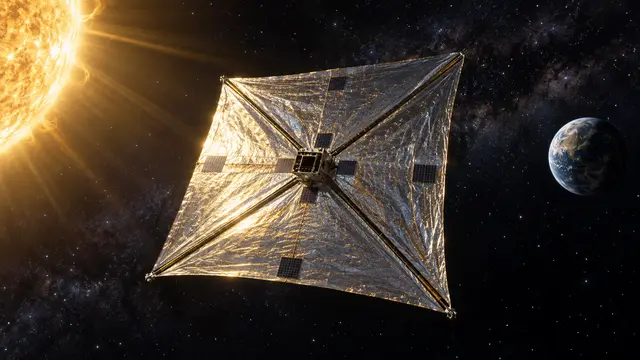
Can a sail serve away from any atmosphere? In 2010, the Japanese probe IKAROS deployed a large square membrane in space. It does not seek a breeze comparable to the land wind. The solar light itself exerts a pressure, very low, but sufficient to gradually modify the trajectory of an adapted machine.
On July 9, the JAXA announced that it had confirmed this acceleration thanks to the precise determination of the orbit. The estimated force is about 1.12 millinewton. Radio measurements make it possible to compare the observed movement with that calculated without the light thrust. The difference reveals a physical effect, beyond the simple success of the deployment.
The membrane also carries thin photovoltaic cells. However, producing electricity and receiving a photon push are two different functions. IKAROS allowed them to be experimented on the same demonstrator. Its launch always required a rocket; once in space, a contribution to its movement could come directly from the light received.
What we know
Light pressure and photovoltaic production are two distinct functions.
To go to the source
- JAXA — Confirmation of Photon Acceleration, 9 juillet 2010 (new tab)↗
- ISAS/JAXA — IKAROS, fiche de mission (new tab)↗
References consulted on 3 October 2026. Linked pages may be in another language.
Signaler une erreur ou apporter une précision