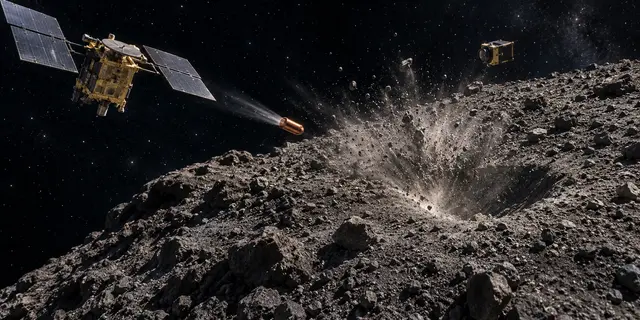
On April 5, 2019, Hayabusa2 released a device intended to hit Ryugu. A two-kilogram copper projectile reaches the asteroid at high speed. The main probe moves away to avoid debris, while a small separate camera observes the event. Researchers thus have an impact whose conditions they know.
Three weeks later, images show a new cavity, about fourteen and a half meters at the level of the old surface. It is not perfectly circular: the blocks already present have influenced its development. The projected materials also drew privileged directions, instead of forming a uniform splash.
This artificial scar helps to understand natural craters. Their size depends on the resistance of the terrain and gravity; without knowing these effects, counting the craters gives an uncertain chronology. The experiment allowed us to refine estimates of the history of the surface. It does not, by itself, provide an indisputable date of birth for the entire asteroid.
What we know
The age of a surface does not necessarily correspond to that of the star.
To go to the source
References consulted on 3 October 2026. Linked pages may be in another language.
Signaler une erreur ou apporter une précision