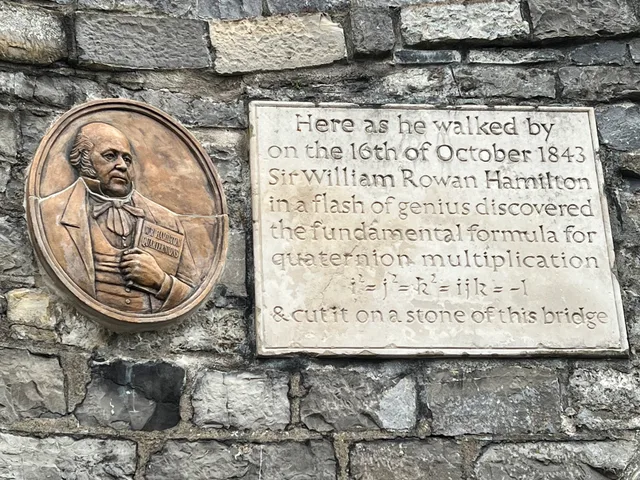
On 16 October 1843, William Rowan Hamilton and his wife marched along the Royal Canal towards Dublin. A mathematical idea comes to him during this walk. According to the account he left of it, he pulls out a penknife and writes a relationship on the stone of the bridge he crosses.
The formula expresses a fundamental property of quaternions: i² = j² = k² = ijk = −1. Hamilton had long been looking for ways to extend certain calculations, and his solution involved four components. In this system, changing the order of multiplication can change the result, unlike the ordinary numbers we first learn about.
The anecdote is documented by the mathematician’s writings preserved and presented by Trinity College Dublin. It does not prove that an original mark today remains legible on the bridge. His interest is elsewhere: an abstract result, which one imagines to be born in the middle of notebooks and paintings, has been associated with a walk and some signs traced in the stone.
What we know
Narrative preserved in Hamilton's writings; no original engraving yet visible asserted.
To go to the source
- Trinity College Dublin — Hamilton and quaternions (new tab)↗
- Trinity College Dublin — Historical account of Hamilton (new tab)↗
References accessed October 11, 2026. Linked pages may be in another language.
Signaler une erreur ou apporter une précision