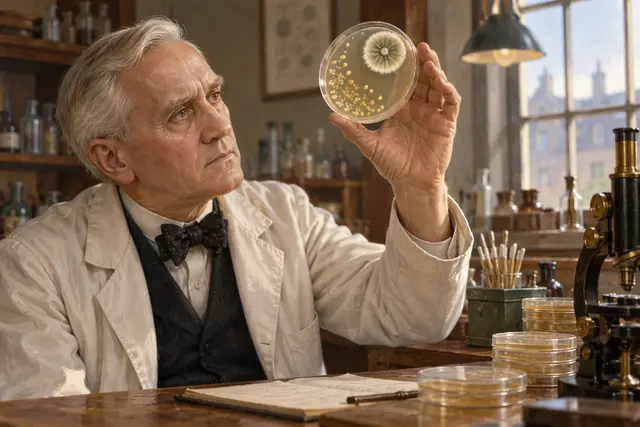
In 1928, Alexander Fleming observed a bacterial culture where mold accidentally developed. Around her, an area catches her attention: the bacteria have disappeared.
A contamination could simply cause an experiment to be thrown away. Here, absence becomes a clue. Fleming is studying the effect of mold and the antibacterial substance that will be called penicillin. The observation does not immediately provide a drug ready to produce and distribute.
Other researchers, including Howard Florey and Ernst Chain, played a key role in the sequel. The story is therefore less due to the miracle of a distracted man than to a succession of works. In the beginning, there was an accident. For it to become a discovery, someone had to look at the empty circle and decide that they deserved a question.
What we know
The initial discovery and development of a usable treatment are two distinct steps, involving multiple teams.
To go to the source
References consulted on September 20, 2026. Linked pages may be in another language.
Signaler une erreur ou apporter une précision