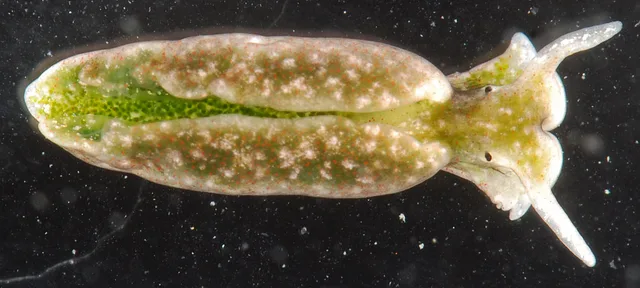
The marine slug Elysia chlorotica looks like a green leaf. This resemblance hides a mechanism more surprising than its color: after consuming an algae, it can retain some of its cellular structures and benefit from their activity in light. His meal continues to work in part in his body.
Young slugs pierce the cells of the seaweed Vaucheria litorea and suck up their contents. Chloroplasts, the structures responsible for photosynthesis, are retained in the cells of the digestive system. They can still transform light energy into usable compounds. The nuclei of the algae cells do not subsist in the same way.
Research has investigated how the animal maintains this unusual association. It does not mean that a slug becomes a plant, nor that it never needs to feed again. The exact fact is: instead of immediately destroying everything he swallows, this mollusk keeps elements of his meal capable of continuing biological work.
What we know
Preserved chloroplasts; mollusk does not become a plant.
To go to the source
References accessed October 11, 2026. Linked pages may be in another language.
Signaler une erreur ou apporter une précision