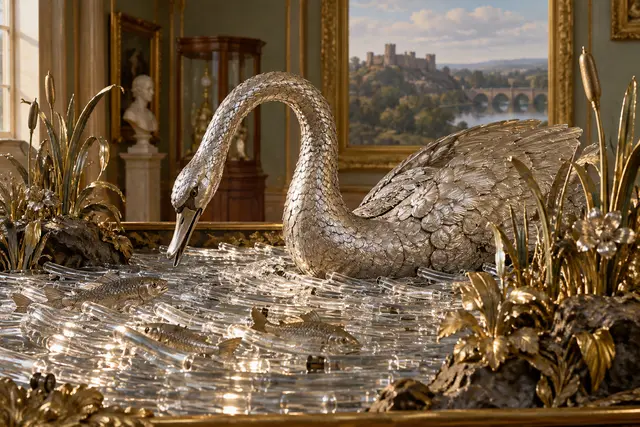
The neck of a silver swan goes down to fish. Under it, a shiny surface evokes moving water. However, this landscape does not contain a real river: glass rods create the illusion, while fish and birds belong to a mechanical ensemble.
The story of the Silver Swan begins in 1773 in James Cox’s workshop and mechanical museum in London. John Joseph Merlin participates in its mechanism, especially that of the neck and head. The object brings together three watchmaking ensembles, charged with the mobile landscape, music and gestures of the swan.
Presented at the Paris International Exhibition in 1867, the automaton joined the collection of the Bowes Museum. His movements do not come from a computer program or an intelligence capable of deciding to fish. Rather, they show what artisans could get with organized mechanisms to give metal the momentary appearance of a living behavior.
What we know
Mechanical automation; no current demonstration schedule guaranteed, no autonomous decision-making ability.
To go to the source
References consulted on 3 October 2026. Linked pages may be in another language.
Signaler une erreur ou apporter une précision