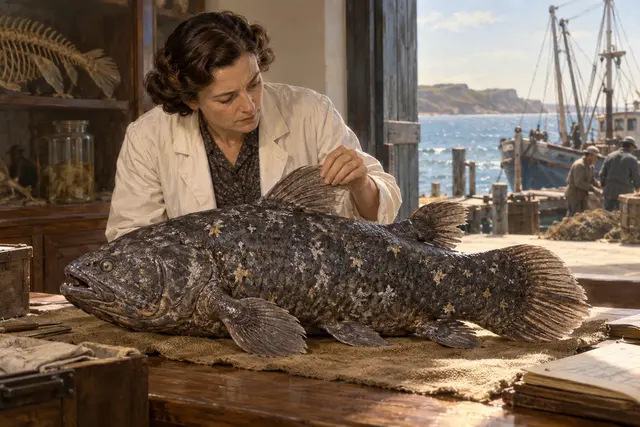
In 1938, a catch off the mouth of the Chalumna River in South Africa caught the attention of Marjorie Courtenay-Latimer. Curator at the East London Museum, she recognizes the unusualness of the fish. This look brings a fishing catch into a scientific story whose consequences will go far beyond the museum.
She reports the specimen to J. L. B. Smith, a passionate fish specialist. The identification links it to coelacanths, a group that scientists knew by its fossils and thought disappeared. The surprise does not come from a resurrected animal: a lineage had continued to live without its current existence being recognized by science.
The search for another specimen lasted for fourteen years, until a new capture in the Comoros in 1952. The first fish was not enough to reveal an entire population. Between catch and discovery, it took an essential gesture: to notice that this body deserved a different attention than that given to the rest of the fishing.
What we know
Ancillary lineage, not age of individual fish.
To go to the source
- NRF-SAIAB — Into the Blue, présentation d’Angus Paterson (new tab)↗
- East London Museum — About Us (new tab)↗
References consulted on September 21, 2026. Linked pages may be in another language.
Signaler une erreur ou apporter une précision